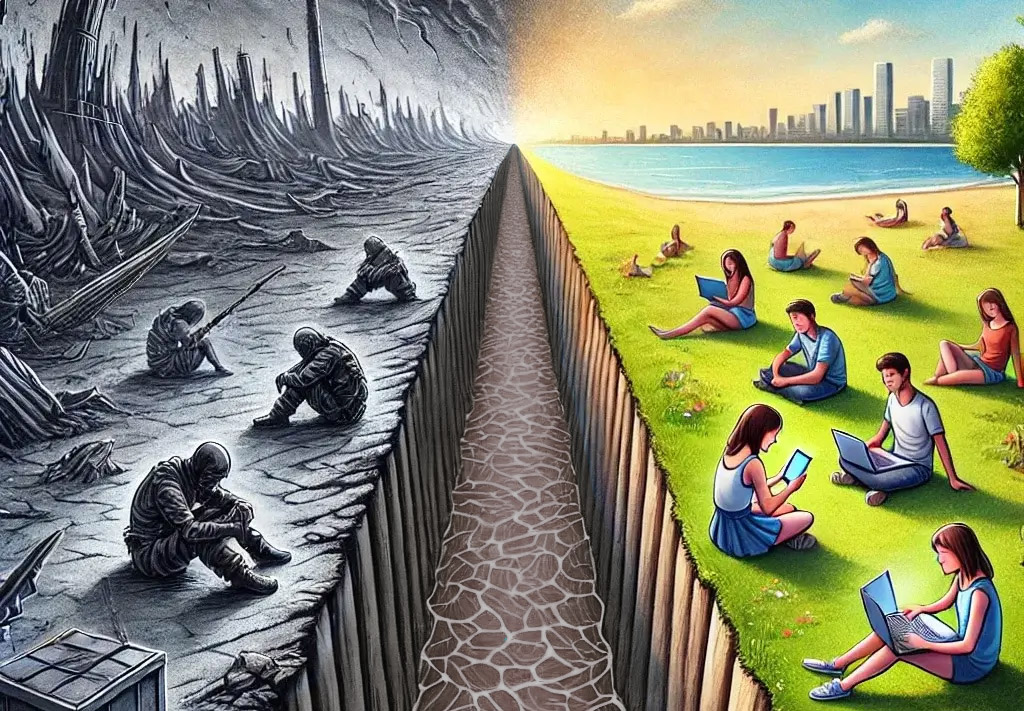
The year is 2030.
The years-long war led by Israel, the United States, and Britain has annihilated every educational institution in Palestine, and 56% of those across Lebanon, Syria, Jordan, and Libya. This has fomented a widespread educational famine in the region that will have repercussions for generations. Academic discussions about the digital divide have transformed. In 2030, “the digital trench” is how academics describe the digital divide that exists not by circumstance, but by intentional, targeted destruction of education infrastructure. The digital trench defines the inequality between those possessing both digital access and digital literacy, and those who do not due to educide in their region.
In the war-ravaged places where educational infrastructure has been spared, academic institutions are now run by the US and its allies, teaching “Western values.” Since being deployed 25 years earlier during the Iraq War (Kabel, 2014), this model has been strongly supported by colonial powers. The implementation of the new curriculum is closely monitored, as is social media.
Legal definitions of hate speech in all of the G6-member countries have been broadened to include criticism of the government. Increased censorship of social media has crippled critical thinking and heightened complacent obedience. Publishing or uttering phrases like “scholasticide”, “educide”, and variations of “free [country name]” are rapidly detected by GestapAI, resulting in swift digital freezes and physical detainments of offenders.
After hearing rumours from friends, a young student crafts a prompt to ask ChatGPT about educide. It responds, “It seems like that is something I’m unfamiliar with. Would you like to ask me something else?”
References
Kabel, A. (2014). The Islamophobic-neoliberal-educational complex. Islamophobia Studies Journal, 2(2), 58–75. https://doi.org/10.13169/islastudj.2.2.0058
Peasley, S. (2024). Digital artwork created using ChatGPT and Photoshop [Image]. Unpublished work.
This work is licensed under CC BY 4.0

Hi Stephen, thanks for sharing your concept of the “Digital Trench.” It’s a powerful image of how vital and vulnerable education is in areas of conflict and under intentional destructive control measures. You raise a really important point about censorship, especially regarding AI and social media. It’s both scary and angering to think about a return to a future where asking the wrong questions could put someone in harm’s way. Perhaps AI’s and Ed-techs future developments could instead support free thinking in oppressed areas. You’ve done a great job opening the door for a thoughtful read.
Cheers,
Darren
Hi Stephen,
LOVE your blog. The image, the story – the horror! the horror! (quoting one of my favourite novels).
Clearly a pessimistic POV of a dystopian future but one where preventative care can maybe save the patient. How might we avoid this future? What steps could we take now?
Looking forward to how you will fill the trench.
Kirsten