Published by Weri Gadou October 27, 2024
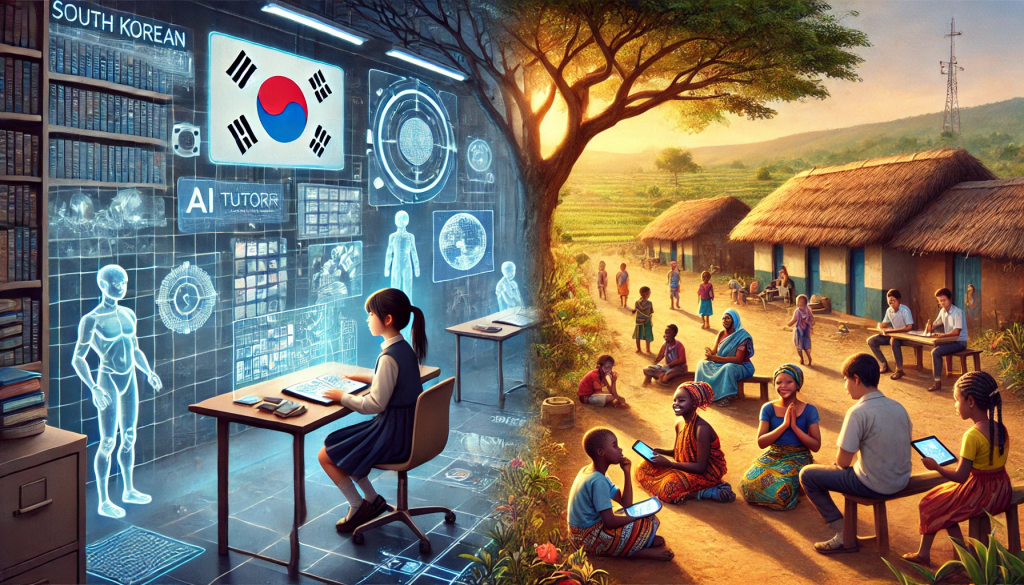
It’s the year 2030, and the world of education looks vastly different from a decade ago. For students in hyper-connected cities like Seoul, technology is deeply embedded in all facets of learning: classrooms now feature AI-driven tutors, augmented reality (AR) modules, and advanced digital assessments, each promising a tailored, data-driven education (Pelletier et al., 2023: Selwyn, 2024). However, this high level of connectivity brings unintended challenges, such as reduced face-to-face interactions, which can foster a sense of isolation or an over-reliance on digital tools (Zhai et al., 2024). In contrast, rural areas have taken a slower, more context-appropriate approach to educational technology, using it to provide resources to historically underserved students (Macgilchrist et al., 2020; Veletsianos et al., 2024).Through the experiences of two girls, Yuna in the highly modernized city of Seoul, South Korea, and Azié in the rural village of Yoho, Côte d’Ivoire, this essay examines the contrasting impacts of EdTech across vastly different environments. It explores how technology can bridge educational gaps in underserved communities while also revealing the risks of excessive digital dependency in hyper-connected environments. These stories underscore the need to balance technological advancement with human-centered learning approaches, ensuring that EdTech enhances education without eclipsing vital interpersonal connections and cultural relevance.
In Côte d’Ivoire’s rural areas, educational technology is helping bridge longstanding educational gaps, providing access to resources that were once unimaginable. Azié, a 12-year-old from Yoho, now has a tablet preloaded with offline learning modules covering subjects from basic literacy to STEM topics, bringing her school closer to the resources urban students often take for granted (Macgilchrist et al., 2020). Each morning, Azié eagerly powers on her device, navigating through her lessons in math and science with the tap of a finger, a task she finds thrillingly new. She smiles as she hears familiar Ivorian proverbs woven into her reading modules, which relate stories her grandmother used to tell her, making the content feel relevant and grounded in her culture. This use of culturally resonant material, rather than curricula that often overlook local languages, strengthens Azié’s engagement and knowledge retention. The flexibility of Azié’s offline learning modules also allows her to study around her family’s daily routines. On days when her parents need extra hands for harvesting rice, yam, and other crops, she’s able to help out, knowing she can return to her lessons later in the day. This adaptive approach to learning accommodates Azié’s dual role as both a student and a contributing family member, a balance she appreciates. When she encounters a challenging concept, she turns to the device’s interactive hints and examples, a feature that, while basic, allows her to proceed independently, an empowering experience for someone in a village without regular access to trained teachers. Veletsianos et al. (2024) emphasize that EdTech, when thoughtfully implemented, can overcome infrastructural barriers and enable rural students to access learning experiences that align with urban standards. Azié’s daily interaction with these modules offers her a taste of what digital learning can offer, fostering foundational skills that not only align with job markets but also support her in navigating a world increasingly defined by digital literacy (McIntyre et al., 2021). Yet, despite these advancements, significant barriers remain. Azié’s family often worries about the device’s battery, carefully rationing its use due to the village’s limited access to electricity. Pelletier et al. (2023) note that such uneven distribution of resources emphasizes the persistent global divide in educational access, highlighting that for many rural students, the promise of EdTech remains only partially fulfilled. Nonetheless, Azié’s experience reflects the transformative power of EdTech in remote regions, showcasing how technology, when integrated with local culture and adapted to infrastructural constraints, can open doors previously unimaginable for students in underserved areas.
Meanwhile, Yuna’s educational experience in Seoul shows a sophisticated integration of technology that shapes every aspect of her learning: classrooms are equipped with AI tutors, augmented reality (AR) overlays, and adaptive learning platforms that cater content specifically to her progress, promising a highly personalized, efficient education (Pelletier et al., 2023; Selwyn et al., 2020). At first, Yuna was excited by the novelty of learning alongside her AI tutor, which offers instant feedback and tirelessly guides her through complex subjects. Yet, over time, this high-tech support has become routine, and she often finds herself longing for a real teacher’s encouragement or a classmate’s friendly nudge. In the moments when she’s struggling, the AI tutor’s responses feel cold and mechanical, efficient, but lacking the warmth and patience that human interaction brings. Sometimes, as she stares at her screen late into the evening, she feels a pang of isolation, missing the spontaneous conversations and camaraderie she’s seen in movies from decades ago, where students encouraged each other and shared in each other’s successes and setbacks. The loneliness that Yuna experiences is not unlike what was documented in the 2024 reportage Gen Zs & Millennials: Why Are We So Lonely?, which described young adults in Singapore feeling similarly disconnected despite living in hyper-connected worlds (CNA Insider, 2024). This sense of isolation reflects concerns from Maughan (2014) and Selwyn et al. (2021) about technology’s impact on social interactions and mental well-being. The constant digital oversight of her progress, while helpful, also adds to a feeling of surveillance that makes her hesitant to explore beyond what the system suggests. Though her education is seamlessly tailored to her needs, the experience feels hollow, as if each success is predetermined by the data driving her assessments rather than a personal achievement. Privacy issues weigh on her mind, too, as she worries about how much of her educational journey is being tracked and stored. This reflects Selwyn et al.’s (2021) critique of the ethical implications of constant digital surveillance in education, cautioning that technology’s efficiency might come at the cost of genuine learning experiences and personal growth. Yuna’s experience demonstrates that while high-tech solutions in education offer convenience and efficiency, they often lack the depth and connection that traditional learning environments provide. As she navigates her digital classroom, she wonders if this trajectory aligns with her own goals, raising concerns about whether such reliance on technology truly serves the holistic aims of education.
The contrasting educational experiences of Azié and Yuna underscore the nuanced role of technology in advancing, but also potentially undermining, the fundamental goals of education, particularly critical thinking, social cohesion, and personal growth. For Azié, EdTech has opened doors that were previously unimaginable, allowing her access to a wealth of knowledge that connects her local experience with a global perspective (Macgilchrist et al., 2020; Veletsianos et al., 2024). This access not only helps her develop foundational skills but also nurtures a sense of belonging to a broader world, enhancing social cohesion and supporting her personal growth (Pelletier et al., 2023). Her modules, rich in local language and cultural references, offer her a unique blend of modern learning tools and culturally relevant content that fosters engagement and retention, fulfilling educational goals that extend beyond mere content delivery (Veletsianos et al., 2024; Macgilchrist et al., 2020). Conversely, Yuna’s story highlights the risks of allowing technology to dominate education without safeguarding its deeper, human-centered aspects (Selwyn, 2024; Maughan, 2014). Her digital, highly customized learning environment provides instant feedback and streamlined assessments, but often at the cost of genuine interpersonal connection and critical engagement (Selwyn, 2021; Zhai et al., 2024). While AI tutors may excel in efficiency, they lack the nuance and warmth that human teachers bring to discussions that stimulate critical thought and emotional intelligence (Selwyn et al., 2020; Maughan, 2014). The data-driven environment, with its emphasis on measurable outcomes, risks reducing Yuna’s education to a series of quantifiable metrics, ultimately sidelining her growth as a well-rounded, socially connected individual (Selwyn et al., 2021). Through these experiences, Azié and Yuna’s stories suggest that educational technology should act as a tool that supports, not replaces, the broader aims of education. This perspective aligns with Macgilchrist et al.’s (2020) argument that technology must remain context-sensitive and should complement the development of reflective, critically-minded, and socially cohesive learners.
The stories of Azié and Yuna capture the dual nature of educational technology in 2030: a powerful tool for accessibility and empowerment in underserved regions, but also one that can foster alienation and digital dependency if unchecked. Their experiences underscore that while technology has the potential to bridge educational gaps, it must be thoughtfully integrated to support the broader goals of learning (Veletsianos et al., 2024; Selwyn, 2021). In Côte d’Ivoire, EdTech is a gateway to opportunity, giving students like Azié access to critical knowledge and digital literacy in a contextually relevant way (Macgilchrist et al., 2020). However, in hyper-connected environments like Seoul, the heavy reliance on digital platforms raises ethical concerns around privacy, mental well-being, and social isolation, cautioning against an overemphasis on data-driven personalization at the expense of human connection (CNA Insider; Pelletier et al., 2023; Zhai et al., 2024).
These implications carry lessons for educational policymakers and EdTech developers globally. A balanced, ethical approach to technology in education requires recognizing the diversity of learning environments and the need to adapt solutions accordingly. EdTech initiatives should be designed not just for efficiency or scale but with a commitment to fostering critical thinking, social cohesion, and personal growth in students worldwide (Maughan, 2014; Selwyn, 2024). By ensuring that technology remains a means to these broader educational goals, we can create a future where EdTech truly enhances human potential and serves as a catalyst for equitable, meaningful learning across diverse contexts.
References
CNA Insider. (2024, October 21). Gen Zs & Millennials: Why Are We So Lonely?. YouTube. https://youtu.be/A4Wa7zOAlHE
Macgilchrist, F., Allert, H., & Bruch, A. (2020). Students and society in the 2020s. Three future ‘histories’ of education and technology. Learning, Media and Technology, 45(1), 76-89.
Maughan, T. (2014, June 18). The Future of Ed Tech is here, it’s just not evenly distributed. Medium. https://medium.com/futures-exchange/the-future-of-ed-tech-is-here-its-just-not-evenly-distributed-210778a423d7
McIntyre, N., Sabates, R., & Eberhardt, M. J. (2021). A Literature Overview of Accountability and EdTech: Recommendations for Using Technology to Improve Accountability in Educational Systems from Ghana and Other LMICs.
Pelletier, K., Mccormack, M., Reeves, J., Robert, J., Arbino, N., … & Zimmerm, J. (2023). 2023 educause horizon report teaching and learning edition (pp. 1-55). EDUC22.
Selwyn, N. (2024). On the limits of artificial intelligence (AI) in education. Nordisk tidsskrift for pedagogikk og kritikk, 10(1), 3-14.
Selwyn, N., Pangrazio, L., Nemorin, S., & Perrotta, C. (2020). What might the school of 2030 be like? An exercise in social science fiction. Learning, Media and Technology, 45(1), 90-106.
Selwyn, N., Hillman, T., Bergviken Rensfeldt, A., & Perrotta, C. (2021). Digital technologies and the automation of education—key questions and concerns. Postdigital Science and Education, 1-10.
Selwyn, N., Hillman, T., Bergviken Rensfeldt, A., & Perrotta, C. (2021). Digital technologies and the automation of education—key questions and concerns. Postdigital Science and Education, 1-10.
Veletsianos, G., Houlden, S., Ross, J., Alhadad, S., & Dickson-Deane, C. (2024). Higher education futures at the intersection of justice, hope, and educational technology. International Journal of Educational Technology in Higher Education, 21(1), 43.
Zhai, C., Wibowo, S., & Li, L. D. (2024). The effects of over-reliance on AI dialogue systems on students’ cognitive abilities: a systematic review. Smart Learning Environments, 11(1), 28.