Published by Joan Oladunjoye – 16th February 2025
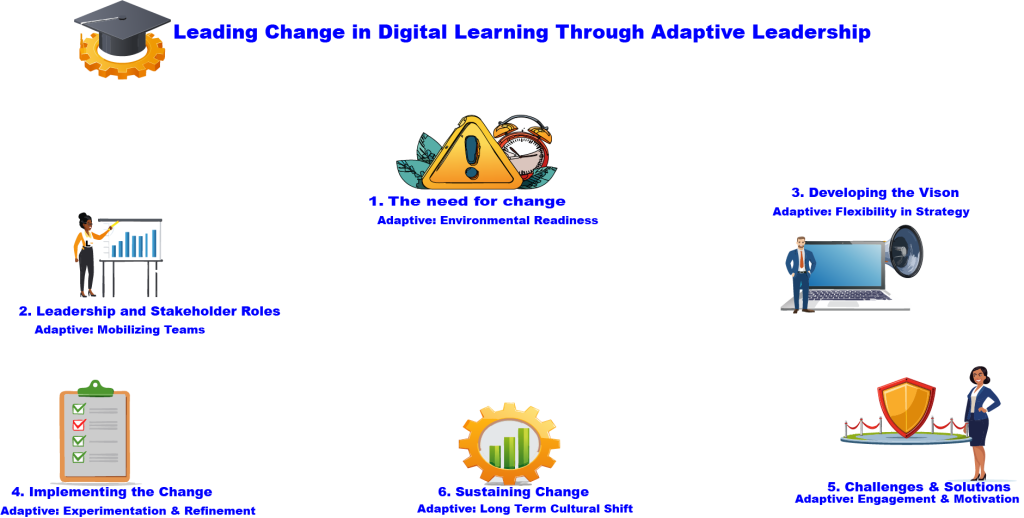
Change in digital learning is inevitable, driven by emerging technologies, evolving pedagogical practices, and the demand for accessible education. The infographic provided outlines a structured approach to change management, covering the need for change, leadership roles, stakeholder engagement, implementation, challenges, and sustainability.
This text synthesizes established change management models and theoretical perspectives, drawing from academic literature and professional consultations. Insights from a colleague consultation using the CBI script (see Appendix A) highlight leadership challenges, while Christy and Sandra’s reflections on the Voices page provide real-world perspectives on resistance and engagement strategies. Together, these elements form a framework for navigating digital transformation in education.
The Need for Change
Identifying the need for change is the first step in successful change management. In digital learning, key drivers include student engagement issues, technological advancements, and shifts in institutional priorities (Khan, 2017). The CBI script highlights triggers such as new funding, staffing adjustments, and student performance data, emphasizing data-driven decision-making.
Kotter’s (1997) change model highlights the importance of establishing urgency, ensuring stakeholders understand why change is essential. Without clear communication, digital initiatives may face resistance, making it crucial for leaders to articulate the necessity and benefits of transformation.
Leadership and Stakeholder Roles
Effective leadership is essential in digital transformation. Kotter’s Change Model (1997) and ADKAR provide structured approaches, emphasizing broad stakeholder involvement. Christy’s experience transitioning healthcare practitioners from Zoom to Microsoft Teams illustrates the importance of strong communication, training, and psychological safety. Initial resistance stemmed from “change fatigue,” aligning with ADKAR’s “Awareness” and “Desire” stages, as well as Lewin’s (1947) Unfreeze-Change-Refreeze model.
Sandra’s perspective highlights teacher autonomy as both a facilitator and a barrier to change. While autonomy fosters innovation, it can hinder institutional initiatives if educators resist mandated tools. She emphasizes leadership support, ensuring changes align with teachers’ workloads and professional needs (Sandra Transcript, 2024).
Theories of distributed leadership (Huggins et al., 2017) suggest that empowering educators fosters a shared vision and smoother transitions. Kotter (1997) reinforces this by stressing broad engagement across an organization. By defining clear roles, leaders can reduce resistance and enhance stakeholder buy-in, ensuring sustainable change.
Developing the Vision
A compelling vision is crucial for digital transformation. Christy’s transcript emphasizes clear communication and stakeholder involvement in articulating a shared goal. Lewin’s (1947) Change Model highlights the “unfreezing” stage, where existing norms are challenged, and stakeholders are prepared for transition.
The CBI script notes that institutions often communicate their vision through Continuous Professional Development (CPD) sessions or phased rollouts, allowing gradual adoption rather than abrupt changes. This strategic approach ensures stakeholders are aligned with transformation goals.
Implementing Change
Successful implementation depends on addressing resistance and fostering long-term adoption. The CBI script highlights the importance of clear objectives, aligning with Kotter’s (1997) strategy of establishing urgency and generating short-term wins. However, Christy’s experience highlights the emotional aspects of change, where staff resistance stems from “change fatigue.”
ADKAR’s reinforcement stage emphasizes the importance of ongoing training and support, preventing regression. Workman and Cleveland-Innes (2012) argue that leadership without personal transformation is merely management. Leaders must ensure educators feel equipped to integrate digital tools into their pedagogy, reinforcing long-term adoption.
Challenges and Solutions
Resistance to change is a major challenge in digital transformation. Sandra’s experience highlights teacher autonomy’s dual nature while it fosters creativity, it can lead to resistance when educators perceive technology initiatives as unnecessary. The CBI script suggests that structured CPD and middle leadership involvement are sufficient for driving change.
Huggins et al. (2017) argue that leadership must extend beyond CPD by involving educators in decision-making processes. Distributed leadership fosters a participatory model that balances professional autonomy with institutional alignment. Instead of solely relying on CPD, organizations should implement structured peer mentorship programs where educators support each other in digital transitions.
The CBI script also emphasizes that while change is expected, poor communication can lead to friction. Collaborative decision-making, pilot programs, and stakeholder engagement create a sense of ownership, reducing resistance (Huggins et al., 2017).
Sustaining Change
Long-term sustainability depends on ongoing support structures, continuous professional development, and leadership commitment. The CBI script notes that institutions often measure success based on student performance, but sustainable transformation requires embedding new approaches into institutional culture (Kotter, 1997).
By reinforcing digital adoption through mentorship and professional learning communities, institutions can prevent reversion to outdated practices. Leaders must not only introduce change but also integrate it into daily workflows, ensuring digital transformation remains an enduring aspect of educational practice.
Conclusion
Managing change in digital learning environments requires more than structured models, it demands leadership that actively engages stakeholders, mitigates resistance, and fosters adaptability. Kotter’s 8-Step Model, Lewin’s Change Model, and ADKAR provide theoretical frameworks, but real-world insights from Christy, Sandra, and the CBI script illustrate that success also depends on professional support, autonomy, and participatory leadership.
Digital transformation is not just about implementing new technologies but about aligning change with institutional culture and human-centered leadership. A key takeaway is that effective change management requires both strategic planning and an empathetic understanding of the people involved.
References
Heifetz, R., Linsky, M., & Grashow, A. (2009). The practice of adaptive leadership: Tools and tactics for changing your organization and the world. Harvard Business Press.
Huggins, K. S., Klar, H. W., Hammonds, H. L., & Buskey, F. C. (2017). Developing leadership capacity in others: An examination of high school principals’ personal capacities for fostering leadership. International Journal of Education Policy & Leadership, 12(1). https://doi.org/10.22230/ijepl.2017v12n1a670
Khan, N. (2017). Adaptive or transactional leadership in current higher education: A brief comparison. International Review of Research in Open and Distributed Learning, 18(3), 179-183.
Kotter, J. P. (1997). Leading change: A conversation with John P. Kotter. Strategy & Leadership, 25(1), 18-23.
Lewin, K. (1947). Frontiers in group dynamics: Concept, method and reality in social science; social equilibria and social change. Human Relations, 1(1), 5-41.
Royal Roads University. (2025, January 20). Voices. https://malat-coursesite.royalroads.ca/lrnt525/schedule/voices/
Workman, T., & Cleveland-Innes, M. (2012). Leadership, personal transformation, and management. Leadership Notes, 13(4), 314-320.