
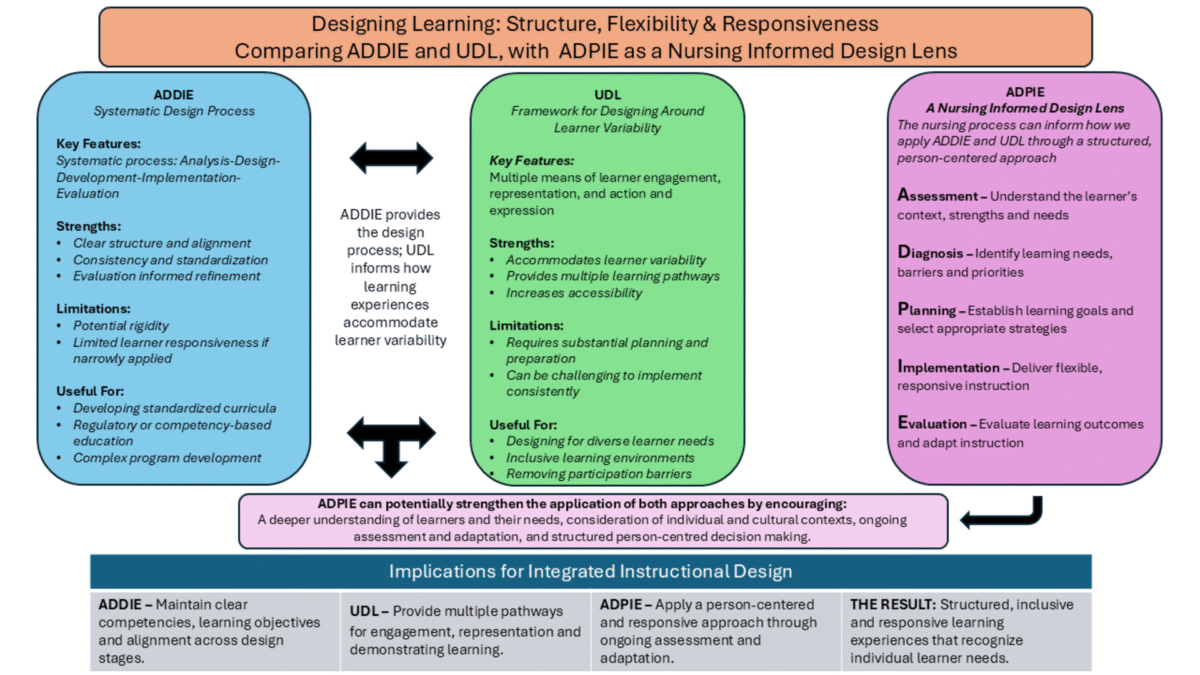
I selected ADDIE and Universal Design for Learning (UDL) to compare because I initially viewed them as representing contrasting priorities in instructional design. ADDIE initially appeared to be a relatively rigid design process that emphasized systematic development, consistency, and efficiency, while UDL initially appeared more focused on learner variability, inclusion, and flexibility (Dousay, 2017; CAST, 2024). I was interested in exploring these contrasting approaches and whether their different priorities could be brought together within nursing education.
At first, I associated ADDIE more closely with objectivist approaches because of its emphasis on defined objectives, systematic processes, and measurable outcomes. Conversely, I viewed UDL as more constructivist because of its emphasis on learner variability and multiple learning pathways. However, comparing the two challenged this distinction; although they have different emphases, neither is necessarily associated with one theoretical orientation. Instructional design models can inform practice without necessarily restricting designers to a particular approach, allowing different theoretical perspectives to inform design decisions (Kenny et al., 2005; Heaster-Ekholm, 2020).
I then introduced ADPIE as a nursing informed design lens, rather than another instructional design model. The nursing process offers a familiar approach for nursing educators to consider learner’s contexts, identify learning needs, plan appropriate support, and evaluate progress (Astle & Duggleby, 2024). For example, in a nursing skills lab, ADDIE could establish consistent learning objectives and competency expectations, UDL could provide multiple ways to access and demonstrate learning, and ADPIE could guide ongoing assessment and responses to individual learning needs.
Creating the visual helped me recognize and communicate these relationships. Rather than simply comparing two approaches, it allowed me to represent how they might be integrated. The key learning I took from this is that instructional design does not require choosing between structure and flexibility, both are important in nursing education, where consistent competency development must also account for individual learner needs in a highly regulated environment (BCCNM, 2026).
A.I. Use Declaration:
ChatGPT 7 was used in the generation of this work. It was used to assist in organizing my comparison and used to assist in the comparison image to promote clarity for readers. The AI was also used to assist with editing for clarity. All ideas and thought were human and nature and the final product is my own intellectual work, this was ensured by nut using the AI to generate ideas. I found AI helpful for this assignment as I am not a graphic designer and am not skilled at creating diagrams or visual artifacts in a way that make sense for others. I also used AI to get practice in using it for future assignments in this course as it is a requirement, I generally do not use AI. I have ethical concerns regarding it’s resource intensity and intellectual bias.
References:
Anastasiou, D., Wiley, A. L., & Kauffman, J. M. (2025). A Critical Analysis of Theoretical Underpinnings of Universal Design for Learning. Exceptionality, 33(3), 145–162. https://doi.org/10.1080/09362835.2024.2426801
Astle, B., Duggleby, W. (2024). Theoretical Foundations of Nursing Practice. In S.T. Editor (Eds.), Potter and Perry’s Canadian Fundamentals of Nursing (pp. 73-83). Elsevier Inc.
BCCNM. (2026). Health Professions and Occupations Act (HPOA) Transition for Educators Resource, Summary of changes and available resources. British Columbia College of Nurses and Midwives. https://www.bccnm.ca/Documents/learning/HPOA_for_EPR_booklet.pdf
CAST. (2024). CAST Universal Design for Learning guidelines version 3.0. https://udlguidelines.cast.org/
Dousay. T. A. (2017). Chapter 22. Instructional Design Models. In R. West (Ed.), Foundations of Learning and Instructional Design Technology (1st ed.). https://edtechbooks.org/lidtfoundations/instructional_design_models
Heaster-Ekholm, K. L. (2020). Popular Instructional Design Models: Their Theoretical Roots and Cultural Considerations. International Journal of Education and Development Using Information and Communication Technology, 16(3), 50–65. https://files.eric.ed.gov/fulltext/EJ1275582.pdf
Helmer, J. (Host). (2023, March 27). Social constructivists with Donald Clark [Audio podcast episode]. In Great Minds on Learning. The Learning Hack Podcast. https://learninghackpodcast.com/podcast/gmols4e22-social-constructivists-with-donald-clark/
Kenny, R., Zhang, Z., Schwier, R., & Campbell, K. (2005). A Review of What Instructional Designers Do: Questions Answered and Questions Not Asked. Canadian Journal of Learning and Technology, 31(1). https://doi.org/10.21432/T2JW2P
Partin, M.L. (Host). (2019, December 17). 009 ~ Constructivism ~ Dr. Rick Worch [Audio podcast episode]. In The Teaching & Learning Professor. https://podcasts.apple.com/us/podcast/009-constructivism-dr-rick-worch/id1485749834?i=1000459908996
Pelegrin, J. (Host). (2025, November 12). From theory to practice: Bringing learning theories to life in instructional design [Audio podcast episode]. In Designing with Love. https://www.designingwithloveblog.com/from-theory-to-practice-bringing-learning-theories-to-life-in-instructional-design/