As someone who is new to instructional design theory, I found myself approaching this comparison with curiosity rather than certainty. After exploring the history and evolution of instructional design models, I began reflecting on my own teaching practice and noticed that different models seemed to describe different stages of my professional growth (An, 2020). Looking back, I think my early years of teaching resembled a more structured approach such as ADDIE. As a new teacher, I spent significant time planning lessons, creating resources, anticipating challenges, and carefully following those plans once instruction began. Over time, however, experience helped me become more comfortable responding to the students in front of me rather than relying solely on what I had designed beforehand. This comparison of Backward Design and the Successive Approximation Model (SAM) helped me recognize how my practice has gradually shifted toward a more iterative and responsive approach to teaching and learning (Dousay, 2017).
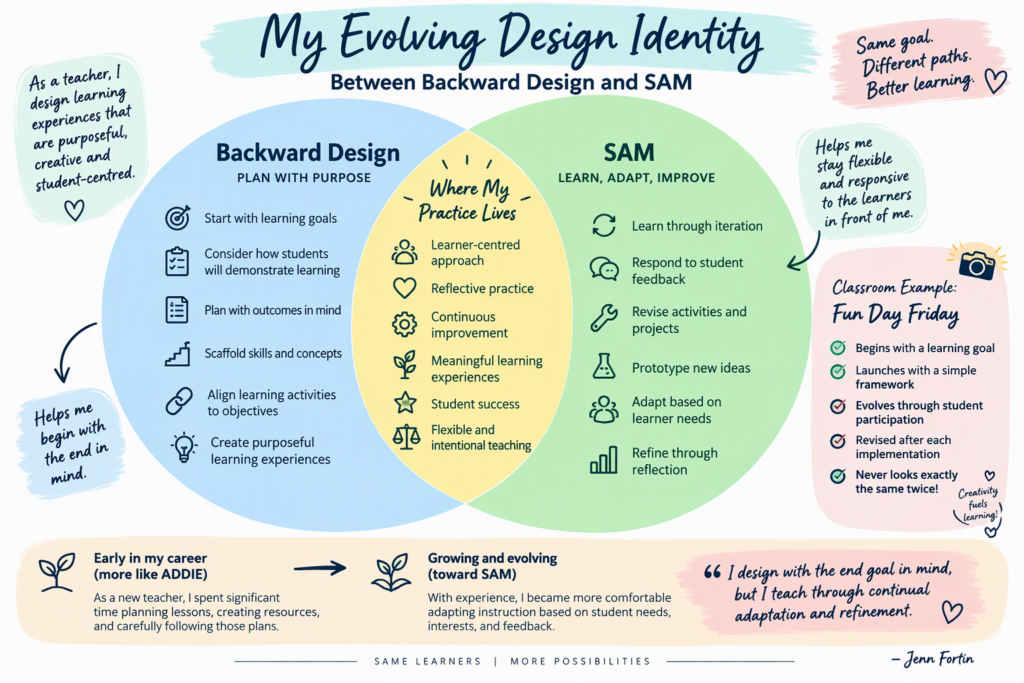
Throughout my career, I have always begun planning with learning goals in mind. Whether designing a media project, technology lesson, or creative challenge, I typically start by considering what I want students to learn and how they might demonstrate that learning. As I learned more about Backward Design, I recognized many similarities between its emphasis on outcomes and my own planning process.
At the same time, SAM resonated with me because it reflects how my teaching has evolved over time. While I still establish clear goals and expectations, I am much more comfortable adapting instruction in response to student needs, interests, and feedback.
One example is my weekly “Fun Day Friday” challenges. While each challenge begins with a general goal and framework, it rarely remains unchanged. I observe how students engage with the activity, gather informal feedback, and make revisions before introducing it again. Each iteration becomes stronger because it is shaped by student experiences rather than solely by my original plan.
This comparison has helped me realize that my practice exists somewhere between these two models. I design with the end goal in mind, but I teach through a process of continual adaptation and refinement. At this stage in the course, I am less interested in identifying a single instructional design identity and more interested in discovering how different models can help me better understand, articulate, and improve my practice. As I continue learning, I hope to develop a deeper understanding of instructional design models and how they can intentionally inform the work I do as an educator.
Below is my oral synthesis:
References
CAST. (2024). CAST Universal Design for Learning guidelines version 3.0. https://udlguidelines.cast.org/
Dousay, T. A. (2017). Instructional design models. In R. West (Ed.), Foundations of learning and instructional design technology (1st ed.). EdTech Books. https://edtechbooks.org/lidtfoundations/instructional_design_models
An, Y. (2020). A history of instructional media, instructional design, and theories. International Journal of Technology in Education. https://doi.org/10.46328/ijte.35
AI Use
Copilot AI was used to support idea generation, organization, and visual design. All final decisions, analysis, and reflections are my own.