My Digital Identity/Digital Presence


My Journey through the MALAT program at RRU


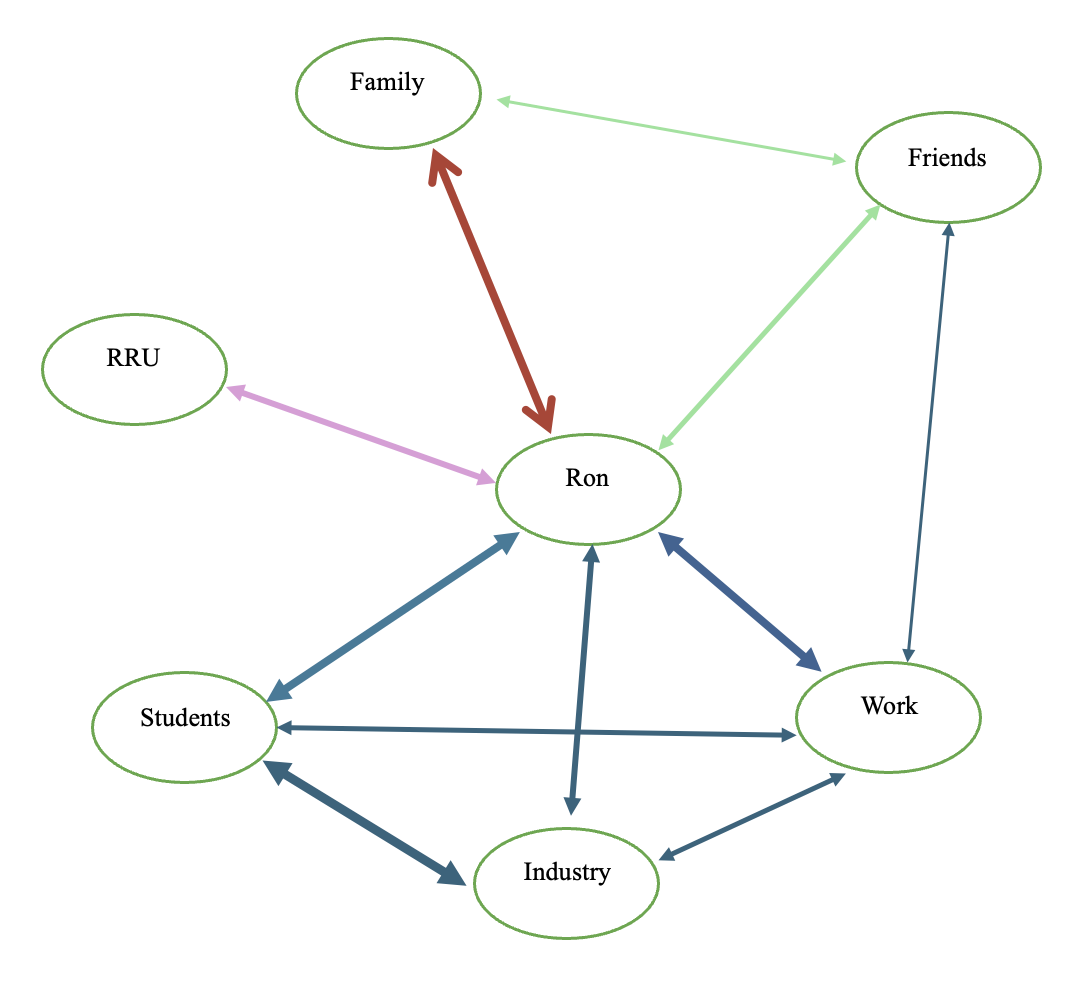
I signed up for a Facebook account years ago when my cousin moved to the southern states and needed to have links back home. Other then some communications with friends I find myself watching others post to their accounts. I use Facebook like I use YouTube, for the entertainment value. In my personal life I am mostly a visitor with the exception of email and messages, I use online news services since they stopped delivering the paper versions and we don’t have a TV to watch adds on. I have started using One Drive to share photos with my siblings.
Web searches I use both at home and at work to look up information and see what the manufacturers are changing. I have never been one to share a lot of myself on the web so Linked In, like Facebook is used to see what others are doing. At work, Teams and One Drive are the main communication and file sharing apps and we use D2L as our LMS.
Since starting the MALAT program I have downloaded and started to learn Basecamp, Zoom, WhatsApp, Google Docs and Word Press. I have never felt the need to post online and create a digital identity. This course is forcing me to reconsider that view and look at ways to authentically present myself in the public eye.
Dave Cormiers’ alternative tension pair looks like a good way to accomplish the goal he was after, looking at how people try to get their work done. The question becomes, what are we looking at, if it is, how do we use the internet, then Visitors and Residents suits the need. I thinks both methods are valid, it just depends on your focus.
My plan when I enrolled in the MALAT program was to learn how to create better educational experiences for my students by merging modern thinking and technology into the curriculum. The first week of LRNT 521, Digital Learning Environments, Networks, Communities, has shown me that curriculum design is messy. Some of my takeaways from the symposium sessions include thoughts on neurodiversity and culture and the effect they have on program design. As Dr. Chris Huffam pointed out in his session titled, “Common Problems Encountered and Lessons Learned in Building Training Solutions: A Multidisciplinary Perspective”, you need to know your audience.
On Tuesday, April 7, Mary Burgess gave a presentation entitled, “Rethinking Participation: Neurodiversity and Inclusion in Digital Learning Communities”, where she talked about the need to audit each course to see if they include and respect all participants. The goal of the audit is to make sure the course meets the needs of all, is available to all, students feel comfortable in the learning environment and are safe enough to participate and ask questions. During her talk, my interpretation of the term neurodivergent shifted from, those with tested and identified variances, to all of us being somewhere on the scale. If we consider each of us as having unique neural pathways and processing information in our own individual ways, it then forces us to consider how to make the information we are presenting digestible by all. It comes back to knowing your audience.
The idea of culture and how it affects the transfer of knowledge becomes more important when you consider the definition of the term. “Culture is the shared set of beliefs, values, customs, behaviors, and artifacts that characterize a group or society. It is learned, not inherited, encompassing language, religion, traditions, and arts that shape how people perceive and interact with the world. Culture is dynamic, constantly evolving over time.” AI Overview gathered from,( Frontiers for Young Minds +3 ). Huffam in his talk on Friday April 10, gave several examples of projects that failed, or at least stumbled due to a lack of cultural understanding of the intended audience. The culture that a person comes from can shape how they perceive and react with the world around them, this then presents a challenge when designing instructional material and processes. When you think about your audience coming from different cultures and being at different points on the neural cognition scale, it becomes a messy process of designing a course that can reach everyone.
This past week has introduced me to some new and interesting ideas and opened some doors that need to be investigated. I would like to thank the near to graduating class for the very informative and helpful conversation at the meet and greet Wednesday evening. As I progress through the MALAT program I hope remember Dr. Russ Wilde’s suggestion to “be humble, you are not always correct, no matter how sure you are”.
References
Burgess, M. (2026, April 7) Rethinking Participation: Neurodiversity and Inclusion in Digital Learning Communities [Webinar]. MALAT 2026 Virtual Symposium. Royal Roads University. https://docs.google.com/document/d/1mQS_o-C_jO2taghriJfXKDsgfa1fUL0mTDMo2JTGSJc/edit?tab=t.0
Huffam, C. (2026, April 10) Common Problems Encountered and Lessons Learned in Building Training Solutions: A Multidisciplinary Perspective [Webinar]. MALAT 2026 Virtual Symposium. Royal Roads University. https://docs.google.com/document/d/1mQS_o-C_jO2taghriJfXKDsgfa1fUL0mTDMo2JTGSJc/edit?tab=t.0
MALAT 2024 Cohort (2026, April 8) Meet and Greet – MALAT Cross Cohort Meet Up [Webinar]. MALAT 2026 Virtual Symposium. Royal Roads University. https://docs.google.com/document/d/1mQS_o-C_jO2taghriJfXKDsgfa1fUL0mTDMo2JTGSJc/edit?tab=t.0
Wilde, R. (2026, April 9) Connecting with Dr. Russ Wilde [Webinar]. MALAT 2026 Virtual Symposium. Royal Roads University. https://docs.google.com/document/d/1mQS_o-C_jO2taghriJfXKDsgfa1fUL0mTDMo2JTGSJc/edit?tab=t.0