

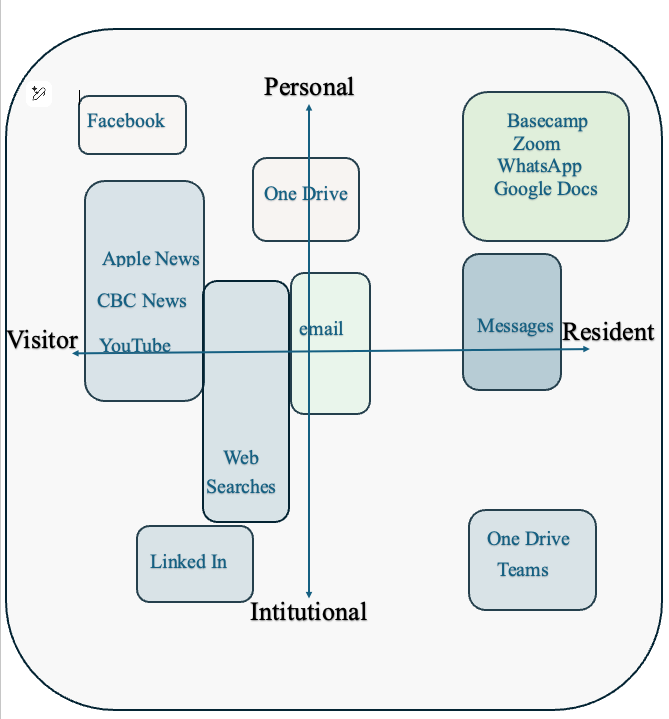

I signed up for a Facebook account years ago when my cousin moved to the southern states and needed to have links back home. Other then some communications with friends I find myself watching others post to their accounts. I use Facebook like I use YouTube, for the entertainment value. In my personal life I am mostly a visitor with the exception of email and messages, I use online news services since they stopped delivering the paper versions and we don’t have a TV to watch adds on. I have started using One Drive to share photos with my siblings.
Web searches I use both at home and at work to look up information and see what the manufacturers are changing. I have never been one to share a lot of myself on the web so Linked In, like Facebook is used to see what others are doing. At work, Teams and One Drive are the main communication and file sharing apps and we use D2L as our LMS.
Since starting the MALAT program I have downloaded and started to learn Basecamp, Zoom, WhatsApp, Google Docs and Word Press. I have never felt the need to post online and create a digital identity. This course is forcing me to reconsider that view and look at ways to authentically present myself in the public eye.
Dave Cormiers’ alternative tension pair looks like a good way to accomplish the goal he was after, looking at how people try to get their work done. The question becomes, what are we looking at, if it is, how do we use the internet, then Visitors and Residents suits the need. I thinks both methods are valid, it just depends on your focus.
19 April 2026 at 10:58 pm
Hi Ron,
I found your map interesting, especially compared to mine. Most of my daily tools ended up clustered pretty heavily in the bottom-right (institutional/resident), whereas yours feels much more spread out across all four areas.
It made me realize how differently we use similar technologies. Do you find your use of some tools changes depending on the situation, or do you feel like your map is pretty consistent day-to-day?
Really interesting to see the contrast.
Craig
20 April 2026 at 8:50 am
Hi Craig,
My use of tools like Facebook, YouTube and news feeds has been very consistent, I use them to see what others are up to. With this course the use of collaborative tools is changing as I am being drawn into the team work aspect.
It looks like your map indicates a higher level of interactivity and we differ a bit on considering being a student personal or institutional. I like technology, I am not good at putting myself out in the public eye.
Ron
29 April 2026 at 12:42 pm
Hi Ron,
It’s interesting to see your map and compare it with my own. Most of my activity falls within the personal-visitor and institutional-resident areas. If it were entirely up to me, I think most, if not all, of my engagement would sit more comfortably in the personal-visitor space. Your’s seems to be more balanced and well-rounded.
With the ever-evolving landscape of post-secondary education, I’m curious whether you ever feel any need or pressure to develop a stronger online presence. I find it interesting how different educational institutions have varying expectations around how visible instructors are expected to be in online spaces.
Celine
3 May 2026 at 10:16 am
Hi Ron,
I liked how you described using Facebook more for observing than posting. It really highlights that visitor role in a relatable way. I think a lot of us use platforms similarly even, if we don’t always recognize it.
Your point about this course pushing you to reconsider creating a digital identity stood out too. That shift from not feeling the need to post to thinking about how to present yourself authentically is a big one.
I also appreciated your take on the different models, it makes sense that both are useful depending on what you are trying to understand. Do you think you see yourself becoming more of a “resident”, or just more intentional as a visitor?
Kelly
3 May 2026 at 4:56 pm
Hi Kelly,
I was just reading some of David Cormiers writings and he said many interesting things, one of them being that asking online peers for their opinions or ideas is one way to collaborate with others that have similar interests. I have yet to try this, but posting on this blog might be a start to becoming more resident and reaching a larger group of like minded individuals.
7 June 2026 at 1:13 pm
Hi Ron,
I really connected with your description of being more of a visitor than a resident online. Like you, I have never felt a strong need to create a digital identity or share much of myself publicly on the web. Before MALAT, I mostly used digital tools for communication, information, and work rather than content creation.
I also found it interesting that we have both been introduced to several new platforms through this program. While I was familiar with some of the tools, blogging and sharing my work publicly has definitely pushed me outside of my comfort zone. It has made me rethink what it means to have an online presence and how to participate authentically in digital spaces.
I appreciated your point about the Visitor and Resident framework and Dave Cormier’s alternative tension pair. I agree that both approaches have value and that the usefulness of each depends on what aspect of online participation we are trying to understand.
Thanks for sharing your perspective!