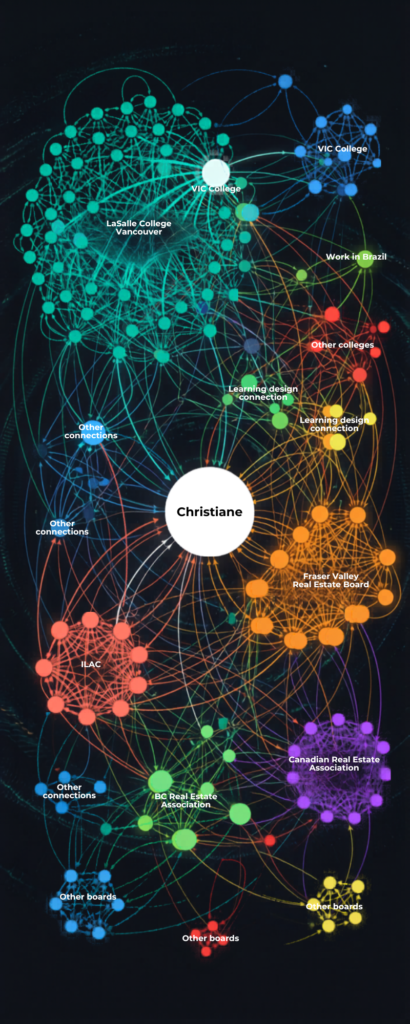
For this assignment, I created a visual representation of my professional network using my LinkedIn connections. I also made a deliberate choice to focus only on professional relationships from the institutions and organizations where I have worked, and removed personal connections to highlight how my professional identity can be defined through workplace networks. I deisgned this map using Canva, and I confess that it was not an easy task. With the help of Canva AI, I was able to design something I was mildly satisfied with.
At the centre of the map is me, as a node, connected to multiple clusters that represent different workplaces across my career. Each clusters reflects a distinct period of my life. However, the overlap in-between them was quite surprising. As I looked into the spreadsheet I downloaded from LinkedIn, I noticed that some individuals from one workplace are also connected to people from another, hence the little “bridges” between different contexts.
This fact helped me connect to the idea that Dron and Anderson (2014) describe, which says that learning occurs through broader networks and loosely connected collectives. My map shows this idea that, while I have worked in distinct institutional groups, my learning and professional growth have also been determined by the wider network that connects them.
Looking ahead, I try to imagine the role of emerging technologies in how these networks function. Bozkurt et al. (2023) and Butch, Lee, and Chen (2024) suggest that AI may transform knowledge-sharing communities by automating participation and by modifying how information flows. With that, I ask myself: how might my networks (both personal and professional) evolve if some of these are mediated or even augmented by AI tools? Will the value of human connections increase, or be redefined?
My network map represents a dynamic system that reflects my professional journey, and it allows me to visualize where I am situated now, and how much these connections continue to influence who I am as an educator and learner.
References:
Bozkurt, A., Xiao, J., Lambert, S., Pazurek, A., Crompton, H., Koseoglu, S., Farrow, R., Bond, M., Nerantzi, C., Honeychurch, S., Bali, M., Dron, J., Mir, K., Stewart, B., Costello, E., Mason, J., Stracke, C. M., Romero-Hall, E., Koutropoulos, A., Jandrić, P. (2023). Speculative futures on ChatGPT and generative artificial intelligence (AI): A collective reflection from the educational landscape. Asian Journal of Distance Education, 18(1), 53–130.
Burtch, G., Lee, D., & Chen, Z. (2024).
The consequences of generative AI for online knowledge communities. Scientific Reports, 14(1), 10413. https://doi.org/10.1038/s41598-024-61001-7
Dron, J, & Anderson, T. (2014). Teaching Crowds. Athabasca University Press. (Note: free PDF available for download). Chapter 4 – 7.
Garrison, R., Anderson, T., & Archer, W. (2000). Critical inquiry in text based environment: Computer conferencing in higher education. The Internet and Higher Education, 2(2–3), 87–105.
Stewart, B., Phipps, L., & Cormier, D. (2019, April 10). The Participatory open: Can we build a Pro-Social, Pro-Societal web? [Video]. You Tube.https://oer19.oerconf.org/sessions/the-participatory-open-can-we-build-a-pro-social-pro-societal-web-o-127
“Mildly satisfied” is more honest than most people are willing to be in academic writing, and I appreciated it. 100% relateable! We both ended up wrestling with placement in our maps. You centered yourself and were surprised by what the edges revealed. I tried not to center myself and the layout kept arguing with me.The question you ended with about whether human connection will increase or be redefined is one I keep sitting with too, from a different angle but with the same unease.