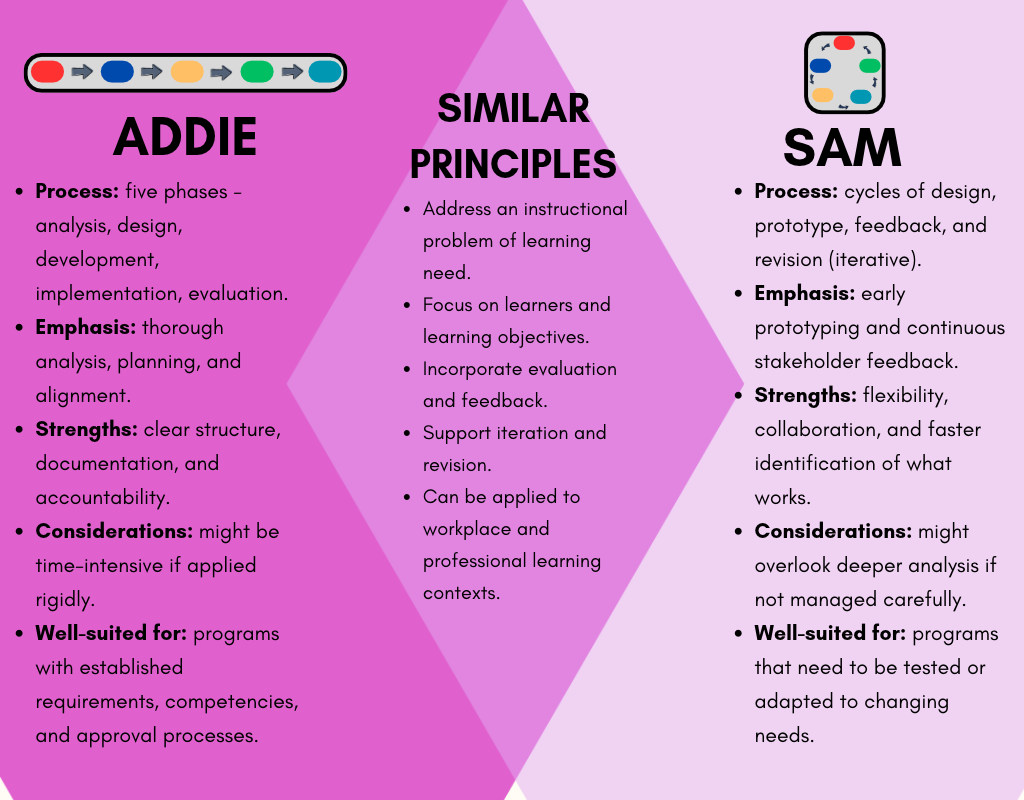
I first learned about and used ADDIE during my undergraduate studies in the 90s, when I designed classes and learning activities tailored to ESL students. As for SAM, I had only previously read about it, but had not examined its features in depth or applied it in practice. Hence, this comparison. One model I have used and know a lot about, and another that is more unfamiliar to me.
As Spatioti et al. (2022) points out, ADDIE can be “rigid, linear, and hierarchical,” but only if you follow its phases too strictly. Indeed, it provides a more systematic framework for organizing instructional design, but my own experience with ADDIE involved continuous adjustments, and revisiting earlier decisions as the learning activities developed.
SAM (Successive Approximation Model) places greater emphasis on rapid prototyping, stakeholder feedback, and successive revisions (An, 2021; Jung et al., 2019), highlighting flexibility and continuous revisions. However, Hutanu et al. (2015) question its suitability for larger projects, suggesting that its iterative structure may become restrictive when project requirements change.
Since I currently work with corporate learning and professional development for real estate professionals, I always have in mind that the learning opportunities that I create must address established competencies while also responding to changing industry practices and learners’ needs. The choice to compare these two models came from myself questioning which instructional design models can support professional learning: a more structured one with clearly defined steps, or a more iterative one that allows more flexibility? ADDIE can provide a structure for ensuring alignment between learning objectives, activities, and assessments, while SAM offers opportunities to test instructional approaches and incorporate feedback throughout development. Research on workplace instructional design suggests that practitioners use different models and approaches depending on their contexts (Giacumo & Breman, 2021). This reinforces my understanding that any instructional design model’s suitability depends on the learners, the professional context, and the learning outcomes we want to achieve.
References
An, Y. (2020). A History of Instructional Media, Instructional Design, and Theories. International Journal of Technology in Education, 4(1), 1–21. https://doi.org/10.46328/ijte.35
Giacumo, L. A., & Breman, J. (2021). Trends and Implications of Models, Frameworks, and Approaches Used by Instructional Designers in Workplace Learning and Performance Improvement. Performance Improvement Quarterly, 34(2), 131–170. https://doi.org/10.1002/piq.21349
Hutanu, A., Prostean, G., Mnerie, A. V., & Schiopu, R. (2015). Contemporaneous Issues in e-Learning Projects of the European Union. Procedia – Social and Behavioral Sciences, 191, 540–545. https://doi.org/10.1016/j.sbspro.2015.04.635
Jung, H. (2019). Advanced Instructional Design for Successive E-learning: Based on the Successive Approximation Model (SAM). International Journal on E-Learning, 18(2), 191–204. https://doi.org/10.70725/962362dtwhzr
Spatioti, A. G., Kazanidis, I., & Pange, J. (2022). A Comparative Study of the ADDIE Instructional Design Model in Distance Education. Information, 13(9), 402. https://doi.org/10.3390/info13090402
AI Use Statement
For this assignment, I used ChatGPT to search for academic sources related to the topics I wanted to explore. I reviewed the suggested sources and selected those I found most relevant and interesting to read in full. I found ChatGPT helpful in identifying relevant literature and suggesting sources that supported my research. Although I usually use AI tools to check grammar and coherence in my writing, I did not use them for that purpose in this assignment.