As a technical officer in a medical school, I am often reminded that humans are at the centre of the program. From this vantage point, a 2035 in which technology dictates the curriculum and pushes people to the background does not sound realistic. The future I envision for undergraduate medical education in Switzerland is an optimistic one, because it builds on a social practice that already exists.
Today’s students already share summaries, discuss clinical cases and challenge one another in group chats. In 2035, technology will not replace how this knowledge is constructed; rather, it will connect what learners produce. I foresee social spaces hosted by the institution, where learners choose whether or not to share their notes and reflections with their peers. Artificial intelligence acts as a facilitator: it links related reflections and surfaces where they diverge, leaving the discussion, and the judgement, to the students.
What makes this plausible is the context. Medical data is sensitive, Swiss institutions value digital sovereignty, and awareness of commercial lock-in is growing. Models from external providers can be plugged into the space and swapped by the institution at any time, so the knowledge built by the community never depends on a single vendor. Selwyn (2024) reminds us that educational AI remains narrow, confined to one task within pre-defined boundaries. What he frames as a limitation, I treat as a design principle: a facilitator that does one thing, and only that, is what keeps humans in the room. It is also what leaves space for the future that Veletsianos et al. (2024) encourage us to imagine: one centred on justice and hope rather than on technological solutionism. What remains uncertain is whether learners will share enough for these connections to matter.
Transparency statement : AI assistance was used for grammar checking, phrasing, and final language polish.
References
Selwyn, N. (2024). On the limits of artificial intelligence (AI) in education. Nordisk tidsskrift for pedagogikk og kritikk, 10(1). https://doi.org/10.23865/ntpk.v10.6062
Veletsianos, G., Houlden, S., Ross, J., Alhadad, S., & Dickson-Deane, C. (2024). Higher education futures at the intersection of justice, hope, and educational technology. International Journal of Educational Technology in Higher Education, 21, Article 43. https://doi.org/10.1186/s41239-024-00475-0
Techno-determinism presents technology as the direct cause of changes in learning, regardless of pedagogy or context. This post examines a press release and a mass-media article through the opposing lenses of the Great Media Debate: Clark’s (1994) position that media are causally inert vehicles for instruction, and Kozma’s (1994) counter-argument that a medium’s specific capabilities can participate in cognition when a design connects them to a task.
The first is a press release written by Tricia Davis-Muffett (2025), Senior Director at Google for Education, promoting Gemini for Education, a suite of AI-powered tools supported by success stories from US-based institutions. The second is a mass-media article, an unsigned report from The News International (2024) republished on Khan Academy Pakistan’s own site, covering the launch of the AI tutor Khanmigo with the stated aim of transforming the country’s educational landscape.
Starting with its title, Davis-Muffett’s (2025) post provides multiple examples of how Gemini for Education “accelerates” learning, is used to “transform” teaching, and can “help students grasp underlying concepts rather than simply providing answers” through a feature the post names Guided Learning. Gemini is consistently the subject of the main verb in these claims.
Teachers appear in the post, but in a specific and limited role: as people whose time the tool saves, and as a fallback the tool stands in for. Davis-Muffett’s own narration states that “professors love that it helps them save time and provides students with in-the-moment assistance,” and one named professor, Dr. Elisa Sobo, is quoted describing the tool as functioning “like having a teaching assistant that the students can go to when the teacher is not available.” At no point does the post describe a teacher, named or otherwise, making a pedagogical decision about how Gemini is used. The decisions that are described belong to institutions: a university is described as one of the first “to go all in on Google,” a system makes “AI fluency a shared expectation.” The techno-determinism here is not that teachers are erased from the story; it is that the decision-maker the post credits is procurement, not pedagogy.
Clark’s View
Clark (1994), restating his 1983 position, holds that media “are mere vehicles that deliver instruction but do not influence student achievement any more than the truck that delivers our groceries causes changes in our nutrition” (p. 22, quoting Clark, 1983, p. 445). The instructional method causes learning; the medium only affects cost, access, and speed of delivery. His replaceability test follows directly: if the same learning gain could come from a different medium, such as a human teaching assistant delivering the same guidance, the medium was never the cause.
Applied here, the “teaching assistant” comparison in the Gemini post concedes Clark’s point without meaning to. If Gemini is doing the work a human teaching assistant would otherwise do, the relevant question is not whether an AI or a person delivers the help, but whether the underlying method, how a specific misconception gets addressed, would produce the same result regardless of who or what delivers it. The post never makes that comparison. It also conflates the logistical benefits of Google’s tool, access, scale, and cost, with an actual influence on learning: the success metrics cited are adoption figures (“10 million college students,” “over 1,000 U.S. higher education institutions”), which Clark would distinguish sharply from evidence of learning. The strongest argument in Gemini’s favour, on Clark’s own terms, is that Google offers it free of charge to accredited institutions, exactly the cost and access advantage his framework allows a medium to claim, without that advantage saying anything about whether students learn differently because of it.
Kozma’s View
Kozma (1994) would resist the premise that “Gemini causes learning” is even the right question. His framework, developed through the ThinkerTools (White, 1993, as cited in Kozma, 1994) and Jasper Woodbury (Cognition and Technology Group at Vanderbilt, 1992, as cited in Kozma, 1994) examples, distinguishes a medium’s technology (its physical capability), symbol systems (how it represents information), and processing capabilities (what it can do with those symbols) (p. 12). The relevant question for Guided Learning is not whether Gemini has capabilities in some general sense, but which specific processing capability is doing the cognitive work, and whether it interacts with a documented mechanism the way White’s dynamic force-vector representations did in ThinkerTools.
On that standard, the post falls short in a specific way: it names an outcome without describing a mechanism. Kozma’s reply to Clark’s replaceability test is his distinction between necessary and sufficient conditions (p. 13): Clark demands necessary conditions before a medium counts as a real variable, but Kozma argues a design science should instead ask what conditions are sufficient to produce learning for given students and tasks. The post never specifies those conditions, so it cannot be tested against Kozma’s standard either. Guided Learning’s capability could matter, in the way computer-based dynamic symbol systems mattered in ThinkerTools, but the post gives no evidence that it does, only that people used it and access widened.
The article quotes Osman Rashid, chairperson of KAP, saying: “Khan Academy Pakistan is more than an initiative; it is a commitment to our children and our future. By integrating AI and localized content, we aim to use Khanmigo to transform the educational landscape of Pakistan, ensuring that every child, regardless of their circumstances, has access to quality learning.” Sal Khan frames it as bringing “the power of AI to tackle the unique challenges faced by students and teachers.” The article also describes “tools and training for teachers to enhance classroom learning,” and states that “for teachers, Khanmigo offers valuable resources like automated lesson planning and personalized feedback tools, making it easier to manage classroom tasks and focus on student engagement.” Teachers are named more often here than in the Gemini post, but the pattern is similar once the roles are separated: training and support are things teachers receive, while lesson planning, arguably the central instructional-method decision in teaching, is described as automated. The article’s own account of the pilot confirms the sequence: it will launch “starting with teachers and gradually extending to students,” with teachers positioned as recipients of the tool before students are, not as designers of how it gets used.
Clark’s View
Clark’s replaceability test, introduced above, applies here too: could the same learning gains come from a cheaper, non-AI intervention, such as a trained volunteer tutor or a well-designed workbook? If so, the medium is not the cause. Clark’s framework also grants Khanmigo something real: media can change the cost and reach of instruction without changing what is learned. A free AI tutor reaching students who would otherwise have no tutor at all is exactly the case his theory permits praising, and Rashid’s own sentence is careful in a way Davis-Muffett’s is not: “transform the educational landscape” is immediately qualified as “ensuring that every child, regardless of their circumstances, has access to quality learning,” an access claim, not an outcomes claim. On Clark’s terms, that is close to an honest use of the medium’s actual advantage. The overreach in this article sits elsewhere, in the framing that AI itself will “tackle the unique challenges faced by students and teachers,” which assigns the tool a role in solving pedagogical problems Clark would insist depends on method, not access.
The automated lesson-planning detail sharpens this. If lesson planning, deciding what gets taught and how, is handled by the tool, then the method Clark says is the actual cause of learning has been placed inside the medium rather than left to the teacher’s judgment. That does not resolve the debate in Khanmigo’s favour. It relocates the question: is the automated lesson plan itself a good method, tested against Clark’s replaceability standard, or is it merely a faster way to produce a lesson plan a teacher could have written? The article does not say.
Kozma’s View
Kozma would ask what Khanmigo’s specific processing capability is, and whether the article describes any interaction between that capability and a documented cognitive process, the standard he applied to ThinkerTools and Jasper. The article comes closer to naming one than the Gemini post did: Khanmigo “acts as a personal tutor for students, providing personalized assistance and helping them understand complex concepts at their own pace.” Self-paced, personalized processing is a real candidate capability in Kozma’s framework. But the article asserts it rather than evidencing it. It does not describe which concepts, for which students, produced which change, the kind of detail White’s force-vector representations or the Jasper videodisc’s random-access review supplied in Kozma’s own examples. Kozma’s closing question, “in what ways can we use the capabilities of media to influence learning for particular students, tasks, and situations” (p. 18), is precisely what this gap leaves unanswered. The article names the population, Pakistani students and teachers, and gestures at a capability, but never the task or mechanism connecting the two.
Conclusion
Clark and Kozma fail both texts on different grounds, which is itself informative. Clark’s test asks what method is actually doing the causal work, and both texts describe teachers primarily as recipients of what the tool provides rather than as agents deciding how it is used; the Khanmigo article goes further, describing the central method decision, lesson planning, as something the tool now performs. Kozma’s test asks for a documented interaction between a specific capability and a specific task, and neither text supplies one: both name an outcome (accelerated learning, transformed education) without describing a mechanism sufficient to produce it for particular students and situations.
Thirty years after Clark and Kozma’s exchange, the argument has not been settled. It has been restated by a company and a newspaper covering that company’s launch event, in each case because the evidence needed to satisfy either standard was left out of the story being told.
AI Transparency Statement
We used AI (Claude) in two different ways. Florian wrote his sections himself and used Claude as a language reviewer and as a sounding board to discuss the Clark and Kozma readings. Christopher used Claude to research candidate sources, fetch and verify primary material, and draft sections of this post. The AI-assisted drafts went through two verification passes, not one, and both caught real errors, which is worth stating plainly rather than implying the first check was sufficient. The first pass revised an early sentence stating that the Gemini post makes no mention of teachers, which a live fetch showed was too broad: the post does mention professors, although in a limited role, as discussed above. A second, independent pass caught three further problems in the AI-drafted sections that the first one missed: a quote wrongly attributed to a named professor that was actually the article’s own narration, a wrong title for a named individual, and a truncated quote that had reversed the point its full sentence actually makes. All three are corrected above. A final read-through checked the remaining direct quotations from the Gemini post against the source and corrected two that did not match its exact wording. We also confirmed, through direct verification against the raw source and a cross-check against the original newspaper report, that the Khanmigo material is a news article republished by Khan Academy Pakistan rather than the company’s own press release, which changed the citation. We reviewed and take ownership of the final analysis. The Clark and Kozma sections were checked against the full text of both 1994 papers rather than summaries of them.
Reflection
The uncomfortable finding of this assignment was not that a first draft contained an error. It was that a review pass we trusted also contained errors, of the same kind, in the same post about being careful with sources. A misattributed quote is a small thing to get wrong and an easy thing for a marker to catch, and it happened after we had already congratulated ourselves for catching a different mistake. The lesson that generalizes: verification is not a single gate a piece of writing passes through once. It is a standard the writing has to keep meeting on a second and third look, especially once a first correction has made everyone, including us, more confident than the evidence yet justified. What verification did not do was shortcut the theoretical reading. Getting Kozma’s argument right, specifically his distinction between technology, symbol systems, and processing capabilities, and his necessary-versus-sufficient-conditions reply to Clark, required reading his full 1994 paper directly. A plausible paraphrase of that argument, which is what an early unverified pass had offered, was close enough to sound right and wrong enough to have misrepresented him.
References
Clark, R. E. (1994). Media will never influence learning. Educational Technology Research and Development, 42(2), 21–29. https://doi.org/10.1007/BF02299088
Kozma, R. B. (1994). Will media influence learning? Reframing the debate. Educational Technology Research and Development, 42(2), 7–19. https://doi.org/10.1007/BF02299087
Derek Muller holds a degree in engineering physics and a PhD in physics education research from the University of Sydney. He is best known as the creator of Veritasium, a YouTube channel that explains science to broad audiences in an accessible and entertaining way.
As a producer of clinical skills training videos, I was naturally drawn to individuals who have contributed to educational technology through this medium. A high-profile science communicator such as Muller hardly qualifies as the hidden history that Watters (2014) invites us to recover. I nevertheless selected him because his earlier, lesser-known research on video as teaching material speaks directly to my own practice, even though it focuses on physics rather than medicine.
Among his contributions, the study at the core of his doctoral work (Muller et al., 2008) compared two videos on the same physics concept: a clear, concise explanation, and a dialogue in which a tutor draws out and addresses a student’s misconceptions. Students who watched the dialogue learned significantly more, although those who watched the explanation rated their video as clearer and felt more confident: perceived clarity is no proxy for learning. Muller later carried these findings beyond academic publishing, questioning the Khan Academy format (Muller, 2011) and the recurring promise that each new medium will revolutionize education (Muller, 2014). The study rests on a conceptual change view of learning: students are not empty containers to be filled but arrive with prior conceptions, often mistaken, that must be surfaced and confronted before new understanding can take hold. Two decades later, this directly challenges current developments: AI-generated learning videos deliver clear, concise explanations at scale, yet that very fluency leaves learners’ misconceptions untouched, which is precisely where Muller located the value of video.
AI Transparency Statement
I used AI (Claude, Fable 5.1 model) to explore individuals connected to video-based learning, to discuss the angle of this post, and to flag French-influenced constructions in my sentences. Building on those discussions, I drafted every paragraph myself before submitting it to Claude for grammar, phrasing and flow. Every reference and link in this post was opened and checked by me.
Reflection
Since I started the MALAT program, AI has been involved in almost all of my posts and assignments. As a native French speaker, my initial use was, and remains, correcting and rewriting drafts that bore the marks of French sentence structure. As I progressed in the program, I opted for a method that helps me make sense of the content rather than only polish it. After establishing a plan of action with the tool, I now systematically write a first draft from that discussion and from sources I have checked myself. AI then spots grammatical mistakes and, more importantly, corrects me when I have misunderstood a concept, much like the tutor in Muller’s dialogue addressing a student’s misconceptions. The limit of the analogy is also my main concern: unlike that tutor, the tool can be fluent and wrong at the same time, so the responsibility for checking remains mine.
Muller, D. A., Bewes, J., Sharma, M. D., & Reimann, P. (2008). Saying the wrong thing: Improving learning with multimedia by including misconceptions. Journal of Computer Assisted Learning, 24(2), 144–155. https://doi.org/10.1111/j.1365-2729.2007.00248.x
One lesson I take from Weller’s (2020) chapter on 2008 is how closely the downsides of e-portfolios he describes match our own experience at the University of Fribourg’s (UNIFR) School of Medicine. Alongside the key benefits, Weller outlines common barriers encountered by both faculty and students: a lack of support for platform use, overly complex interfaces and, most importantly, the perception among students that e-portfolios were simply too time-consuming. He also notes that students are often unable to export their e-portfolio once their studies end — a real problem for lifelong learners when the institution stops hosting it.
In 2025, we ran a series of focus group interviews to better understand how our medical students perceived their e-portfolios. Beyond confirming the barriers above, we found that most students used the platform only because the Master of Medicine program required it. They uploaded the bare minimum and kept a more traditional vault of evidence — folders and files on their own computers. These interviews prompted us to question the relevance of e-portfolios to our students’ learning experience, and the decision has already been made to phase them out within the next two to three years.
One Conflicting Lesson
Weller’s (2020) chapter on 2005, which covers video, was particularly relevant to my own work creating instructional videos at UNIFR. To me, video is more than a tool: it remains a universal and effective learning medium that can be combined with most of the other tools and pedagogical approaches Weller describes. Where the chapter conflicts with my experience, however, is in its second part, on the “flipped classroom” or “flipped learning” concept, in which students engage with the learning material (including videos) before discussing it with their instructor in face-to-face class time.
While Weller cites several authors who are critical of this model, notably for the lack of evidence for its effectiveness, there are circumstances where it remains a practical way to deal with less-than-ideal learning programs. In our case, most of the instructors who teach in the Master of Medicine program are also active practitioners with limited time dedicated to teaching. The flipped classroom model helps them make the most of their class time by focusing on where students struggle and addressing points of confusion.
Transparency statement : AI assistance was used for grammar checking, phrasing, and final language polish.
References
Weller, M. (2020). 25 years of ed tech. Athabasca University Press. https://www.aupress.ca/books/120290-25-years-of-ed-tech/
What surprised me the most reading Weller’s (2020) first chapters were probably the ones about attempts at standardization. I started my apprenticeship in Information Technology back in 2002 and, while already being an aficionado, I had no idea what it truly was about, even less in ed tech to say the least. More than 20 years later, reading about e-learning standards for the first time, it immediately appeared to me that this concept was unlikely to endure.
As Weller (2020) mentioned in Chapter 7 about learning objects as well as some of my peers in their blog post (Goerzen, 2026), the messy nature of education poses an inherent challenge to attempts to standardize something that is meant to be constantly redefined and reshaped. Learners, contexts and pedagogies keep shifting, and a standard frozen at a given point in time can hardly keep up with that perpetual movement.
This tension is not unique to education either: as Weller (2020) also points out, parallels can be drawn with software programming. Back in my apprenticeship days, we were told that Unified Modeling Language (UML) was the standard for modeling software. Many development tools and technologies have tried to create standards and references to be adopted by all and, while some of them have succeeded partially for some periods, they would often end up being replaced with new technologies or methodologies. Perhaps this has to do with human nature being attracted to the shiny new things. Or perhaps standards were never meant to be permanent in the first place: they act as temporary scaffolding, useful while a field finds its footing, before being dismantled and rebuilt. Seen that way, their impermanence is less a failure than a feature — even if nobody would have sold UML to us quite that way back in 2002.
Transparency statement : AI assistance was used for grammar checking, phrasing, and final language polish.
In an era where technology is ubiquitous, the ability to distinguish true from false information has become more critical than ever, especially in a learning context. Yet the concept of fake news is not a new one and has been previously observed throughout history (Gross & Schumacher, 2019). While it is easy to fathom how digital tools can contribute to the spread of misinformation, they also provide an opportunity for learners to sharpen their ability to evaluate the reliability of sources and develop their overall critical thinking. Additionally, our analysis reveals a neutral dimension in which digital learning neither amplifies nor mitigates the spread of misinformation.
Positive Impacts
Digital learning has increased access to information, educational resources, and diverse perspectives.
Online learning environments can help promote critical thinking, media literacy, and source evaluation skills (Beetham, 2019).
Learners now have greater access to fact-checking tools and multiple viewpoints when evaluating information online.
Discussions surrounding misinformation have encouraged educators to place greater emphasis on teaching students how to critically assess online information and digital content.
Educational institutions increasingly recognize digital literacy as an essential lifelong learning skill in a rapidly changing digital world (UNESCO, 2024).
Negative Impacts
Misinformation and fake news can spread rapidly through digital platforms and online learning environments.
The overwhelming amount of online information can make it difficult for learners to determine what is real/fake.
Many learners rely on quick online searches instead of deeper research, reflection, and analysis.
Access to information does not automatically lead to understanding or critical evaluation (Gross & Schumacher, 2019).
AI-generated content and algorithm-driven platforms have made it increasingly difficult to distinguish reliable information from misleading or false content (Selwyn, 2022).
Students may struggle to distinguish trustworthy academic sources from unreliable online information.
In-Between Impacts
Fake news and misinformation are not new concepts, but digital technologies have increased the speed and scale at which they spread (Gross & Schumacher, 2019).
The challenge of distinguishing truth from falsehood has long been a central concern in education and pedagogy (Wulf & Zirfas, 2014, as cited in Gross & Schumacher, 2019).
Digital learning environments create both opportunities for learning and opportunities for misinformation.
Technology itself is neither fully positive nor negative; its impact depends on how learners engage with information and how digital systems are designed (Cuban, 1993).
Critical thinking and digital literacy have become increasingly important in learning environments where information is constantly generated, shared, and reshaped.
Considering the above, critically engaging with digital tools has become crucial to assess the reliability of information in an educational context. The spread of misinformation has taken many forms throughout history, from oral dissemination to early technology such as printed propaganda. By extension, digital tools can be considered just another instrument prone to the proliferation of false information. Yet, the ability to think critically has always been and remains the last line of defense against misinformation.
References
Beetham, H. (2019, April 10). Trouble with critical: Reframing critical digital literacies as real-world interventions [Video]. YouTube.
Cuban, L. (1993). Computers meet classroom: Classroom wins. Teachers College Record, 95(2), 185–210.
Gross, B., & Schumacher, S. (2019). Digital media consumption and fake news as a challenge to lifelong learning. Pedagogia Oggi, 17(2), 230–241.
Selwyn, N. (2022). The future of AI and education: Some cautionary notes. European Journal of Education, 57(4), 620–631.
UNESCO. (2024). AI competency framework for teachers. UNESCO.
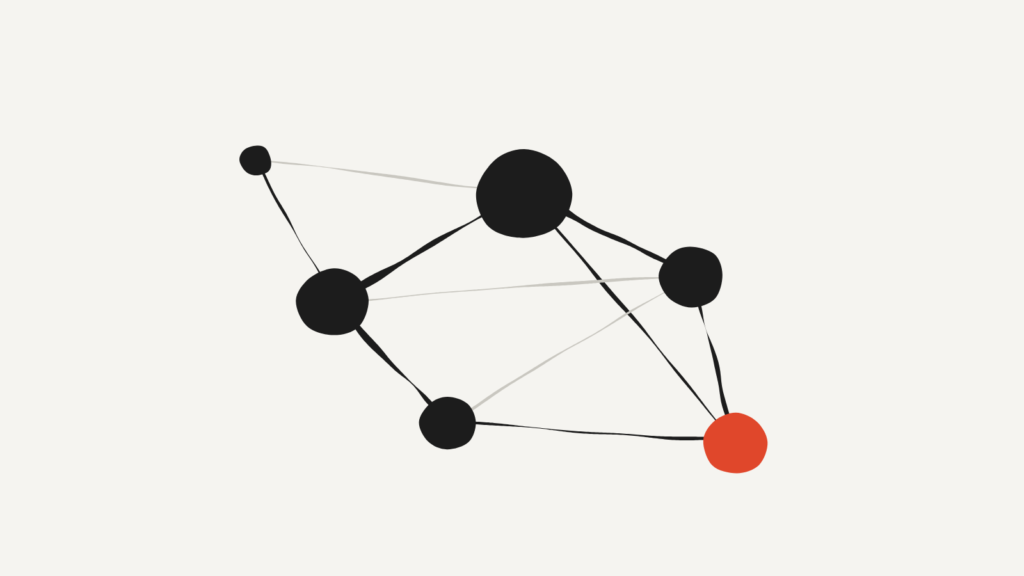
According to Dron & Anderson (2014), “A network…consists of nodes (the points on the network) and edges (the connections between them)”. The following map represents how I perceive my own network of relationships. To create this visual, I initially experimented with the Graph View in Obsidian using the Extended Graph plugin. While I managed to sketch the first set of groups, the resulting representation lacked clarity: many connections overlapped and repositioning nodes resulted in erratic movements. I then switched to Adobe Illustrator and benefited from its straightforward mapping process despite a steeper learning curve for an occasional user like me.
To determine the structure of my network, instead of trying to extract a list of contacts from a digital platform, I reflected on the people to which I feel meaningfully connected today and organized them into broader groups. To make the map three-dimensional, I used node size to represent an estimation of the number of individuals within each group and the width of the direct (black) connections to indicate the frequency of my interactions with them. In addition, the grey connections represent indirect ties between other groups. This way, the map does more than locate me within my network; it also provides a visual clue on the nature of my interactions across that network.
What appeared to me while creating the map is that my stronger and more active ties are concentrated with a relatively small number of groups. In contrast, larger groups do not necessarily mean more frequent interactions. Another interesting finding is that most of these groups are directly connected to each other, which could confirm Milgram’s (1967) “small world” theory, suggesting that most people are connected through a small number of intermediaries.
That said, this map—being a temporary snapshot—does not reveal how my network has evolved over time. For instance, a group of former schoolmates, which once held a more central place in my network, has gradually diminished over time in profit to groups coming from my professional sphere. In contrast, some groups, such as my family, have maintained a consistent presence in my network. While predicting a potential evolution to my network might be speculative, I can anticipate some positive shifts with some specific groups, such as the MALAT Cohort.
Transparency statement : AI assistance was used for grammar checking, phrasing, and final language polish.
References
Dron, J., & Anderson, T. (2014). Teaching Crowds. ACP – Athabasca University Press.
Milgram, S. (1967). The small world problem. Psychology Today, 2(1), 60–67.
My current digital presence reflects a tendency that I have identified during the creation of my map of technology use; I present my online self in a very controlled and selective manner that only leaves small traces in the publicly accessible web. Having gradually withdrawn any personal content from publicly accessible platforms over the last decade, if you Google me today, you will only find a few results work related, a LinkedIn profile which I barely use and the remnants of a stripped-down version of a Vimeo page I used to curate to expose my work as an independent filmmaker.
Finding a Voice and Workflow
Before setting any goals, reflecting on what digital identity means in my own context was essential. Rowland and Estevens (2025) identify three distinct understandings of digital identity among users: digital identification, self-presentation, and the datafied self. My approach aligns most closely with self-presentation — the conscious choice of what one shares and how, driven by a desire to keep a tight control over one’s image and privacy. From there, my digital presence simply becomes the where and the how of that sharing.
Approach and Gaps
From this, two goals emerge. First, finding a voice suitable in a professional or academic context while keeping a genuine and personal take in my future blog posts. Second, finding a workflow that allows me to create these blog posts faster. I will approach this blog as a delimited and intentional space to define my online self, keeping in mind my knowledge and skills gaps. The most prominent one being that I am a non-native English speaker. While some of my peers may already have a writing voice prior to this program, I have yet to find mine. For the first posts, I have often felt my sentences fragmented and clumsy, probably from the fact that I process information and construct sentences first in my native language—French—before translating them in writing. In addition, each reading and post has proven to be very time consuming to me, a common frustration among non-native English speakers according to a study by Curry & Lillis (2004).
Immersion as a tool
As a solution to these gaps, I will rely on the immersion into the network this program has offered me, mostly by analyzing my peers’ voices through their posts and notice how mine differs from theirs. In addition, I will consider my instructor’s feedback and browse the writing centre resources.
Measures of Success
If applied thoroughly, the success of this plan will be measured through my ability to go through related readings faster, integrate references from the research more easily and to become comfortable with posting my thoughts while showing consistency in my voice. Beyond the program itself, I also hope that the reflective habits and critical thinking skills developed along the way will find their way into my daily work at UNIFR, where digital learning environments are becoming an increasingly central part of how medicine is taught and practiced.
Transparency statement : AI assistance was used for grammar checking, phrasing, and final language polish.
References
Curry, M. J., & Lillis, T. (2004). Multilingual Scholars and the Imperative to Publish in English: Negotiating Interests, Demands, and Rewards. TESOL Quarterly, 38(4), 663. https://doi.org/10.2307/3588284
Rowland, J., & Estevens, J. (2025). “What is your digital identity?” Unpacking users’ understandings of an evolving concept in datafied societies. Media, Culture & Society, 47(2), 336–353. https://doi.org/10.1177/01634437241282240
Mapping your own technology use using the visitor/resident typology is more challenging than it appears. White & Le Cornu (2011) define visitors as users who perceive technology as a tool to perform a task, whereas residents see it as a social space where they can interact. They also argue that between these two roles a continuum of profiles exists. Reflecting on my own use reveals an obvious division between my personal use — shifting toward a visitor behaviour — and my professional use — leaning toward a more resident stance — of digital tools.
But even in the latter case, I tend to operate within semi-private contexts, which confirms a general tendency to keep my fully public digital footprint to a minimum. This appears consistent with broader trends: according to Ofcom (2026), roughly half of adults have reduced or stopped posting on social media altogether. This trend may be even more pronounced when considering that up to 90% of users browse without ever interacting — a profile Mitchell (2026) refers to as “lurkers”.
That said, this lack of nuance limits the explanatory power of the visitor-resident/personal-institutional tension pair. Cormier’s (2018) alternate model provides a different angle, accounting for more organic forms of interaction that I, as an IT professional, tend to favour.
Transparency statement : This post was drafted with the assistance of AI, used for grammar checking and light editing. All ideas and arguments are my own.
White, D. S., & Le Cornu, A. (2011). Visitors and residents: A new typology for online engagement. First Monday, 16(9). https://doi.org/10.5210/fm.v16i9.3171
This year’s virtual symposium (LRNT521 Digital Learning Environments, Networks, Communities) offered a valuable opportunity to examine how various institutions and organizations leverage technology to deliver digital learning experiences and navigate the challenges that arise along the way. The experience proved especially insightful when contrasting some of the concepts encountered with the learning methods employed at the school of medicine of the University of Fribourg (UNIFR) where I work as a technical officer.
In her presentation “Rethinking Participation: Neurodiversity and Inclusion in Digital Learning Communities”, Mary Burgess (2026) introduces a few examples of neurodivergent profiles—such as autistic spectrum disorder or ADHD—regrouped under the umbrella term “Neurodiversity” and describes how curricula are audited and redesigned to accommodate these differences and improve the learners’ experience. Notably, at UNIFR, neither the Bachelor’s nor the Master’s program in medicine currently integrates neurodiversity considerations into curriculum design. The sole exception remains assessment accommodations—under the form of extended time during examinations—for students with dyslexia.
The presentation “Safeguarding Academic Integrity” by Stephen Peasley (2026)—part of his applied research project—is particularly relevant in today’s academic landscape, as the research questions he raises are universally applicable across most educational systems: How AI should be used in an education context and how can institutions regulate its use? At UNIFR, during the Master of Medicine program, enrolled students are provided access to an interactive AI-powered tutor specifically designed for customized and on-demand learning. While students are encouraged to use it without restrictions, overreliance on it could create a risk of developing passive learning habits and as well as reduce their critical thinking (Kim et al., 2025). Yet, the availability of an AI-based tool as a resource for knowledge is greatly limited—if not entirely excluded—in a clinical context where an immediate physician/patient interaction is required.
Transparency statement : AI assistance was used for grammar checking, phrasing, and final language polish.
References
Burgess, M. (2026, April 7). Rethinking Participation: Neurodiversity and Inclusion in Digital Learning Communities [Webinar]. Royal Roads University. https://bit.ly/VS2026Burgess
Kim, J., Yu, S., Detrick, R., Lin, X., & Li, N. (2025). Designing AI-powered learning: Adult learners’ expectations for curriculum and human-AI interaction. Educational Technology Research and Development, 73, 3397–3421. https://doi.org/10.1007/s11423-025-10549-z