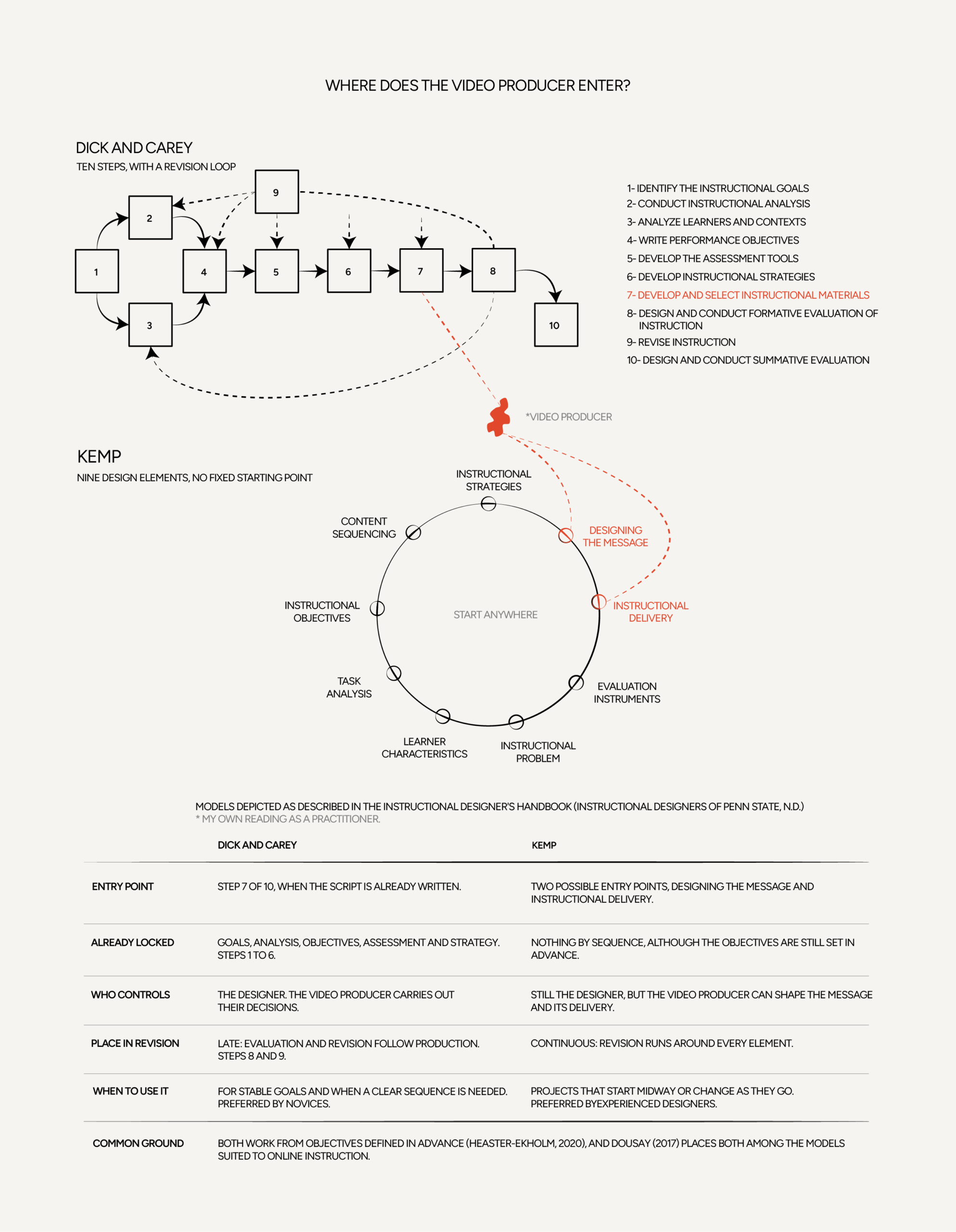
In my design identity post, I shared that I had been making instructional design (ID) decisions without knowing it while creating learning videos for medical education. For this assignment, I built on this idea by comparing two ID models and locating video production in each. Dick and Carey and Kemp are among the models that Dousay (2017) cites as well suited to online contexts. Both see ID as a means of problem solving and have a systems focus (Instructional Designers of Penn State, n.d.), and both work from objectives set in advance (Heaster-Ekholm, 2020). Beyond that, they differ considerably.
Dick and Carey
Built on the ADDIE pattern, the Dick and Carey model is a ten-step procedure in which each step feeds the next (Heaster-Ekholm, 2020). Described as linear and more rigid (Instructional Designers of Penn State, n.d.), it is rooted in behaviourist theory and centred on the instructor. Creating training videos falls naturally under step 7, “develop and select instructional materials” (Heaster-Ekholm, 2020, p. 55), once goals, objectives and strategy have been decided.
Kemp
The Kemp model, also known as the Morrison, Ross and Kemp model, is a circular model composed of nine design components, and a designer can start with any of them (Heaster-Ekholm, 2020). Unlike Dick and Carey, it is learner centred. Video creation belongs to instructional delivery (Instructional Designers of Penn State, n.d.), the component that covers the selection of media (Heaster-Ekholm, 2020).
Insights
The comparison gave me words for my practice. In a Dick and Carey process, the producer carries out decisions made upstream; in Kemp, the message choices I was already making are named as a design component. In future projects, I would ask to be involved before the script is written. I chose a journey map because it shows where the producer enters each model.
References
Dousay, T. A. (2017). Instructional design models. In R. E. West (Ed.), Foundations of learning and instructional design technology. EdTech Books. https://edtechbooks.org/lidtfoundations/instructional_design_models
Heaster-Ekholm, K. L. (2020). Popular instructional design models: Their theoretical roots and cultural considerations. International Journal of Education and Development Using Information and Communication Technology, 16(3), 50–65. https://files.eric.ed.gov/fulltext/EJ1275582.pdf
Instructional Designers of Penn State. (n.d.). Instructional designer’s handbook. The Pennsylvania State University. https://psu.pb.unizin.org/idhandbook/
AI Use Declaration
I used Claude (Anthropic) as a sounding board to discuss the assignment brief, possible angles and pairs of models, and the format of the representation. Claude produced a first proposal for the journey map, which I then recreated from scratch myself. I wrote the first draft of the reflection; Claude corrected the language, flagged statements it could not find in my sources, and wrote a few additional sentences. It also helped me format the references and draft this declaration.
I checked its corrections against my sources, some of which I had identified myself, and restored terms it had wrongly removed. The position of the producer in each model is my own interpretation, drawn from my practice.
Reflection
AI helped me explore formats and caught a misconception in my draft about the similarities between the two models. It also had limits: it could not know where a video producer sits in a design process, and it questioned terms that came from a source it had not seen. It influenced my design decisions, since the format and the guiding question came out of our discussion. My main concern remains that my own voice disappears through the edits, and that a tool can be fluent and wrong at the same time.