Possible Main Impacts of Digital Learning on Misinformation/Fake News

Christina Steklin & Florian Progin

In an era where technology is ubiquitous, the ability to distinguish true from false information has become more critical than ever, especially in a learning context. Yet the concept of fake news is not a new one and has been previously observed throughout history (Gross & Schumacher, 2019). While it is easy to fathom how digital tools can contribute to the spread of misinformation, they also provide an opportunity for learners to sharpen their ability to evaluate the reliability of sources and develop their overall critical thinking. Additionally, our analysis reveals a neutral dimension in which digital learning neither amplifies nor mitigates the spread of misinformation.

Positive Impacts

  • Digital learning has increased access to information, educational resources, and diverse perspectives.
  • Online learning environments can help promote critical thinking, media literacy, and source evaluation skills (Beetham, 2019).
  • Learners now have greater access to fact-checking tools and multiple viewpoints when evaluating information online.
  • Discussions surrounding misinformation have encouraged educators to place greater emphasis on teaching students how to critically assess online information and digital content.
  • Educational institutions increasingly recognize digital literacy as an essential lifelong learning skill in a rapidly changing digital world (UNESCO, 2024).

Negative Impacts

  • Misinformation and fake news can spread rapidly through digital platforms and online learning environments.
  • The overwhelming amount of online information can make it difficult for learners to determine what is real/fake.
  • Many learners rely on quick online searches instead of deeper research, reflection, and analysis.
  • Access to information does not automatically lead to understanding or critical evaluation (Gross & Schumacher, 2019).
  • AI-generated content and algorithm-driven platforms have made it increasingly difficult to distinguish reliable information from misleading or false content (Selwyn, 2022).
  • Students may struggle to distinguish trustworthy academic sources from unreliable online information.

In-Between Impacts

  • Fake news and misinformation are not new concepts, but digital technologies have increased the speed and scale at which they spread (Gross & Schumacher, 2019).
  • The challenge of distinguishing truth from falsehood has long been a central concern in education and pedagogy (Wulf & Zirfas, 2014, as cited in Gross & Schumacher, 2019).
  • Digital learning environments create both opportunities for learning and opportunities for misinformation.
  • Technology itself is neither fully positive nor negative; its impact depends on how learners engage with information and how digital systems are designed (Cuban, 1993).
  • Critical thinking and digital literacy have become increasingly important in learning environments where information is constantly generated, shared, and reshaped.

Considering the above, critically engaging with digital tools has become crucial to assess the reliability of information in an educational context. The spread of misinformation has taken many forms throughout history, from oral dissemination to early technology such as printed propaganda. By extension, digital tools can be considered just another instrument prone to the proliferation of false information. Yet, the ability to think critically has always been and remains the last line of defense against misinformation.

References

Beetham, H. (2019, April 10). Trouble with critical: Reframing critical digital literacies as real-world interventions [Video]. YouTube.

Cuban, L. (1993). Computers meet classroom: Classroom wins. Teachers College Record, 95(2), 185–210.

Gross, B., & Schumacher, S. (2019). Digital media consumption and fake news as a challenge to lifelong learning. Pedagogia Oggi, 17(2), 230–241.

Selwyn, N. (2022). The future of AI and education: Some cautionary notes. European Journal of Education, 57(4), 620–631.

UNESCO. (2024). AI competency framework for teachers. UNESCO.
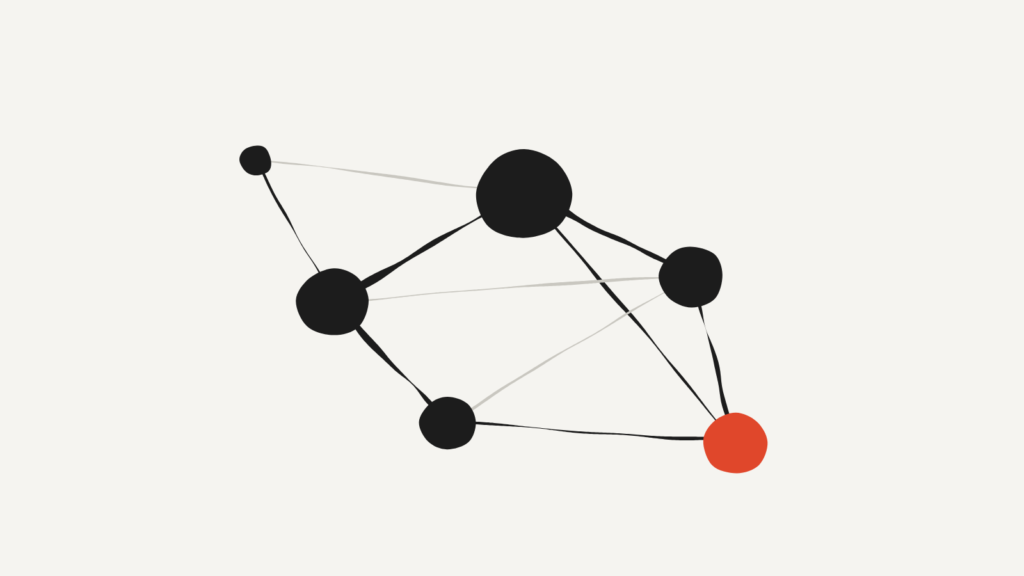
Visual Network Mapping

According to Dron & Anderson (2014), “A network…consists of nodes (the points on the network) and edges (the connections between them)”. The following map represents how I perceive my own network of relationships. To create this visual, I initially experimented with the Graph View in Obsidian using the Extended Graph plugin. While I managed to sketch the first set of groups, the resulting representation lacked clarity: many connections overlapped and repositioning nodes resulted in erratic movements. I then switched to Adobe Illustrator and benefited from its straightforward mapping process despite a steeper learning curve for an occasional user like me.

To determine the structure of my network, instead of trying to extract a list of contacts from a digital platform, I reflected on the people to which I feel meaningfully connected today and organized them into broader groups. To make the map three-dimensional, I used node size to represent an estimation of the number of individuals within each group and the width of the direct (black) connections to indicate the frequency of my interactions with them. In addition, the grey connections represent indirect ties between other groups. This way, the map does more than locate me within my network; it also provides a visual clue on the nature of my interactions across that network.

What appeared to me while creating the map is that my stronger and more active ties are concentrated with a relatively small number of groups. In contrast, larger groups do not necessarily mean more frequent interactions. Another interesting finding is that most of these groups are directly connected to each other, which could confirm Milgram’s (1967) “small world” theory, suggesting that most people are connected through a small number of intermediaries.

That said, this map—being a temporary snapshot—does not reveal how my network has evolved over time. For instance, a group of former schoolmates, which once held a more central place in my network, has gradually diminished over time in profit to groups coming from my professional sphere. In contrast, some groups, such as my family, have maintained a consistent presence in my network. While predicting a potential evolution to my network might be speculative, I can anticipate some positive shifts with some specific groups, such as the MALAT Cohort.

Transparency statement : AI assistance was used for grammar checking, phrasing, and final language polish.

References

Dron, J., & Anderson, T. (2014). Teaching Crowds. ACP – Athabasca University Press.

Milgram, S. (1967). The small world problem. Psychology Today, 2(1), 60–67.

Digital Identity and Digital Presence

My current digital presence reflects a tendency that I have identified during the creation of my map of technology use; I present my online self in a very controlled and selective manner that only leaves small traces in the publicly accessible web. Having gradually withdrawn any personal content from publicly accessible platforms over the last decade, if you Google me today, you will only find a few results work related, a LinkedIn profile which I barely use and the remnants of a stripped-down version of a Vimeo page I used to curate to expose my work as an independent filmmaker.

Finding a Voice and Workflow

Before setting any goals, reflecting on what digital identity means in my own context was essential. Rowland and Estevens (2025) identify three distinct understandings of digital identity among users: digital identification, self-presentation, and the datafied self. My approach aligns most closely with self-presentation — the conscious choice of what one shares and how, driven by a desire to keep a tight control over one’s image and privacy. From there, my digital presence simply becomes the where and the how of that sharing.

Approach and Gaps

From this, two goals emerge. First, finding a voice suitable in a professional or academic context while keeping a genuine and personal take in my future blog posts. Second, finding a workflow that allows me to create these blog posts faster. I will approach this blog as a delimited and intentional space to define my online self, keeping in mind my knowledge and skills gaps. The most prominent one being that I am a non-native English speaker. While some of my peers may already have a writing voice prior to this program, I have yet to find mine. For the first posts, I have often felt my sentences fragmented and clumsy, probably from the fact that I process information and construct sentences first in my native language—French—before translating them in writing. In addition, each reading and post has proven to be very time consuming to me, a common frustration among non-native English speakers according to a study by Curry & Lillis (2004).

Immersion as a tool

As a solution to these gaps, I will rely on the immersion into the network this program has offered me, mostly by analyzing my peers’ voices through their posts and notice how mine differs from theirs. In addition, I will consider my instructor’s feedback and browse the writing centre resources.

Measures of Success

If applied thoroughly, the success of this plan will be measured through my ability to go through related readings faster, integrate references from the research more easily and to become comfortable with posting my thoughts while showing consistency in my voice. Beyond the program itself, I also hope that the reflective habits and critical thinking skills developed along the way will find their way into my daily work at UNIFR, where digital learning environments are becoming an increasingly central part of how medicine is taught and practiced.

Transparency statement : AI assistance was used for grammar checking, phrasing, and final language polish.

References

Curry, M. J., & Lillis, T. (2004). Multilingual Scholars and the Imperative to Publish in English: Negotiating Interests, Demands, and Rewards. TESOL Quarterly, 38(4), 663. https://doi.org/10.2307/3588284

Rowland, J., & Estevens, J. (2025). “What is your digital identity?” Unpacking users’ understandings of an evolving concept in datafied societies. Media, Culture & Society, 47(2), 336–353. https://doi.org/10.1177/01634437241282240

Using technologies : Conceptual map

Mapping your own technology use using the visitor/resident typology is more challenging than it appears. White & Le Cornu (2011) define visitors as users who perceive technology as a tool to perform a task, whereas residents see it as a social space where they can interact. They also argue that between these two roles a continuum of profiles exists. Reflecting on my own use reveals an obvious division between my personal use — shifting toward a visitor behaviour — and my professional use — leaning toward a more resident stance — of digital tools.

But even in the latter case, I tend to operate within semi-private contexts, which confirms a general tendency to keep my fully public digital footprint to a minimum. This appears consistent with broader trends: according to Ofcom (2026), roughly half of adults have reduced or stopped posting on social media altogether. This trend may be even more pronounced when considering that up to 90% of users browse without ever interacting — a profile Mitchell (2026) refers to as “lurkers”.

That said, this lack of nuance limits the explanatory power of the visitor-resident/personal-institutional tension pair. Cormier’s (2018) alternate model provides a different angle, accounting for more organic forms of interaction that I, as an IT professional, tend to favour.

Transparency statement : This post was drafted with the assistance of AI, used for grammar checking and light editing. All ideas and arguments are my own.

References

Cormier, D. (2018, March 31). Digital practices mapping – Intro activity for digital literacies course. Dave’s Educational Blog. https://davecormier.com/edblog/2018/03/31/digital-practices-mapping-intro-activity-for-digital-literacies-course

Mitchell, S. (2026). Psychology suggests people who browse social media but never post or comment aren’t passive. Silicon Canals. https://siliconcanals.com/d-psychology-suggests-people-who-browse-social-media-but-never-post-or-comment-arent-passive-theyve-simply-opted-out-of-the-performance-while-retaining-access-to-the-information-which-is-a/

Ofcom. (2026). Passive social media use, AI companionship, and online side hustles: UK adults’ media and online lives revealed. https://www.ofcom.org.uk/media-use-and-attitudes/media-habits-adults/passive-social-media-use-ai-companionship-and-online-side-hustles-uk-adults-media-and-online-lives-revealed

White, D. S., & Le Cornu, A. (2011). Visitors and residents: A new typology for online engagement. First Monday, 16(9). https://doi.org/10.5210/fm.v16i9.3171

Reflections from the Virtual Symposium

This year’s virtual symposium (LRNT521 Digital Learning Environments, Networks, Communities) offered a valuable opportunity to examine how various institutions and organizations leverage technology to deliver digital learning experiences and navigate the challenges that arise along the way. The experience proved especially insightful when contrasting some of the concepts encountered with the learning methods employed at the school of medicine of the University of Fribourg (UNIFR) where I work as a technical officer.

In her presentation “Rethinking Participation: Neurodiversity and Inclusion in Digital Learning Communities”, Mary Burgess (2026) introduces a few examples of neurodivergent profiles—such as autistic spectrum disorder or ADHD—regrouped under the umbrella term “Neurodiversity” and describes how curricula are audited and redesigned to accommodate these differences and improve the learners’ experience. Notably, at UNIFR, neither the Bachelor’s nor the Master’s program in medicine currently integrates neurodiversity considerations into curriculum design. The sole exception remains assessment accommodations—under the form of extended time during examinations—for students with dyslexia.

The presentation “Safeguarding Academic Integrity” by Stephen Peasley (2026)—part of his applied research project—is particularly relevant in today’s academic landscape, as the research questions he raises are universally applicable across most educational systems: How AI should be used in an education context and how can institutions regulate its use? At UNIFR, during the Master of Medicine program, enrolled students are provided access to an interactive AI-powered tutor specifically designed for customized and on-demand learning. While students are encouraged to use it without restrictions, overreliance on it could create a risk of developing passive learning habits and as well as reduce their critical thinking (Kim et al., 2025). Yet, the availability of an AI-based tool as a resource for knowledge is greatly limited—if not entirely excluded—in a clinical context where an immediate physician/patient interaction is required.

Transparency statement : AI assistance was used for grammar checking, phrasing, and final language polish.

References

Burgess, M. (2026, April 7). Rethinking Participation: Neurodiversity and Inclusion in Digital Learning Communities [Webinar]. Royal Roads University. https://bit.ly/VS2026Burgess

Kim, J., Yu, S., Detrick, R., Lin, X., & Li, N. (2025). Designing AI-powered learning: Adult learners’ expectations for curriculum and human-AI interaction. Educational Technology Research and Development, 73, 3397–3421. https://doi.org/10.1007/s11423-025-10549-z

Peasley, S. (2026, April 7). Safeguarding academic integrity [Webinar]. Royal Roads University. https://bit.ly/PeaselyMALATVS2026