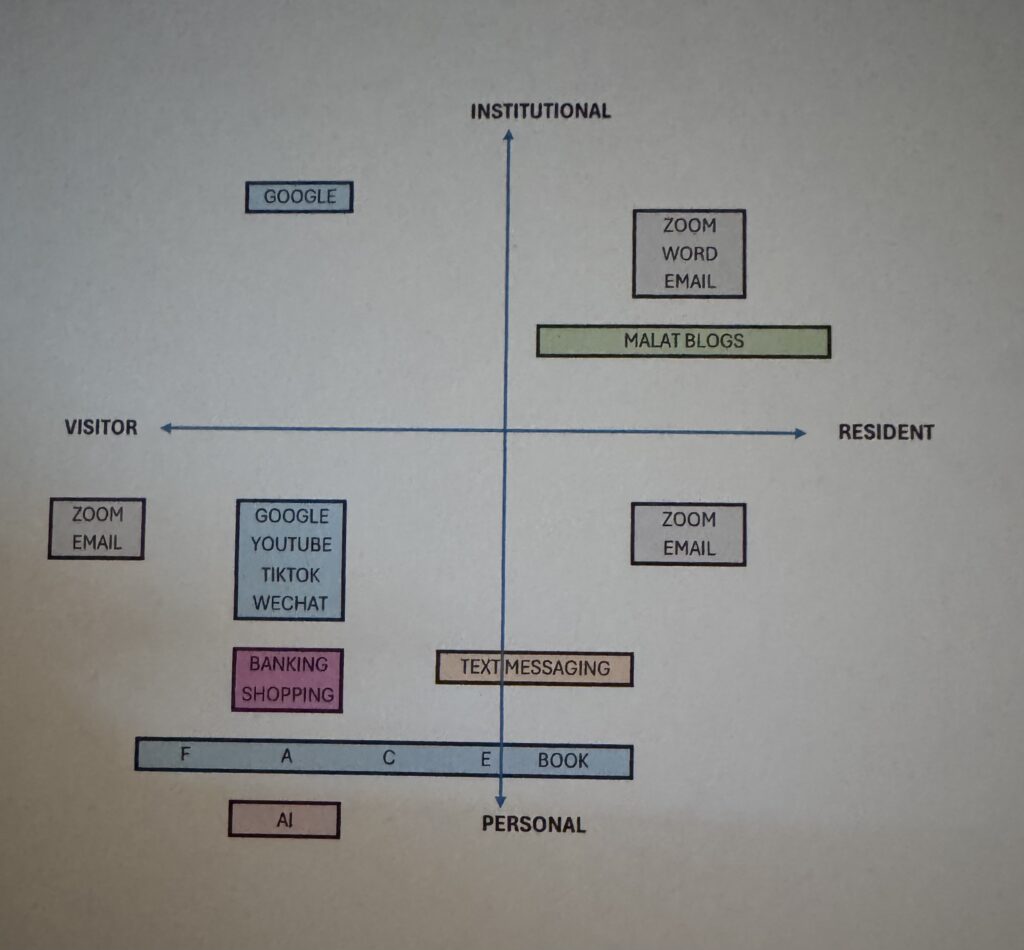
Mapping my technology use using the resident–visitor typology (White & Le Cornu, 2011), made me realize that I am primarily a visitor in most of my online activity. I tend to use technology as a tool to complete tasks rather than as a space to build an online presence. For example, I regularly use platforms like YouTube, TikTok, and Google for entertainment or information, but I rarely contribute content or interact publicly. Even on Facebook, my participation is minimal and typically limited to occasional comments or sharing significant life events. (I believe my last post was almost two years ago when my father turned ninety!)
Interestingly, this has not always been the case. While previously studying at RRU fifteen years ago, I was much more active on platforms such as Instagram, Facebook, and Twitter. At that time, I engaged more frequently, shared content, and maintained a more visible online presence. Comparing that period to my current habits highlights a clear shift from more resident behaviour to a predominantly visitor approach in my personal digital life.
This pattern extends into my professional and academic use of technology. In my teaching and coursework, I use tools such as Zoom and Microsoft Word primarily in a functional way. I use them to deliver lessons, access materials, and complete tasks rather than to establish an ongoing visible presence. However, my experience living and teaching in China also shaped my technology use in different ways. While WeChat is not commonly used in Canada, it functions as an essential all-in-one communication platform in China. I still use WeChat to stay connected with friends there, and when teaching students in China, classes and even payments are often managed entirely through the app. This highlights how digital platform use is also influenced by cultural and regional contexts.
Boyd (2010) describes social media spaces as “networked publics,” where technology shapes participation, visibility, and interaction online. This idea stood out to me as I thought about how differently I engage with digital platforms depending on the cultural, personal, professional, or educational context.
However, this is beginning to shift with my participation in the MALAT program, where I am now required to create blog posts. This has moved me slightly toward the resident end of the spectrum in an academic context. One insight that stood out to me is how intentionally I separate my personal and professional online identities. My personal use remains largely private, while my professional presence is minimal and mostly task oriented. I was somewhat surprised to see how little I engage as a “resident,” especially given my role as an educator in a digital environment. This mapping of my technology use highlights a potential area for growth, particularly in developing a more active and visible professional online presence.
Overall, my online engagement is not fixed, but shifts depending on context, purpose, culture, and even different stages of life. While I currently lean strongly toward being a visitor, especially in my personal life, my past experiences and current studies suggest that this position can and likely will continue to evolve.
Note: ChatGPT was used to refine the language in the final draft. All concepts and ideas are mine.
References
Boyd, d. (2010). Social network sites as networked publics: Affordances, dynamics, and implications. In Z. Papacharissi (Ed.), A networked self: Identity, community, and culture on social network sites (pp. 39–58). Routledge.
White, D. S., & Le Cornu, A. (2011). Visitors and residents: A new typology for online engagement. First Monday, 16(9).
Leave a Reply