
Reading Weller’s (2020) history of educational technology, the two most compelling takeaways are: firstly, how the field repeatedly grapples with the exact same core tensions, and secondly, failing to recognize this is “a knowledge management problem” (Watson, 2026, para. 2).
Decades later, we are still caught in the tug-of-war between:
- technology versus pedagogy,
- scale versus human support,
- openness versus control, and
- efficiency versus meaningful learning (Weller, 2020).
From a knowledge management (KM) perspective, this cyclical pattern isn’t accidental—it stems from how we treat different types of knowledge (Kudoos, 2026).
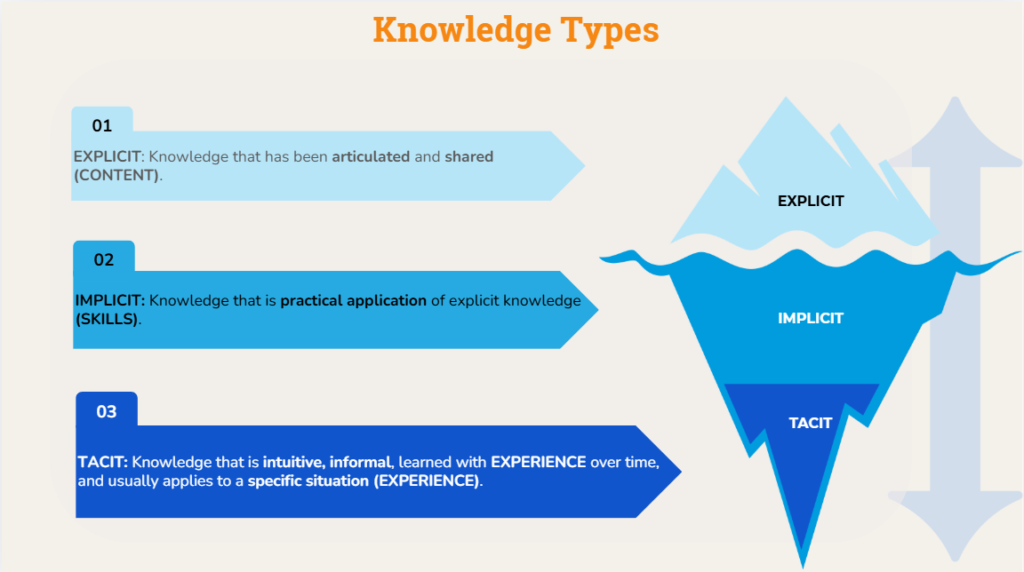
Educational systems naturally gravitate toward efficiency, scale, and control because explicit knowledge—the articulated, shared content above the surface (Kudoos, 2023 —is remarkably easy to digitize, package, and distribute. We saw this in the rush toward early e-learning and learning objects (Weller, 2020). These early innovations promised operational efficiency by turning learning into modular, reusable content, often mistaking content management for true knowledge transfer.
Where technology struggles is bridging the submerged, human layers: implicit knowledge (the practical application and skills derived from explicit concepts) and tacit knowledge (the intuitive, informal wisdom learned through context and experience over time) (Kudoos, 2026). Early web innovations like constructivist spaces, wikis, and open communities attempted to foster these deeper layers, but institutional pressures repeatedly flattened learning back into standardized, explicit repositories (Weller, 2020).
As educational technology continually evolves, the risk of “ed tech amnesia” remains high if we ignore these historical patterns (Weller, 2020, p.7). Digital platforms can effortlessly process and cross-reference infinite kinds of structured data, but they operate predominantly within the realm of explicit information. If we evaluate educational success purely through speed, retrieval, and scale, we repeat past mistakes. Achieving meaningful learning requires us to intentionally design educational spaces that move beneath the surface—translating explicit content into applied implicit skills and deeply rooted tacit experience (Kudoos, 2026).
References
Kudoos, Z. (2026). The iceberg model of knowledge [Graphic]. Knowledge Management 101 [Unpublished course material].
Watson, C. [Craig Watson]. (2026, 08, 27). Hi Zubeida, I like your point about looking back and recognizing patterns. Looking through old photos for this activity, I [Discussion forum post]. Moodle. https://moodle.royalroads.ca
Weller, M. (2020). 25 years of ed tech. Athabasca University Press. https://doi.org/10.15215/aupress/9781771993050.01
Hi Zubeida,
That graphic of the three different types of knowledge is great, and I sympathize with your observation that institutions tend to value the explicit layer as “the teaching.” The world would be so much neater if only humans, and all the things we think, feel, and do, could fit into neat little boxes to be categorized and ordered!
I’ve been reading about Knowledge Building theory, which looks at how knowledge is built socially and how digital tools can support the communal improvement of ideas. It has me thinking that perhaps the problem with learning objects, and now AI, is not simply that technology struggles to capture tacit knowledge. Maybe it is that we keep treating knowledge as something that can be captured, packaged, transferred, and consumed. AI may make that process incredibly sophisticated by personalizing and adapting explicit content, but personalization alone doesn’t not necessarily lead to implicit and tacit knowledge.
I think sociocultural learning, implicit and tacit knowledge are going to become increasingly discussed topics as AI develops as they may help explain why AI can be remarkably good at delivering information yet still struggle with some of the social and experiential dimensions of learning. I’ll be flying the human-connection flag, even when institutions are trying to convince us that efficiency, scale, and automation are the same thing as better learning.
Great comments, Claire!
You’ve hit on the core issue: treating knowledge as a packaged commodity to be “transferred and consumed” is why edtech repeatedly hits a wall with deep learning.
Your connection to Knowledge Building theory is spot on. AI can personalize explicit content, but it can’t replace social construction and experiential wisdom. To design for those deeper layers, I pair Nonaka and Takeuchi’s (1995) SECI model with Bloom’s Taxonomy (Anderson & Krathwohl, 2001). Platforms excel at the Combination phase by organizing explicit data at the base of Bloom’s Taxonomy (Anderson & Krathwohl, 2001), but true learning happens through Socialization and Internalization—actively applying explicit concepts until they become embodied, tacit skills.
Blog comments and threaded discussions are standard ways higher ed addresses this, backed by course credit. The real challenge is in corporate space: how to move beyond static documentation and create meaningful, reflective knowledge-sharing without it feeling like forced compliance.
As AI automates content delivery, flying the human-connection flag isn’t just nice to have—it’s the defining edge of real learning design.
References
Anderson, L. W., & Krathwohl, D. R. (Eds.). (2001). A taxonomy for learning, teaching, and assessing: A revision of Bloom’s taxonomy of educational objectives. Longman.
Nonaka, I., & Takeuchi, H. (1995). The knowledge-creating company: How Japanese companies create the dynamics of innovation. Oxford University Press.
Hi Zubeida and Claire! (in reference to the original post and comments further above)
In my work environment, I struggle with the seemingly adversarial tug-of-war issues described by Zubeida; scale versus support, efficiency versus meaningful learning, and similar.
On one hand, we are encouraged to explore ways to use technology to increase scalability. Effectively, to figure out how to write ourselves out of the teaching equation to some extent. On the other hand, I agree with your statement about the role of the human learning connection.
While there may be a self-serving element in my stance, since it speaks to the viability and usefulness of my role in the future, I do sincerely believe that a blend of commodified learning elements and human facilitation is the most effective combination in many instructional environments. The writing is on the wall that AI and related technologies will become increasingly adept at providing and replacing specific elements of what I currently feel I contribute as a human instructor. However, my experience tells me that there is a significant emotional component to learning, whether it is children or adults at any stage of life.
Hi Matt:
I really appreciate your perspective on this. The tension you describe—balancing scale and automation against meaningful human support—is a constant challenge in organizational design.
Part of the issue is that institutional evaluations of learning are often extremely surface-level. Metrics typically focus on completion rates, participant counts, or post-course test scores that measure short-term recall rather than long-term behavioral change or skill application. The deeper, qualitative impacts on true learning—such as problem-solving capacity, critical thinking, and confidence—are rarely measured because they require more intentional assessment models.
When organizations view technology primarily through a lens of cost-cutting, they often target headcount reductions under the assumption that automation offsets salary expenses. However, replacing human capacity with tech tools rarely delivers the ROI executives expect.
As Josh Bersin highlighted in his research and keynotes with Eightfold AI (Eightfold 2026), the highest-performing organizations don’t use AI and automation simply to shrink their workforce. Instead, they maintain headcount while using technology to remove repetitive tasks, effectively freeing up human capacity for more complex, high-value, and creative work.
Organizations that shift from viewing talent as a cost center to redesigning work around human capability consistently outperform those focused purely on efficiency. Technology should be used to augment human capacity so instructors and practitioners can focus on the emotional, social, and contextual elements of learning that technology cannot replicate.
References
Eightfold. (2026, June 17). HR 2030: Building the agentic HR organization [Video]. YouTube. https://youtu.be/X7EZ6lauXxw
Hi Zubeida,
You pointed out something in your post that has always resonated with me: the importance of human support and meaningful learning! While e-learning has made education more accessible and convenient with just the click of a button, I personally feel that it can sometimes miss a fundamental part of the learning process—learning from peers and engaging in face-to-face discussions in real time.
It will be really interesting to see how technology continues to evolve and how it can help bridge these gaps while still maintaining the human connection that makes learning so meaningful!
Asma
Thanks, Asma!
I agree that the human element is essential. I tend to think of edtech like any other technology: it doesn’t replace people, it helps them work more efficiently. Using a hand mixer doesn’t remove the baker from the process, but it speeds up the work and creates more capacity for creativity and refinement. For me, the key is analyzing the learning process to determine which activities are best supported by technology and which require meaningful human interaction and support.
Hi Zubeida,
I really liked your discussion of explicit, implicit, and tacit knowledge. It made me think about how much of what I do as an instructor comes from experience rather than something I could easily explain in a manual.
After teaching adults for many years, I can often tell when students are confused even when nobody says anything. Sometimes I change the way I am explaining something, give another example, slow down, or even take a break because I can sense that I am losing the class. I don’t think I consciously learned how to do those things. They developed through experience.
That really helped me understand your point about tacit knowledge and why simply delivering information efficiently is not the same as meaningful learning. Technology can give learners access to an enormous amount of information, but there are still parts of teaching and learning that are difficult to package or digitize.
Thanks for giving me a different way to think about this!