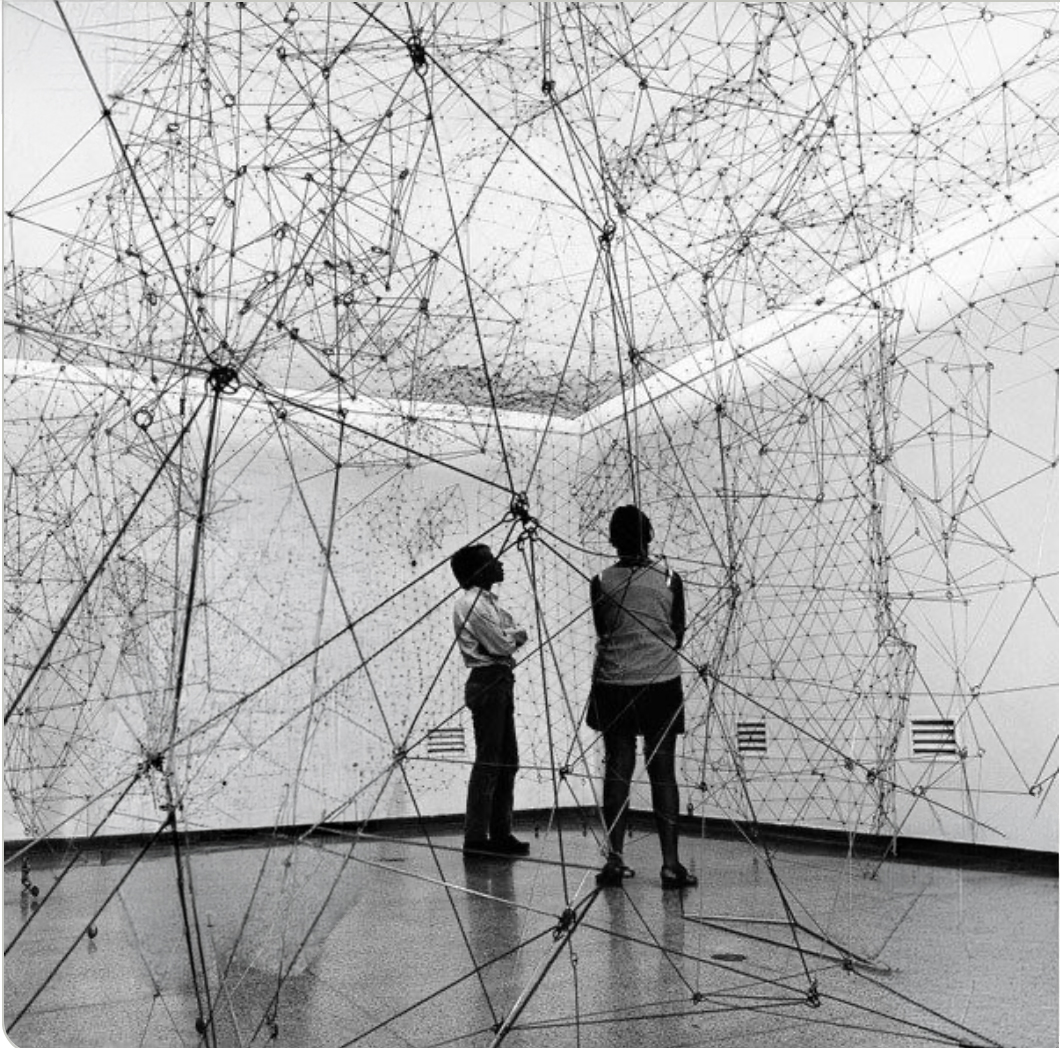
Moving from target audience to engaged learner has changed my responsibility the person on the other end. With an audience, the goal is persuasion: reach them and nudge a behaviour. With a learner, there’s no transaction waiting at the end. What I owe them instead is respect for their time, their curiosity, and an exchange of feedback that actually shapes the next steps. For me, it’s a new kind of responsive design, one of collaboration.
As a freelance graphic communications designer with media arts degree, my role has been to organize information, craft novel messages or attentional hooks with little responsibility for audience engagement. Did it land? Did anything change for the person on the other end? I don’t know. That gap, that question, is how I ended up curious about instructional design. In recent years, I’ve built learning assets for clients alongside their HR or L&D teams. Right now I’m working with an presence-based coaching business to build out a new multi-year coaching program for enterprise clients.
What I value when creating learning experiences
The liminal space. I care about the space between, whether that’s the white space of a visual composition, the pause in a speech or the act of reflection. It’s a revolt against information inundation. For a learner, this pause is where new information meets what they already know, and meaning can form. To stay in that space, the learner needs confidence to protect this time of not knowing, to trust that the uncertainty is part of the process and more valuable than filling the space with more information. Sometimes it’s where a learner finds the connection they didnt expect. If a learner feels confident, whole new ways of interpreting and understanding can open up. As an instructional designer, I’m want to facilitate from this place where the learner has the capacity to be critical of how they are learning.
How I’m beginning to understand my design identity
Conscious consumption & slowing time. Our lives are dominated by digital demands that we can’t avoid. The people I’m designing for don’t have the luxury of unscheduled, relational time. The kind where trust forms because it can be hard to prove valuable. In a context that rewards speed, designing for a pause might mean giving those relational moments structure, permission and importantly measurable outcomes. Building in time for people to talk, listen and notice each other, and treating that time as part of the learning rather than a break from it. Reflection doesn’t only happen alone; we often notice ourselves most clearly in the presence of another. This is why I’m interested in metacognition as a way to build self-confidence and self-reflection: a kind of self-presencing that carries a built-in pause from consumption.
With the MAIS program, I see a new design identity emerging, one that focuses on conversation as a medium of creation, meaning-making and proof of critical thinking. For many, GenAI is collapsing the writing skillset and I feel that metacognition and semiotics are becoming that much more important.
I’m looking forward to seeing where everyone else is starting from, and how our different contexts shape the way we think about learning.
Hi Kirsten:
Thank you for such a thought-provoking reflection! The shift you describe—from crafting persuasive hooks for a “target audience” to cultivating genuine, collaborative dialogue with an “engaged learner”—is a powerful lens for instructional design. Framing white space, pauses, and the liminal space of “not knowing” as an intentional revolt against information overload really stands out.
Your emphasis on protecting relational time and treating conversation as the actual medium of meaning-making—rather than a break from the “real” content—resonates deeply with me. I experience this dynamic firsthand when coaching clients; when we slow down and create space for authentic dialogue and mutual reflection, both the client and I walk away with new insights. As I work toward developing a structured learning program to complement my coaching practice, your idea of giving those relational moments intentional structure and permission is something I will definitely carry forward.
In a fast-paced enterprise environment where speed and measurable ROI are king, how are you approaching the challenge of making the value of that “pause” and relational reflection visible to stakeholders?