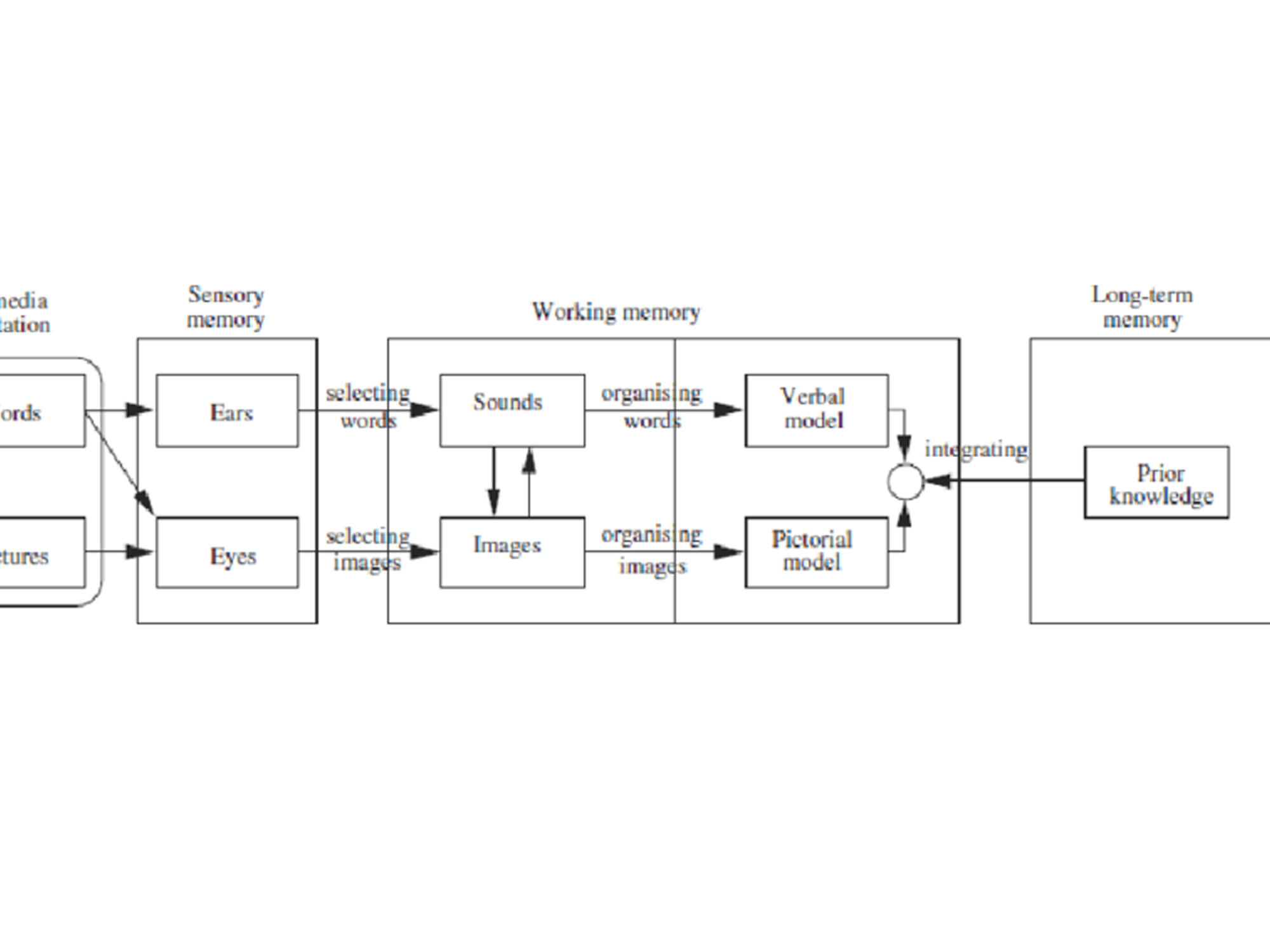
Richard Mayer is an educational psychologist at University of California, Santa Barbara (UCSB) whose work sits at the intersection of cognition, instruction and technology. He is best known for his Cognitive Theory of Multimedia Learning (CTML), in which he proposes that learners process information through two channels, verbal and visual, each with limited capacity. The theory offers 12 principles of multimedia learning designed to manage learners’ cognitive processing (Mayer, 2017). His work has generated a substantial body of research examining the application and boundaries of multimedia learning principles (Cromley & Chen, 2025).
I am keenly aware of the cognitive strain within the digital realm, brought on by technology-induced friction and the scarcity of attention in an information-rich world (Simon, 1971). Human cognitive architecture places constraints on learning, so instructional design needs to begin with the learner rather than the technology. Technology should support selection, organization and integration (Mayer, 2017).
Mayer’s work has influenced instructional design by translating cognitive science into evidence-based principles for designing multimedia instruction. It helps designers determine not simply what technology can do, but how words, images, audio, and interaction can be combined to support learning while managing cognitive processing.
As AI becomes a dominant tool for accessing a vast body of online information, it has the potential to economize the time and attention required to navigate the web. Its use in educational technology seems inevitable. Mayer speaks somewhat optimistically about AI and how, as a tutor, it might provide a lower-stress source of support, and a way to improve learning. This application of Mayer’s work is already extending into AI-based educational tools. Al Shaikh et al. (2024), for example, applied CTML in the design and evaluation of an AI educational video assistant that uses large language models. This suggests that Mayer’s work can provide a foundation not only for evaluating existing multimedia technologies, but also for designing emerging AI learning technologies around how people learn.
References
Al Shaikh, R., Al-Malki, N., & Almasre, M. (2024). The implementation of the cognitive theory of multimedia learning in the design and evaluation of an AI educational video assistant utilizing large language models. Heliyon, 10(3), e25361. https://doi.org/10.1016/j.heliyon.2024.e25361
Breede, I. (Host). (2026, April 27). Multimedia learning today (No. 15) [Audio podcast episode]. In MADE for U of T. University of Toronto, Education Technology Office. https://edtech.engineering.utoronto.ca/made-for-u-of-t-ep-15-multimedia-learning-today/
Cromley, J. G., & Chen, R. (2025). A meta-analysis of Richard Mayer’s multimedia learning research: Searching for boundary conditions of design principles across multiple media types. Educational Research Review, 49, 100730. https://doi.org/10.1016/j.edurev.2025.100730
Mayer, R. E. (2017). Using multimedia for e-learning. Journal of Computer Assisted Learning, 33(5), 403–423. https://doi.org/10.1111/jcal.12197
Simon, H. A. (1971). Designing organizations for an information-rich world. In M. Greenberger (Ed.), Computers, communications, and the public interest (pp. 38–52). Johns Hopkins Press.
AI Use Statement
I used ChatGPT as a research support tool to explore my inquiries and identify potential scholars, research, and sources for further investigation. I selected and reviewed the sources independently and used the original sources to inform my work.
Hello Kirsten
I very much agree with your comment that instructional design needs to begin with the learner. The problem I am seeing is that not all people think that way. There are a number of courses where all the learning tools are digital and not all students are tech savvy.
As much as I believe that tech is definitely assisting with learning, I feel that in too many cases the human component is being removed.
Thoughts?