
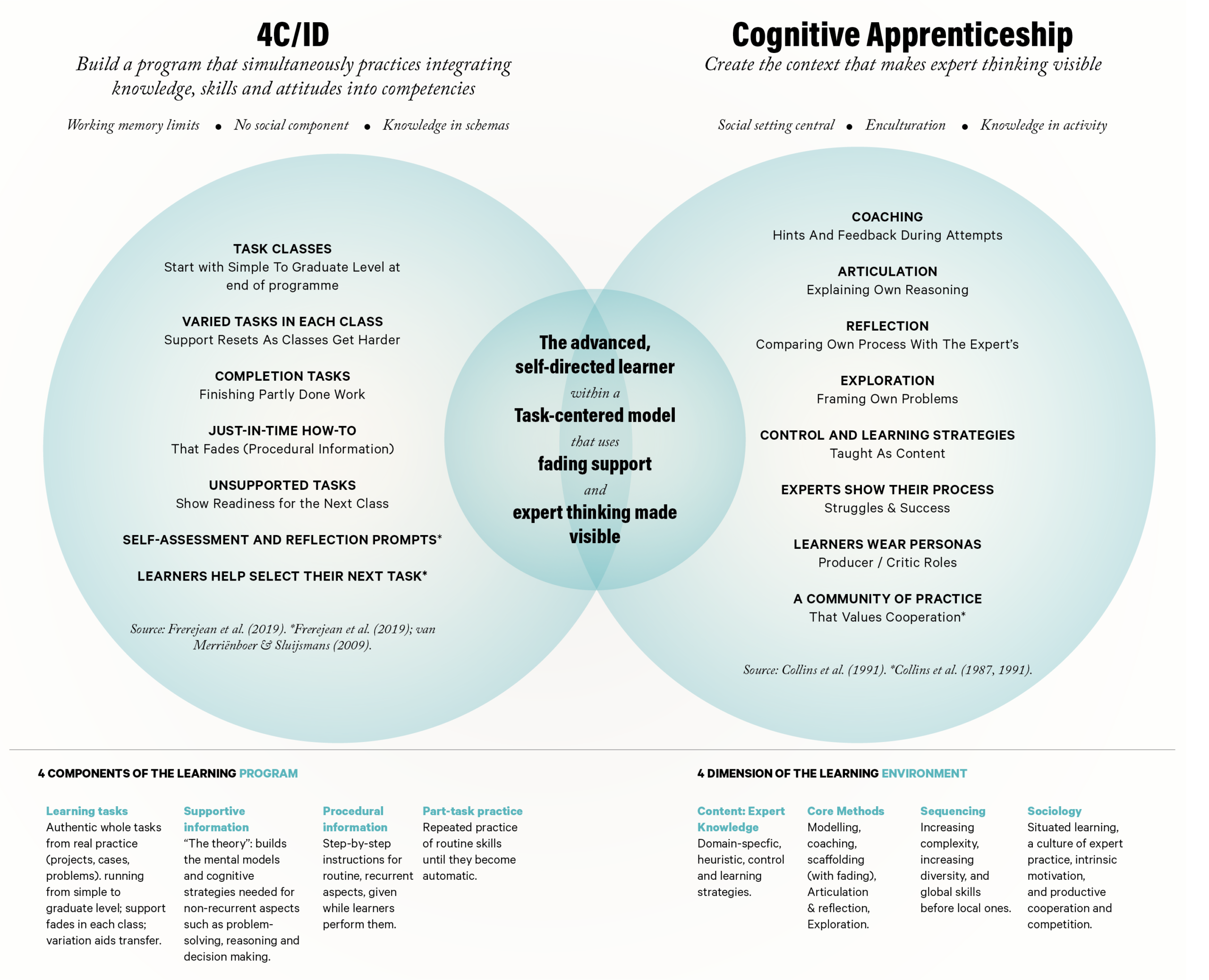
I am working with an executive coach who has developed a proprietary team-coaching methodology and plans to train internal enterprise coaches in its use. These learners must keep working while they learn, and their access to the expert is limited, yet only she can demonstrate the nuanced reasoning her framework requires. With this in mind, I discovered two task-centred models that identify self-directed strategies that account for cognitive load (van Merriënboer & Sluijsmans, 2009) while making expert thinking visible (Collins et al., 1991).
Four-Component Instructional Design (4C/ID), rooted in cognitive load theory, describes a program in four components: learning tasks, supportive information, procedural information and part-task practice (Frerejean et al., 2019, p. 515). Whole tasks are grouped by complexity, with support that fades as learners gain independence (p. 516). Van Merriënboer and Sluijsmans (2009) extended the model to self-directed learning, in which each task involves performing, self-assessing and selecting the next task.
Cognitive apprenticeship, rooted in situated cognition (Brown et al., 1989), shares this commitment to whole, authentic tasks but emphasises making expert thinking visible. Its framework spans 4 dimensions: content, methods, sequencing and sociology (Collins et al., 1987). Experts model, coach and scaffold, while articulation and reflection draw out learners’ own reasoning and this exploration builds autonomy. The model is rich in ideas about expertise and learning culture but less prescriptive about how to build a program.
The comparison showed that the models complement rather than compete. 4C/ID specifies what goes into a program (Frerejean et al., 2019, p. 515), whereas cognitive apprenticeship describes the environment in which expert thinking becomes visible (Collins et al., 1987). For my client, 4C/ID can structure a program that coaches progress through independently under realistic workloads, while cognitive apprenticeship governs how the expert’s scarce time is spent: making her thinking visible and drawing out the coaches’ own.
This pairing also eases a practical tension. Situated approaches resist firm learning outcomes (Brown et al., 1989), which can make them harder to justify to clients. 4C/ID offers a bridge, linking tasks to competencies and assessment (Frerejean et al., 2019, p. 521) so expert reasoning can develop within outcomes the client can see.
References
Brown, J. S., Collins, A., & Duguid, P. (1989). Situated cognition and the culture of learning. Educational Researcher, 18(1), 32–42. https://doi.org/10.3102/0013189X018001032
Collins, A., Brown, J. S., & Holum, A. (1991). Cognitive apprenticeship: Making thinking visible. American Educator, 15(3), 6–11, 38–46.
Collins, A., Brown, J. S., & Newman, S. E. (1987). Cognitive apprenticeship: Teaching the craft of reading, writing, and mathematics (Technical Report No. 403). University of Illinois at Urbana-Champaign, Center for the Study of Reading. https://hdl.handle.net/2142/17958
Frerejean, J., van Merriënboer, J. J. G., Kirschner, P. A., Roex, A., Aertgeerts, B., & Marcellis, M. (2019). Designing instruction for complex learning: 4C/ID in higher education. European Journal of Education, 54(4), 513–524. https://doi.org/10.1111/ejed.12363
van Merriënboer, J. J. G., & Sluijsmans, D. M. A. (2009). Toward a synthesis of cognitive load theory, four-component instructional design, and self-directed learning. Educational Psychology Review, 21(1), 55–66. https://doi.org/10.1007/s10648-008-9092-5
AI Use Declaration
I used Generative AI to help exploring and narrowing down a selection of ID models based on my interests. It helped me identify peer-reviewed and seminal sources and through discussion, helped me test my ideas. I used the tool to suggest edits as well as help with APA7 reference formatting. The visual is one I crafted in Indesign as a tool for my own use and one I will be adding to.