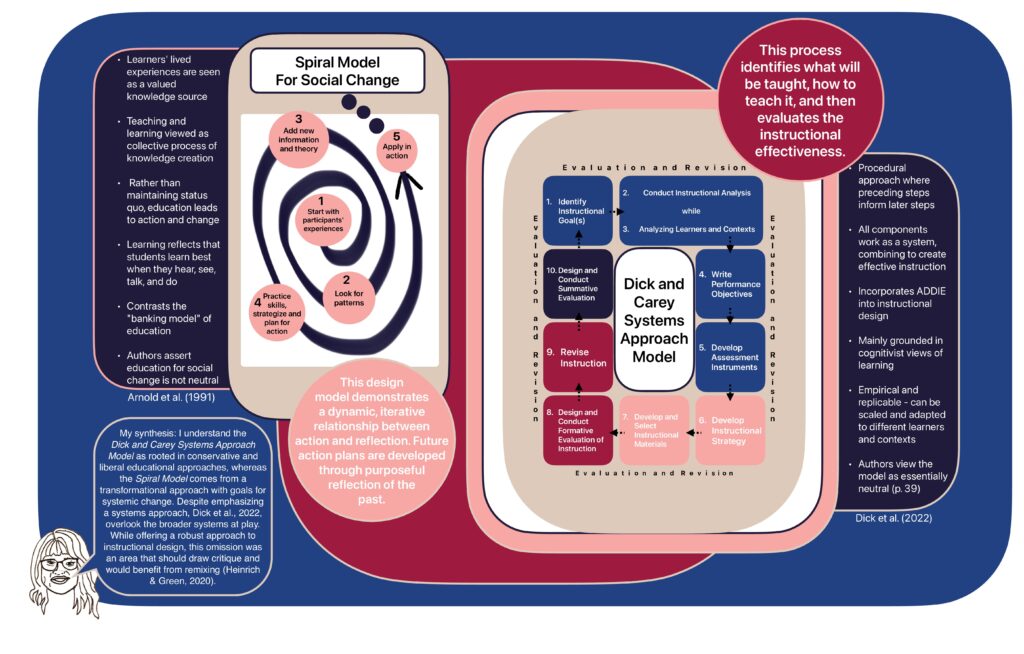
My visual artifact considers the Dick and Carey Systems Approach Model (D&C Model; Dick et al., 2022) alongside the Spiral Model (Arnold et al., 1991) because I wanted to investigate how the authors’ unique conceptual understandings of the word system led them to create rather divergent models.
Dick et al. (2022) presented a systems approach model for designing instruction incorporating interrelated individual inputs and outputs to form a coherent system. In contrast, Arnold et al. (1991) proposed a design model emphasizing a critical approach for dismantling broader systems at play in society. Arnold et al. (1991) were critical of those asserting neutrality in education, believing those failing to recognize “individuals are socially situated in an unequal world” (p. 32) were vulnerable to manipulation by those holding power. Interestingly, Dick et al. (2022) positioned their model as “essentially neutral” (p. 12) when employed by experts.
Despite the authors’ complex understanding of system intricacies, Dick et al. (2022) explicitly situate learners based on attitudes and preferences, and from their specific educational contexts. I believe this reflects the authors’ explicit cognitivist leanings and a desire to intentionally create an easily transferrable model, regardless of positionality. The systematic methodology built into the D&C Model creates opportunities for robust learning outcomes.
My critique of the D&C Model is its lack of acknowledgment of broader systems, which I infer narrows views of learners. In consideration of this limited view, I wondered about the possibilities of a remixed model building on strengths from both representations. Heinrich and Green (2020) asserted “remixing provides avenues to novel design, learning, and assessment that can connect for intersectional, reflective, and possibly, transformational learning” (conclusion section). At the very least, a more expansive view at the analyzing learners and context input level of the D&C Model might result in more desirable learning outputs of the system, and most importantly, more affirming experiences for the learner.
References:
Arnold, R., Burke, B., James, C., Martin, D., & Thomas, B. (1991). Educating for a change. Between the Lines; Doris Marshall Institute for Education and Action.
Dick, W., Carey, L., & Carey, J. O. (2022). The systematic design of instruction (9th ed.). Pearson.
Heinrich, W. F., & Green, P. M. (2020). Remixing approaches to experiential learning, design, and assessment. Journal of Experiential Education, 43(2). https://doi.org/10.1177/1053825920915608
AI Statement
I used ChatGPT to generate the reference list for this post. I then asked Claude to review the list for APA formatting. I checked each entry against the version of the source I consulted. This process showed a discrepancy between what was generated from AI versus the versions I consulted. For example, my copy did not have pagination which is why I had used (conclusion section) to describe its location. During final editing, I ran my draft through the Writer’s Diet test (www.writersdiet.com) to catch weak constructions, such as excess ad-words (adjectives and adverbs) and waste words (“this,” “that,” “it,” and “there”). My visual artifact involved no AI. I painstakingly deliberated over every detail in Freeform, from the graphic organization to the colour palette and drawings, creating every element by hand rather than generating any of it.