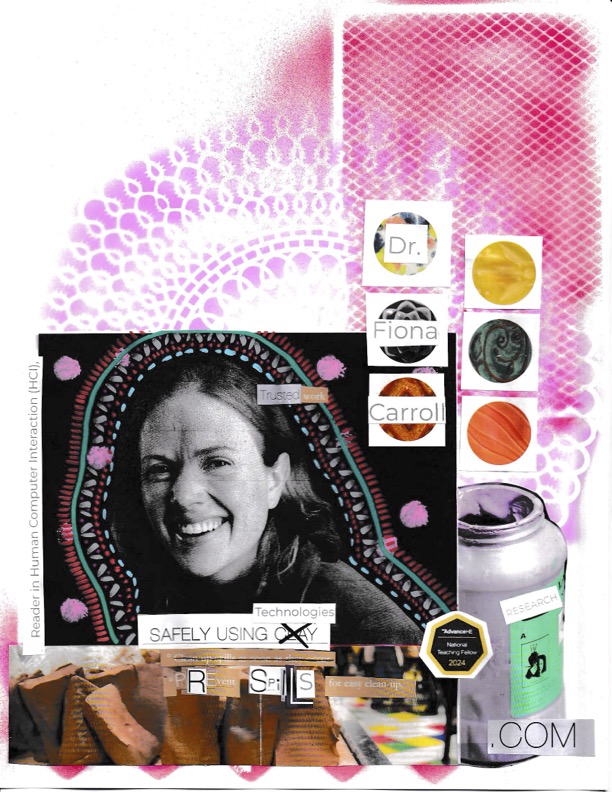
Fiona Carroll is an “accomplished academic” (Dashti et al., 2022a, p. 84) whose work in Human-Computer Interaction emphasizes relationality of humans and digital technologies. Carroll’s many interdisciplinary projects inform and converge with the field of educational technology (edtech). I was drawn to Carroll’s interplay of technology with aesthetics (Carroll et al., 2023; Carroll et al., 2022; Carroll et al., 2020), creativity (Dashti et al., 2022a), and design (Carroll et al., 2026). Initially, discovering Virtual Reality (VR) pottery in edtech (Guan et al., 2021) left me skeptical. How could it be pottery without physical access to the expressivities of clay? However, Carroll’s work expanded my perspective by appealing for technological refinements through enhanced sensory engagement, while also recognizing VR as nurturing creativity and artistic self-confidence (Dashti et al., 2022b).
For Carroll, learning is experiential (Carroll et al., 2022), embodied (Dashti et al., 2022b), and grounded in social constructivism (Weller, 2020). Within learning spaces and the community, Carroll sees inclusive access to technology as paramount to learning (Carroll & Dastjerd, 2026). Weller (2020) asserted that it is “the social responsibility of educators both in reinforcing the position of technology and in exposing students to potentially harmful environments” (Chapter 25). Rather, Carroll considers it a shared responsibility of teachers and the technology (Carroll & Dastjerd, 2026).
Perhaps this belief led Carroll to her most recent work advancing digital literacy and ethical use of tech, which I believe to be her most impactful contributions to edtech. Carroll et al. (2026) asserted, “it is not enough to ask what technologies can do for us; we must also ask what they should do for us” (p. 2, emphasis in original). Carroll pushes the possibilities in edtech, while staying true to a critical, human-centered approach (Carroll & Calderon, 2021; Carroll et al., 2026;). Much like a seasoned ceramicist, virtual or otherwise, Carroll emboldens edtech to slow down and examine for technological cracks.
Transparency Statement
Artificial Intelligence was minimally used in the creation of this assignment. Occasionally, I put an isolated query into google which now has an automatic AI suggestion. For example, “Do you capitalize chapter 25 in a parenthetical citation without a page number APA 7?” and “doi for 25 years of ed tech”. I also accepted an underlined spelling or grammar correction from Microsoft Word and on a few occasions clicked the “get citation” button on the Royal Roads Lean Library extension as a starting place for my reference list. No Generative AI was used otherwise. I referenced my hardcopy of the Publication Manual of the American Psychological Association (7th Edition) for reference guidance, utilized the RRU Writing Center, and received a final proofread from my mother-in-law. When viewing the assignment initially, I made the decision not to use AI due to the requirement of the plan and reflection, and I stuck to that plan.
References
Cardiff Met completes innovative digital skills project for young people. (2026, June 24). Cardiff Metropolitan University News. https://www.cardiffmet.ac.uk/news/2026/cardiff-met-completes-innovative-digital-skills-project-for-young-people.php
Cardiff Metropolitan University. (2021, July 6). BSc (Hons) computing with creative design at Cardiff Met – degree highlights [Video]. YouTube. https://www.youtube.com/watch?v=GdeuwCzOzb0&t=157s
Carroll, F., & Calderon, A. (2021, October 7). Instagram kids: Tech development must move from usability to safety. The Conversation. https://doi.org/10.64628/AB.w5tf4uhph
Carroll, F., & Dastjerd, S. G. (2026). Digital literacy as a modern necessity: Insights from developing an inclusive digital culture in Welsh communities. Community Development, 57(4), 618–636. https://doi.org/10.1080/15575330.2026.2661176
Carroll, F., Pigott, J., Taylor, A., Thorne, S., & Pinney, J. (2023). Creative environmental exhibition: Revealing insights through multi-sensory museum experiences and vignette analysis for enhanced audience engagement. Heritage, 7(1), 76–94. https://doi.org/10.3390/heritage7010003
Carroll, F., Slattery, D. M., Renaud, K., & Bauerly, K. E. S. (2026). Understanding people: Extensions of human–computer interaction. Design Science, 12, Article e3. https://doi.org/10.1017/dsj.2025.10047
Carroll, F., Taylor, A., & Pigott, J. (2022, May 25). How the scientific equivalent of impressionist paintings can make you feel data. The Conversation. https://doi.org/10.64628/AB.ht4stk5th
Carroll, F., Webb, M., & Cropper, S. (2020). Investigating aesthetics to afford more ‘felt’ knowledge and ‘meaningful’ navigation interface designs. In E. Banissi, F. Khosrow-Shahi, A. Ursyn, M. W. McK. Bannatyne, J. M. Pires, N. Datia, K. Nazemi, B. Kovalerchuk, J. Counsell, A. Agapiou, Z. Vrcelj, H.-W. Chau, M. Li, G. Nagy, R. Laing, R. Francese, M. Sarfraz, F. Bouali, G. Venturin, … M. S. Mabakane (Eds.), 2020 24th International Conference Information Visualisation,(pp. 214–219). Institute of Electrical and Electronics Engineers. https://doi.org/10.1109/IV51561.2020.00043
Carroll, L. (2022, July 18). DTLSN in Blaneau Gwent. [Video]. Youtube. https://www.youtube.com/watch?v=MzXdRveLkXo&t=198s
Dashti, S., Navarro-Newball, A. A., Prakash, E., Hussain, F., & Carroll, F. (2022a). Digital twin for virtual pottery. In A. Sierra Rativa, S. C. Bernal, J. M. Escobar, A. A. Burbano Lopez, A. A. Navarro-Newball, M. Postma, & M. van Zaanen (Eds.), XR academia: Research and experiences in virtual reality, augmented reality, mixed reality, and artificial intelligence in Latin America and Europe. (pp. 63–84). Open Press Tilburg University. https://doi.org/10.26116/6wmr-t534
Dashti, S., Navarro-Newball, A. A., Prakash, E., Hussain, F., & Carroll, F. (2022b). PotteryVR: virtual reality pottery. The Visual Computer. 38 (4035–4055). https://doi.org/10.1007/s00371-022-02521-2
Guan, J.-Q., Wang, L.-H., Chen, Q., Jin, K., & Hwang, G.-J. (2021). Effects of a virtual reality-based pottery making approach on junior high school students’ creativity and learning engagement. Interactive Learning Environments, 31(4), 2016–2032. https://doi.org/10.1080/10494820.2021.1