
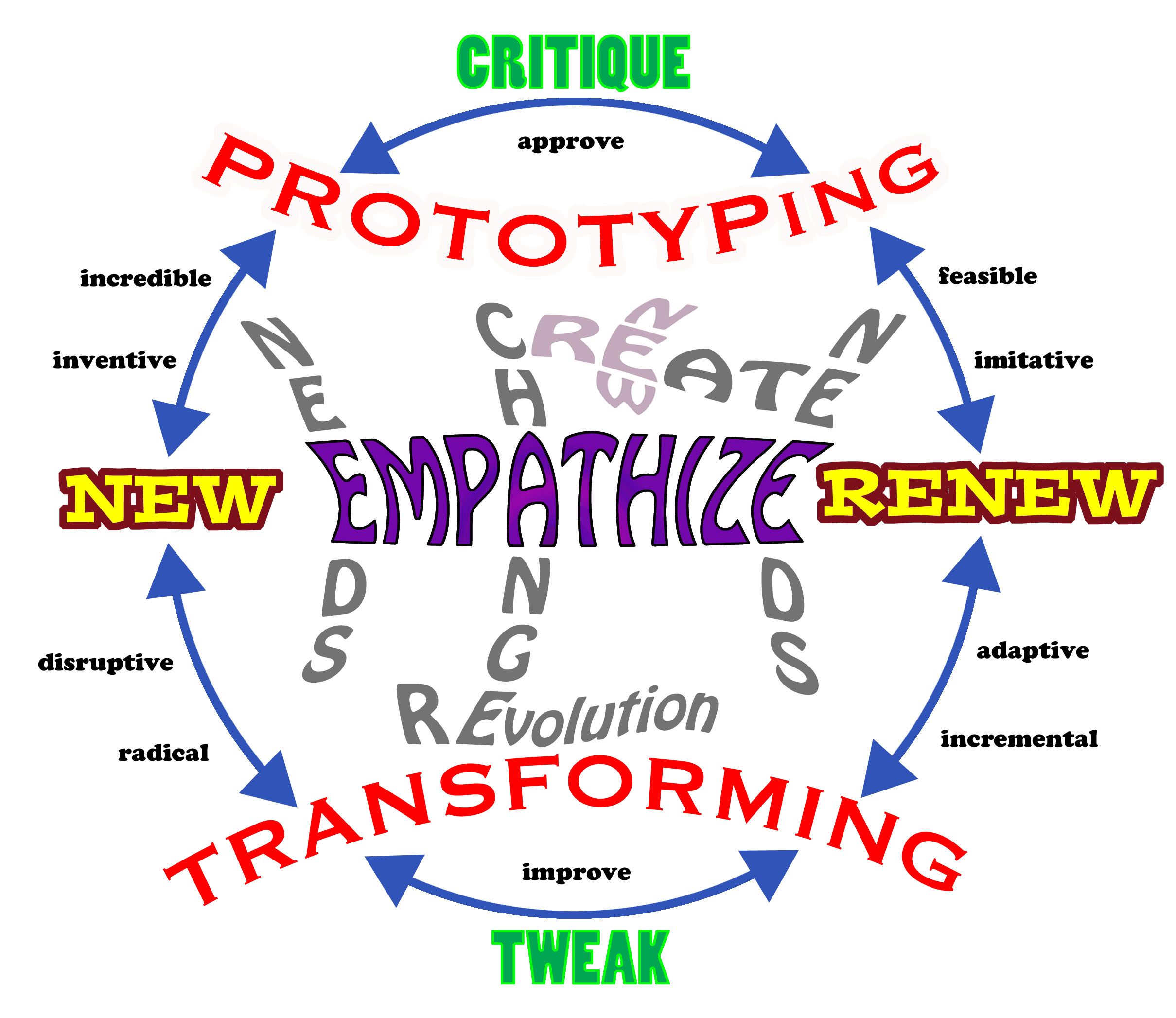
When contemplating the concept of the renew-to-new continuum within my context, I wonder if there is anything I can do in my life that is truly new. We’re all building on the knowledge and ideas and inventions that have come before us. When I think of newness and innovation in a revolutionary sort of way, I think of the iPhone or YouTube, not of me introducing a new learning management system into my workplace. That being said, I suppose the continuum can be molded to fit its appropriate environment, and there’s no need to compare my workplace to the massive progress of the entire planet. Earth-wide innovations are happening too fast and frequently for me to keep up, but I can at least do my part to accept and move with the inevitable, innovative evolution toward digital learning.
Unit 2 asks why we innovate, and we can reflect on this question framed by a poetic musing from Dron: “If we learn new ways of changing, then we can begin a rich evolutionary process where the rules of evolution themselves evolve, thus enabling more change and continuous evolution towards a peak of fitness that forever moves as we approach it” (2017, p. 261).
Goldman (2012) describes one such evolutionary process – the journey to becoming a design thinker – using the term mindshifts to signify four key approaches that are adopted on this path:
- Human-Centered: focus on empathy;
- Experimental: perspective that everything is an evolution, a prototype;
- Collaborative: radical teamwork creates transformative innovations; and
- Metacogitive: being conscious of the greater context within the design process.
For use in our context-specific design process, we were introduced to design principles, and asked to develop our own. For my assignment, I compiled a fairly straightforward list of helpful items such as “listen to users” and “simplify,” but out of the collection, one of my design principles sparkles and shines as an upgraded version of the infamous Golden Rule, and it goes a little something like this:
“Create a learning environment that I would like to learn in.”
References
Dron, J. (2014). Innovation and Change: Changing how we Change. In Zawacki-Richter, O. & T. Anderson (Eds.), Online distance education: Towards a research agenda. Athabasca, AB: AU Press.
Goldman, S., Carroll, M. P., Kabayadondo, Z., Cavagnaro, L. B., Royalty, A. W., Roth, B., & Kim, J. (2012). Assessing d.learning: Capturing the journey of becoming a design thinker. In H. Plattner, C. Meinel & L. Leifer (eds). Design thinking research: Understanding innovation. (pp. 13-33). Berlin: Springer.