The overall message for me from the week is the pervasiveness of learning. Two presentations resonated with me, and made the most sense with my current level of knowledge.
Learning Ecosystem
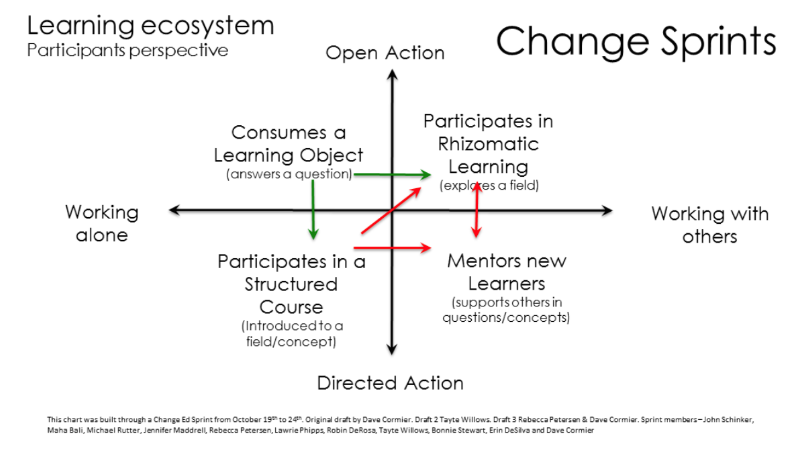
One meaningful session was the Learning ecosystem model that Dave Cormier described in his presentation, Intentional messiness of online communities. I have pasted a screen capture from his presentation:
Learning Ecosystem
In the model, the X-axis continuum runs from Working Alone to Working Together, and the Y-axis continuum runs from Open Action to Directed Action. Each quadrant offers a type of participation, with arrows identifying connections between and among the quadrants. The further you move into the right upper quadrant, the messier the learning becomes. The model applies to any sort of learning, even that inspired by television programs.
A Casual Learning Example
I enjoy watching television programs based on historical characters, such as Marco Polo, and I always research the topics surrounding the drama. Using an example of enriching my television viewing experience, my initial research fits in the upper left quadrant, where I consume a learning object, answering basic questions about the man and his history.
There is nothing to guide or control my depth of research aside from self-interest. If I enroll in a course on Middle Eastern or Far Eastern history, I become involved in directed action.
If I continue researching and learning—by interacting in online forums or study groups, or embarking on a tour of the Silk Road (at either end of the $ spectrum!)—I venture into rhizomatic learning.
In that realm I gain a deeper understanding of the field beyond my initial learning. Mentoring results from both structured and rhizomatic learning, which produces more rhizomatic learning and a larger learning community. I may engage in further learning, and expand the process to other areas, such as cartography or the invention of gunpowder.
Teaching Learning Paradigm Model
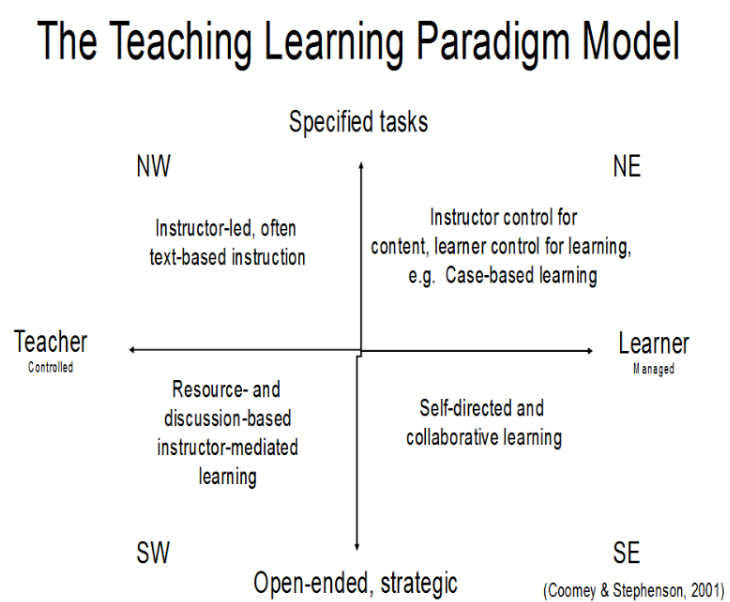
The second presentation that resonated with me was the Teaching Learning Paradigm Model presented by Roland vanOostveen in his presentation, Fully Online Learning Community Model. Here’s a screen capture of the matrix he offered:
Teaching Learning Paradigm Model
The most striking aspect of this model is how much it explains in a simple matrix. From the left of the X-axis where the teacher controls the content to the right of the X-axis where the learner manages her own learning, the type of learning and the impetus to learn are governed by the structure, ranging from specified tasks on one end of the Y-axis to open-ended, strategic tasks on the other end of the Y-axis.
An Unwitting Application of the Paradigm
If I apply the matrix to my experience, my current activities teaching design courses are solidly in the NW quadrant where students work through the course lessons. I have (unknowingly, until now!) been leading my students into the SW quadrant.
Over the past two or three years, I have had students apply what they’ve learned to their own work, which they then post online for my critique. Empirically, I find students more engaged and interested when working with their own projects.
References
Cormier, D. (2017). Learning Ecosystem Model [PowerPoint slide]. Retrieved from online symposium, Royal Roads University.
vanOostveen, R. (2017). The Teaching Learning Paradigm Model [PowerPoint slide]. Retrieved from online symposium, Royal Roads University.
Recent Comments