Unit 3:Reflections—The impact of structure on my digital plans
As a visual person, I particularly relate to diagrams, and found the Anderson and Dron typology discussion helpful. 1Dron, J., and Anderson, T. (2014). Teaching Crowds: Learning and Social Media. Athabasca University Press.
The authors offer a rule of thumb for guidance, as follows:
- If the social entity persists even if there are no participants, likely it is a group.
- If there is little consequence to knowing who is involved and the topic is the most significant aspect, it is likely to be a set.
- If identifiable people are recognized by one another, it is probably a net.2Dron, J., and Anderson, T. (2014). p. 82.
In Chapter 3: A Typology of Social Forms for Learning, the authors present a Venn diagram showing three overlapping circles representing groups, sets, and nets. 3Dron, J., and Anderson, T. (2014). Figure 3.2: Venn diagram view of the typology. p. 83
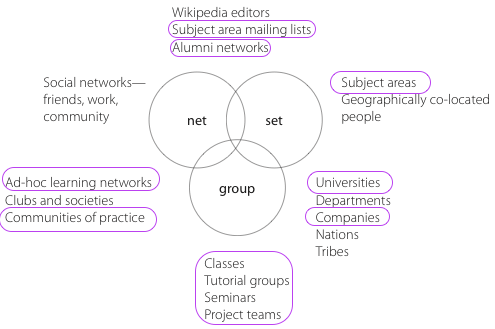
Figure 3.2 Venn diagram view of the typology
In the reproduction of the diagram, I’ve identified areas of my digital identity plan, which fit into the diagram’s concepts:
- The group realmdistinct entities with existences of their own includes groups I belong to on various social and professional sites.
- The set realmpeople bound together by commonalities or shared interests includes my authoring and user forum activities.
- The net realmidentifiable people recognized by one another is untapped territory, and shows that I don’t place much importance on social networks, nor is that a significant feature of my digital identity plan.
- Many of my activities are in overlapping areas, such as a net-group realm where I am involved with LinkedIn or similar activities, and the group-set overlapping area that includes classes and our group projects and assignments.
References
Dron, J., & Anderson, T. (2014). Chapter 3: A Typology of Social Forms for Learning. In Teaching Crowds: Learning and Social Media. doi: 10.15215/aupress/9781927356807.01
Recent Comments