So, the other night, hubby and I were in the living room partaking of our usual evening multi-tasking, both of us in our favorite locations with tablets in hand, watching CNN, periodically commenting on what we’re watching or reading. I explained that I just finished a couple of hours of reading on how to write a paragraph, and found it totally fascinating. He put down his tablet and looked at me. I waited and waited—watching him watching me—and finally he said, “I just don’t know what to say. How could that possibly be interesting to anyone?” “Hah!” sez I. I badly wanted to share what I learned, but clearly I was addressing the wrong audience.
…and that’s why I have dogs.
This is my reflection on the topic of academic writing. On the one hand—as some classmates expressed—understanding this information before attempting work in the previous course would have been helpful. On the other hand, I think the sequence of emphasis is better this way.
When we wrote the papers in the last course, it was enough to bring the APA concepts into play, let alone produce them flawlessly. I found it challenging enough to come to grips with the concept of being a student, paying attention to conveying and supporting my ideas, and so on.
Now that I’ve adjusted to the shock of being a student again, I’m ready to take some detailed writing concepts on board and build on what I natively produced in the previous course.
The first resource I found especially helpful was the Writing an Academic Paragraph presentation from the RRU Library.
Slide 7 models building an argument in three segments:
- Argument. This first sentence presents the topic for the paragraph.
- Evidence. Cited source that supports the claim.
- Analysis. How evidence supports the argument.
Further on, Slide 12 shows a full sample with a series of callouts to the components that make up the paragraph. I offer my interpretation of a paragraph structure, where the “…” indicates additional evidence/analysis pairs.
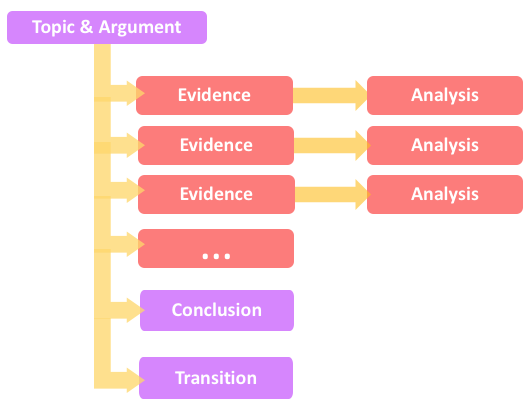
Paragraph structure
I found other ideas and concepts striking, including the structure of a paragraph, and the length and complexity of a paragraph.
The formulaic structure of a paragraph
Two video resources on our reading list were especially useful. (If you haven’t watched the videos, click each screen capture to open the corresponding YouTube video.)
Information paragraph
In this first screen capture, you see a color-coded information paragraph:
- Yellow indicates the introductory sentence, and words used to transition between concepts.
- Blue indicates the concepts introduced.
- Green indicates the citations (although there’s one instance that’s not highlighted.)
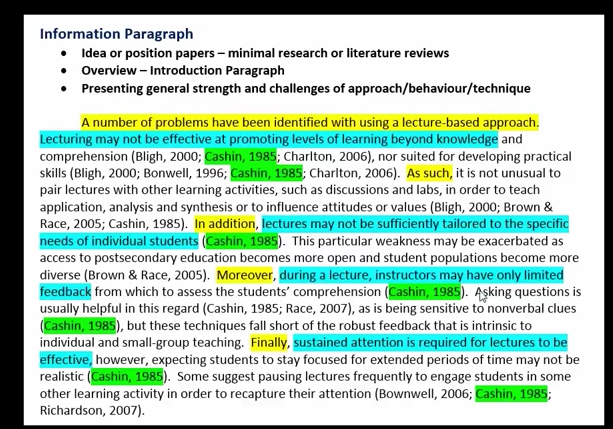
Kay, R. (2015, November 4). Academic Writing – Information Paragraph
The structure is rhythmic and follows a predictable pattern.
Research-based paragraph
The second screenshot shows a short research-focused paragraph, color-coded by citation:
- Yellow indicates the paragraph’s theme sentence.
- Each of the three references are included in the initial citation following the theme sentence.
- Each citation introduces a concept added to the paragraph.
- The order of the citations match throughout.
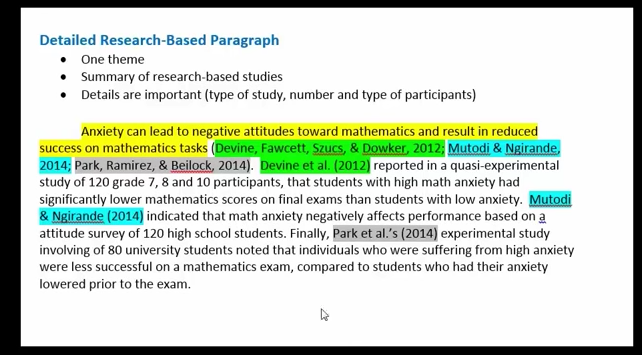
Kay, R. (2015, November 4). Academic Writing – Researching a Paragraph
It makes perfect sense! This one paragraph not only shows me how to construct the paragraph, but suggests ways in which to organize the research that produces this output.
Eureka.
The length and complexity of a paragraph
The idea that a single paragraph should be approximately one page long1Royal Roads University Writing Centre. Writing an Academic Paragraph, slide 3 transcript is mind-boggling and contrary to what I’m accustomed to writing. I’ve been writing online content for years, for blogs, websites, or student lessons. Before that I wrote a bunch of books, which had their own structural and template requirements.
A basic tenet of online writing is short, snappy sentences in short paragraphs. Heaven forbid you should expect your reader to concentrate on what they’re reading! My online course materials follow the same “short and snappy” principle. Not only are the lessons highly-structured, the contents are evaluated for reading ease and grade level2Acceptable scores for Flesch Reading Ease are >70, and Flesch-Kincaid Grade Level <7..
Here’s an example from one of my lessons:
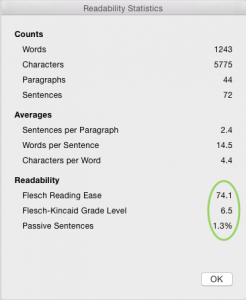
Readability Statistics (lesson)
In this random example, I’ve easily hit the readability targets. My second example scores the appendix portion of the briefing note from our last course. I used my regular type of paragraph structuring, which was appropriate as I covered multiple topics.
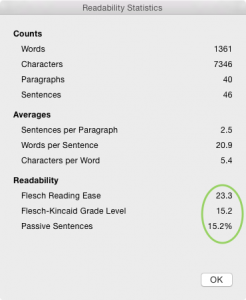
Readability Statistics (briefing note)
The Readability Statistics screenshots are captured from Word. The problem is the length of time it takes to evaluate the document first, rather than just getting the stats, as well as the limited information in the results. I discovered a great online tool, and its shortcut is already on my Bookmarks toolbar.
Readable.io
Readable.io runs a series of algorithms against pasted text and gives you a range of readability scores and text analytics. This may or may not be a useful tool for you, dear classmates, but it is perfect for me. The more I understand the structure of what I’m producing, the easier it becomes to incorporate that structure into my publication design. Here’s a screenshot of the contents of this blog post evaluated at Readable.io.
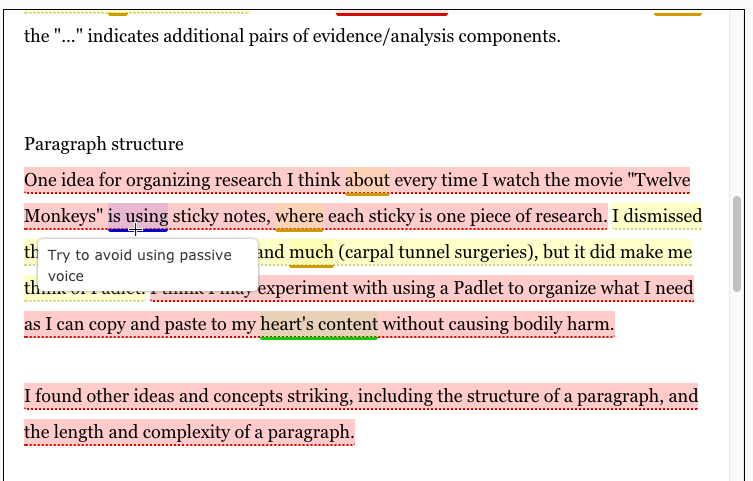
Readability output
You can hover over a highlighted segment to see the error in question. Along with the text quality highlighting, there are many scores available to consider. I don’t think it’s relevant to know that my prose sounds more male than female (although that is scored!) but it is relevant for me to quickly evaluate my writing to find ways to improve it.
In many ways, it feels like an automated copy editor, which is something I miss as a student! There are paid and free versions of the service, and I don’t see the need for subscribing to the service at this point.
References
Kay, R. (2015). Academic Writing – Information Paragraph. Retrieved from https://www.youtube.com/watch?v=6W9g5BBzgbo&index=1&list=PLrVp3Whndt16AKcSzWHp_VuP2JBrfPDWt
Kay, R. (2015). Academic Writing – Researching a Paragraph. Retrieved from https://www.youtube.com/watch?v=6W9g5BBzgbo&index=1&list=PLrVp3Whndt16AKcSzWHp_VuP2JBrfPDWt
Royal Roads University Writing Centre. Writing an Academic Paragraph. Retrieved from http://media.royalroads.ca/media/Library/writingcentre/presentations/Para_full/Para_full.html
July 3, 2017
Hi Donna,
Thanks for the great tips…especially the readability.io.
I too found the resources from RRU very informative…although to be completely honest I don’t think I’m up to your level of enthusiasm yet…I hope I get there soon.
Steve