As mentioned in my explosion of thought blog post, my immediate impression of the term “educational technology” applied to the computer era, and the facilitation of learning via electronic means. That idea was a humble impression, but with thought and focus, I realize my naiveté.
My deeper thinking launched from descriptions of technology in the classroom dating back centuries (Haran, 2015). One intriguing device was a hornbook, a wooden paddle with basic reading content such as the alphabet pasted on to the paddle, which was then covered with transparent layers of horn. This device, a testament to the ingenuity of man, was used before the advent of widespread book printing, and I’m sure the earliest example of laminated pages.
The article described another technology—the use of sandboxes—where students had a small sandbox on their desks in which they drew letters, a monitor checked their work, and then ironed the sand to continue on in the lesson.1
Hornbooks and sandboxes led me to thinking about writing on bark with ink made from crushed berries (a device I actually assembled—albeit digitally—in a game I played earlier today), which then led me to far older “technologies” employed before written words.
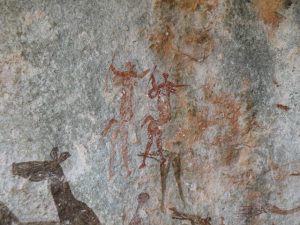
Rock art, Pixabay CC0
My current position is that the dawn of man’s ability to communicate is the dawn of educational technology, reaching as far back as cave paintings. As Marchant (2016) stated, “What sets us apart is our ability to think and plan for the future, and to remember and learn from the past—what theorists of early human cognition call ‘higher order consciousness.’”
Many cultures didn’t have written language, using spoken language and epic poems taught intergenerationally to preserve their history. By my definition, those who kept the culture’s history were the technological device, and the myths and poems were the knowledge disseminated.
For example, “Krákumál: The Death Song of Ragnar Lodbrok” 2 is a song from c. late-1100’s detailing the events leading to the death of the Scandinavian King Ragnar. The knowledge was preserved for the ages, even to this day, as it served as an educational resource in the scripting of the television series “Vikings.” 3
Higher order consciousness is the essence of education.
Footnotes
1 Of course, sandboxes still appear on many desks, now in the form of Zen gardens.
2 Read an English translation of the first 13 stanzas of the poem at http://www.odins-gift.com/pclass/ragnar.htm
3 Read about the TV program at http://www.history.ca/vikings/
References
Haran, M. (2015, May 29). A History of Education Technology. Retrieved from: http://institute-of-progressive-education-and-learning.org/a-history-of-education-technology/
Marchant, J. (2016, January). A Journey to the Oldest Cave Paintings in the World. Retrieved from: http://www.smithsonianmag.com/history/journey-oldest-cave-paintings-world-180957685/#c1u9yOFvdhQsWLJZ.99
Connolly, E. (2017). Rock art [Online image]. Retrieved September 19, 2017 from https://pixabay.com/en/rock-art-bushman-africa-ancient-2755159/
Recent Comments