https://my.visme.co/edit/1c7598084ba767d020a04ee5b9f65238#
Rationals
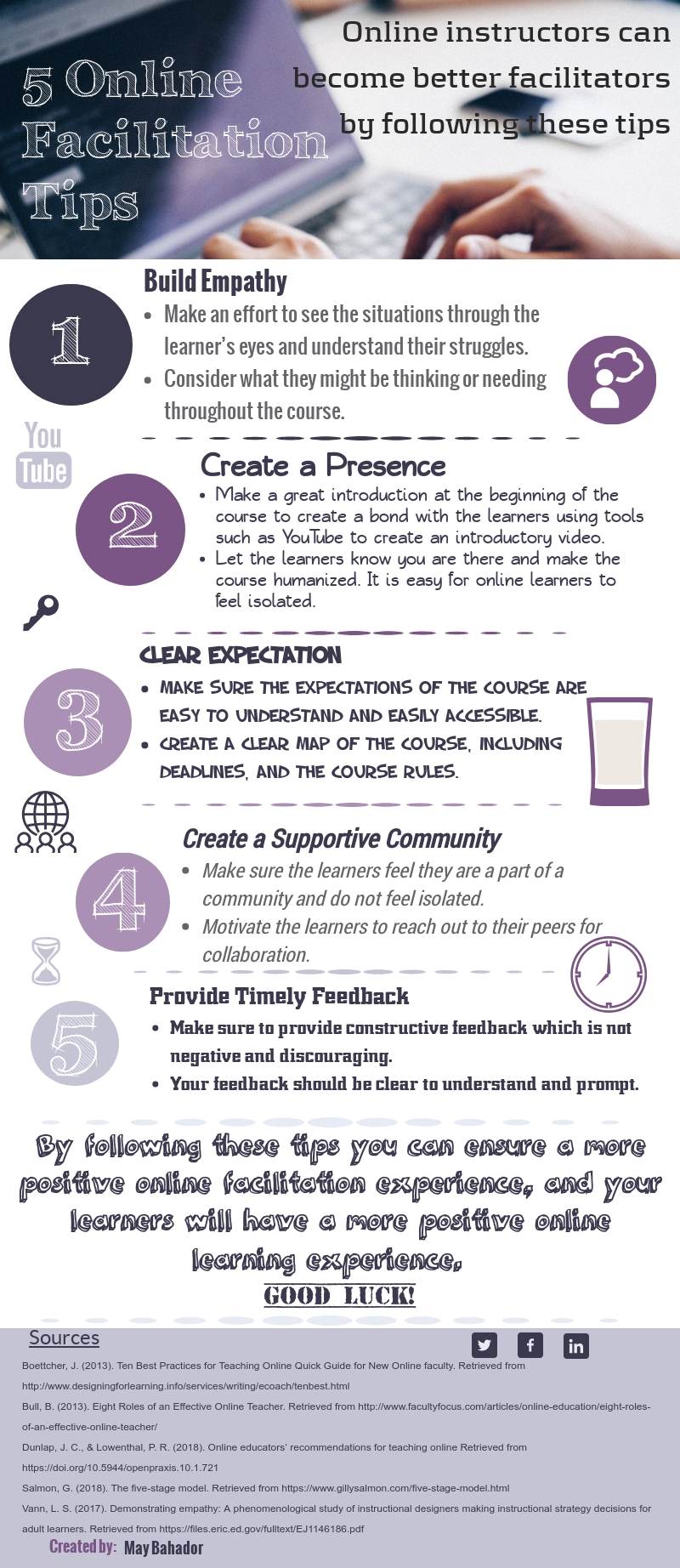
There are many tips I could list for online facilitation but I will instead narrow them down to the five most important ones based on my own experience and the reading from this course. I will be briefly explaining why I choose each tip:
The first tip is for the online facilitators to build empathy for their learners. It is easy for an online student to feel isolated and neglected since they do not have the same level of interaction as the face-to-face students. As researched by Vann (2017), the delivery of an online course can be very different from the face-to-face design and on occasion, instructors do not have the same level of empathy toward their adult learners. She also found that 87% of online students perceived a lack of compassion from their online instructors when compared to face-to-face instructors. The online facilitators should be considering how the learners feel and what could be going on in their minds (Boettcher, 2013).
The second tip is the presence of the facilitator in an online course. It is important for the online instructors to try to make a bond with the learners early on in the course so the presence of them is known to the learners (Boettcher, 2013). They can create an introductory video using tools such as YouTube. They should make the learners know they are there and make the course humanized. They should act as a social butterfly so the learners feel comfortable approaching them (Bull, 2013)
The third tip is to provide the learners with clear expectations. It is important to use simple instructions and expectations in the course so the learners can know early on what is expected of them to do and how to access those (Salmon, 2018).
The fourth tip is to create a supportive community for the learners. Facilitators should take any opportunity to make human connections with the learners from the beginning of the course so the learners can feel confident and comfortable to approach the instructors and their cohorts for support (Dunlap and Lowenthal, 2018).
The last tip is to provide feedback. It is important for the facilitator to have a positive attitude even when providing constructive feedback so the learners can stay encouraged to learn and move forward (Bull, 2013). It is also important for the feedback to be timely and specific so the learners will stay engaged and encouraged to do better (Boettcher, 2013).
References:
Boettcher, J. (2013). Ten Best Practices for Teaching Online Quick Guide for New Online faculty. Retrieved from http://www.designingforlearning.info/services/writing/ecoach/tenbest.html
Bull, B. (2013). Eight Roles of an Effective Online Teacher. Retrieved from http://www.facultyfocus.com/articles/online-education/eight-roles-of-an-effective-online-teacher/
Dunlap, J. C., & Lowenthal, P. R. (2018). Online educators’ recommendations for teaching online: Crowdsourcing in action. Open Praxis, 10(1), 79–89. Retrieved from https://doi.org/10.5944/openpraxis.10.1.721
Salmon, G. (2018). The five-stage model. Retrieved from https://www.gillysalmon.com/five-stage-model.html
Vann, L. S. (2017). Demonstrating empathy: A phenomenological study of instructional designers making instructional strategy decisions for adult learners. Retrieved from https://files.eric.ed.gov/fulltext/EJ1146186.pdf
September 19, 2018 at 7:21 pm
Hi May,
Your first tip is so obvious, but yet I did not think of it. Empathy covers a variety of the tips I suggested. Building an online community needs empathy, but so too does identifying learner needs and effective course design. An excellent first tip, and good synthesis not only of this course so far, but our MALAT experience in general. Nice one!
September 21, 2018 at 9:36 pm
Thanks Marshall! I can attest from personal experience how important empathy is for online teaching.
September 23, 2018 at 4:34 pm
Good day, May. Thanks for your infographic – and I totally agree with Marshall that your first tip is a great add that brings forward many of the ideas we’ve explored over the course. Your third tip around creating a supportive community is the one that stood out for me from this exercise. I remember reading the details that Dunlap and Lowenthal outlined in their 2018 article about creating a supportive community. The ideas around making a human connection online make so much sense to me, as they perfectly translate to success in face-to-face learning. From what I recall, you work with learners from diverse backgrounds and abilities. Do you have any proven best practices for engaging diverse learners to create a sense of community? Thanks again, May! Karen.
September 23, 2018 at 8:19 pm
Thanks for your comment, Karen!
I usually start with separating the learners into smaller groups so it won’t be overwhelming for them to open up and contribute in class, and gradually building up the sense of a community.
September 25, 2018 at 9:24 am
Hi May,
Apologies for my “test” post – I’m not sure I can delete it from your page!
I really enjoyed your infographic and feel as though I connected with your rationale greatly as I too ended up focusing more on the human side of facilitation more than anything else as well.
Much like how an experience at a doctor’s office can greatly be impacted by some bedside manner, I feel like the experience in a course (whether it be in person or online) could be greatly impacted based on the human connection led by the facilitator. Points you made around positivity and connection are so critical in how I experience learning environments and hope to take those traits on when I facilitate in the future. I will be sure to leverage your well-designed resource in the future 🙂