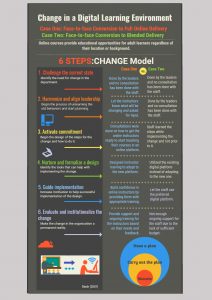
Click on the above infographic to enlarge – This infographic was created on https://venngage.com/
For this assignment, I will be focusing on the information I gathered through interviews in two different cases of change in digital learning environments. Both cases were based on a change in public education sectors but in different organizations. The infographic above compares the two cases to the six-steps of CHANGE model. The six-step CHANGE Model follows a rational progression of change to make an effective and constructive change (Beich, 2007). The first case was a transition of face-to-face courses to full online delivery, and the second case was the transition of a face-to-face course to a blended method of delivery. I observed that even though the two cases were different, they did have similarities.
Readiness to Change
Both cases did not measure the readiness of the organizations for change and just dove into it. “When organizational readiness for change is high, organizational members are more likely to initiate change, exert greater effort, exhibit greater persistence, and display more cooperative behavior. The result is more effective implementation” (Weiner, 2009, p. 1). The college in case one was better prepared for the change and had some consultation done with the staff before the change happened, however, the change was very sudden and there was not enough time to prepare. The organization in case two did not have any consultation with the staff beforehand and the organizational readiness for change was very low. This fact caused resistance and frustration among the staff.
Case One: Face-to-face Conversion to Full Online Delivery
The leadership aligned with this case was more of an adaptive leadership method. “Adaptive leaders do not just make changes, they carefully recognize potential changes in the external environment and consider the best path that will positively affect the organization” (Khan, 2017, p. 179). The leaders considered the benefits of online learning for the community and that was the reason for making the change. Even though the change was rushed, the leaders were open to discussion with the staff on designing the steps of change and getting their input as to how to effectively make the change. The design of an online course can be very different from face-to-face design and on occasion, instructors do not have the same level of understanding toward their adult learners (Vann, 2017). There was training for the instructors on how to use the platform but not enough focus on the way of teaching an online course.
Case Two: Face-to-face Conversion to Blended Delivery
The leadership aligned with this case was more of a transactional and authoritarian leadership method, where the decision was made by the leaders and it was just expected of the college to adjust to the changes. Transactional leaders are the ones in power and most of them will make the decision without considering external factors or the opinions of their followers (Khan, 2017). There was no consultation done before implementing the blended delivery courses and the staff was faced with the change, and the usage of a new digital platform without proper training or information. Regardless of a lack of training the blended delivery was implemented but this change caused much frustration among the staff. The digital platform that was originally chosen for the delivery of the courses by the leader was not adopted by many of the teachers because of a lack of training and information. If the teachers and staff were given proper training about the online platform and were shown the ways they could have benefited from using it, they would have been more accepting of the change and would have adapted to the platform. Continuous training and support would have also made the change more successful.
Conclusion
Change is never easy but with proper planning and education, it can be done smoothly. It is important to consider internal and external factors in order to have a successful change. In both cases, the new delivery method was launched, but case one adapted to the new digital platform because of the leaders’ approach in providing better communication and training. In the second case, the proposed digital platform was not adopted by many of the teachers because of the lack of consultation, training, and support.
References
Biech, E. (2007). Models for change. In Thriving through change: A leader’s practical guide to change mastery. Alexandria, VA: ASTD.
Khan, N. (2017). Adaptive or Transactional Leadership in Current Higher Education: A Brief Comparison. The International Review of Research in Open and Distributed Learning, 18(3).
O’Toole, James (2008). Notes Toward a Definition of Values-Based Leadership. The Journal of Values-Based Leadership, 1(1).
Weiner, B. J. (2009). A theory of organizational readiness for change. Implementation Science, 4(67).
Vann, L. S. (2017). Demonstrating empathy: A phenomenological study of instructional designers making instructional strategy decisions for adult learners. International Journal Of Teaching & Learning In Higher Education, 29(2), 233-244.
March 5, 2018 at 2:57 pm
So in case two the organization transitioned from face-to-face to blended on a new “digital platform” without consultation? I’m not surprised that this caused resistance and frustration among staff!