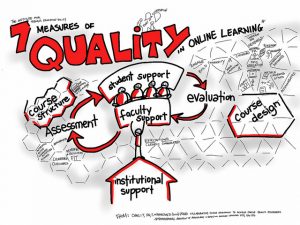
Image sourced from Flicker. (CC 0). Giulia Forsythe
Our team chose a modality of Educational Apps and the instance we selected was edX (and the edX app). As edX is essentially a hub for Universities around the world to deliver MOOCs, I decided that for my individual critical inquiry I would investigate how quality assurance is handled at edX, and by extension MOOCs in general.
MOOCs, xMOOCs, cMOOCs…
First of all, it seems almost impossible to pin down what a MOOC specifically is, it is a moving target as they are fluid and their formats and delivery are ever changing. One thing most scholars can agree on is that at it’s very basic level a MOOC is:
- Massive – Meaning it is designed to attract and educate as many people as possible.
- Open – Referring to removal of any and all academic barriers that would restrict participation.
- Online – Essentially meaning that no element of the course would require participation at a physical location.
- Course – it has a start and end date, it has a common theme or domain, and there is a progression of events related to the theme or domain (Downes, 2016).
The next issue I came upon was to determine whether edX was delivering xMOOCs or cMOOCs, two terms that I had never encountered before. Apparently a cMOOC focuses more on a connectivist learning environment as participants take on the role of both learner and teacher, it mirrors the openness of the web “because the educational content is continuously generated by the online community and shared with others in an open manner” (Admin, 2013). The xMOOC uses a different format that resembles more of a traditional classroom structure instead of an open online community. Another notable factor that distinguishes an xMOOC is that there is usually a higher education institution behind it rather than, perhaps, a group of like-minded individuals building a cMOOC (D Morrison, 2013).
After navigating through edX, from what I have seen it is definitely a hub for xMOOCs.
Are MOOCs Up To Snuff?
My initial investigating turned up little hard evidence on MOOCs and how quality assurance was being applied to them. One study I did find was on applying the Quality Matters™ (QM) standard to various MOOCs that are delivered on various platforms. It studied two MOOCs delivered by Coursera, two MOOCs delivered by edX, and two MOOCs delivered by Udacity and determined that none of the courses received the required 85% to achieve QM standard. The study did however note that some of the courses would have passed if certain standards had not been applied (Lowenthal & Hodges, 2015). This idea of not applying certain standards to MOOCs got me thinking…should a traditional quality assurance process even be applied to MOOCs. Stephen Downes suggests that the determinant for success in a MOOC should be process defined and not outcome defined as they should be platforms for discovery and experience (Creelman, Ehlers, & Ossiannilsson, 2014, p. 81). Martin Weller suggests that MOOCs should only be compared to each other rather than to traditional online courses since their development has been so recent and their delivery is not the same (p. 84). Some point to the fact that low retention rates amongst MOOCs indicate that the quality or learning must be suffering, however, Downes (2016) suggests that participants withdrawing from MOOCs are just a product of the design of MOOCs themselves, where learners slip in and out at their own learning leisure.
EdX’s Approach to MOOC Quality Assurance
Although deeper investigation is required into what EdX’s expectations are for the development and delivery of its MOOCs, I was able to find a general checklist for educators and institutions on basic expectations for MOOC development. The MOOC development checklist (EdX MOOC Development Checklist, 2018) closely resembles many standards that are in the QM rubric for online quality assurance (Higher Ed Program, n.d.). I have been QM trained and am very familiar with the expectations of courses that achieve the QM standard, and as such I am planning on contacting edX to see to what extent they utilize the QM standard.
What’s next?
I had many questions when I started to research the topic of quality assurance in MOOCs, and now that I have conducted a little research the number of questions I have has grown:
- What type of quality assurance process does edX employ, if any?
- If there is a required quality assurance process, does edX require institutions to fall in line with its processes? The institutions quality assurance processes? A combination of both?
- Should I expand my research to include other MOOC delivery platforms such as Udacity and Coursera?
- Should MOOCs even be put through a ‘traditional’ quality assurance process, or should they exist outside any traditional quality assurance process?
- Should I do a comparative study on how an institution (such as Harvard or UBC) approaches quality assurance in courses they deliver on edX as compared to how they approach quality assurance to online courses delivered internally?
- Should I apply a proven quality assurance program (such as QM) to a few edX courses and see how they fare?
- If I run these MOOC courses through QM, how do they compare against traditional online courses that have been run through QM?
These are just some of the questions, and it seems with every article I read more questions than answers come up. I plan on approaching my inquiry with a simple Know-Wonder-Learn framework that I was introduced to by my team member Bobbi. I like it’s simplistic approach that allows you to maximize your efforts on the research rather then trying to understand a confusing framework.
I welcome any comments that you have and feel free to add to my list of every growing queries.
References
Admin. (2013, August 7). What is the difference between xMOOCs and cMOOCs?. [web log]. Retrieved from http://blogs.onlineeducation.touro.edu/distinguishing-between-cmoocs-and-xmoocs/
Creelman, A., Ehlers, U-D., & Ossiannilsson, E. (2014). Perspectives on MOOC quality – An account of the EFQUEL MOOC quality project. The International Journal for Innovation and Quality in Learning. 3. 78-87.
D Morrison. (2013, April 22). The ultimate student guide to xMOOCs and cMOOCs. [web log]. Retrieved from http://moocnewsandreviews.com/ultimate-guide-to-xmoocs-and-cmoocso/
EdX MOOC Development Checklist. (2018). Retrieved from https://courses.edx.org/c4x/edX/edX101/asset/edX_MOOC_Development_Checklist-a11y.pdf
Higher Ed Program > Rubric | Quality Matters Program. (n.d.). Higher Ed Program > Rubric | Quality Matters Program. Retrieved January 30, 2014, from https://www.qualitymatters.org/rubric
Lowenthal, P. R., & Hodges, C. B. (2015). In search of quality: Using quality matters to analyze the quality of massive, open, online courses (MOOC’s). International Review of Research in Open and Distributed Learning. 16(5). 83-101.
S Downes. (2016, December 11). The quality of massive open online courses. [web log]. Retrieved from https://www.downes.ca/post/60468
You’ve captured succinctly much of the scope of the MOOC discourse that’s been going on over the past better part of a decade. Applying QM is an interesting thought, and as you note is more applicable to traditionally delivered online/distance courses than to MOOCs, which often intentionally do not supply the support mechanisms associated with traditional online/distance delivery. But there are some exceptions. The question of openness is an interesting one as it can mean both freely accessible (no cost, using readily available tools, etc.), and openly created and licensed, as seen more in the early cMOOCs. In your research you’ll find that some institutions are starting to use MOOCs for credit or advanced entry into graduate programs, using various approaches to assess students’ learning – which bases quality control mainly on the outputs. Then again, many MOOCs participants are already well educated and that puts a sociological frame on the issue of who the intended learners are and if MOOCs are really meeting the claims of democratization of education.
Hi Irwin,
Thanks for your prompt reply.
In your opinion do you think I should focus only on quality assurance for MOOC’s within edX, or expand to include all MOOC’s?
Steve, you nerd! You’ve outdone us all! This was a really helpful read about MOOCs. I’m looking at the lack of standards applied across MOOCs, as they apply to accommodation, but I found a LOT of good information here: https://www.w3.org/. This is more about the design than it is content, though…
Hi Krista.
Thanks for the reply and the resource! That site is full of great resources and I have already found some related to my individual topic.
Cheers!
P.S….thanks for the nerd comment, I’ll take it as a compliment? lol
Hi Steve, I thought I replied yesterday but I must have lost it through the Captcha process. It’s probably better to restrict your study since even within EdX you’ll find variations, particularly if the offerings are through a university which of course will have its own QA processes and just use EdX as a platform.