Category Archives: LRNT 526

Unit 3 Activity 1 – Reflection

What’s gonna work…Teamwork

In Team Awesome Sauces journey building our presentation on the ​edX101: Overview of Creating an edX Course (edX, 2018b) I realized a couple of important things.  First, collaborating as a team from several different time zones is very challenging…we had many synchronous meetings but due to time zone issues (and work, and family…) having everyone present was difficult.  In spite of that, I feel that the combination of using appear.in to virtually connect and record our sessions and using google docs to asynchronously connect and comment on each others work was very successful. Our committed team members worked tirelessly at all hours of the day it seemed in order to assist each other in our endeavor.


Presentation and Feedback

I felt our presentation went well, and that the audio and video quality was acceptable in collaborate.  What I was really impressed with was how many of our classmates came out to support us on a Friday night of the long weekend!  The discussion after the presentation to me was the most valuable part. In fact, there were a couple of comments in our team feedback that had stated that people wished we could have extended that.  Other valuable feedback was that almost unanimously our classmates appreciated the connection to a recipe for awesome sauce that provided cohesion for our presentation. Also, a couple participants stated that they had wished we could have explain more fully what edX actually was and gone deeper into our actual instance.  In retrospect, we did gloss over some finer details and incorrectly assumed that all had prior knowledge of edX. All in all, I was very pleased with both the presentation and the feedback.


Quality Assurance in MOOCs

My particular focus was on the quality assurance (QA) in this edX MOOC, and by extension MOOCs in general.  I keep thinking that there should be a magic bullet in terms of QA for MOOCs…a template for how to build a successful MOOC, but the more I look into it the more I find that just like traditional courses, each MOOC is unique and so is the composition of all the participants within that MOOC.  EdX has their own checklist (edX, 2018a), but I found it to focus more on style than substance, and when I compared this checklist and the edX101: Overview of Creating an edX Course (edX, 2018b) to a well utilized traditional online course QA such as Quality Matters (Higher Ed Program > Rubric | Quality Matters Program, n.d.), they both seemed to fall well short.  As I completed my research for this project, I started to fall into the line of thinking that the success of a MOOC should process focused, not outcomes oriented (S Downes, 2016).


MOOCs are here to stay for a while I believe, and as they are a completely different animal than a traditional online course, time will tell what makes a successful MOOC.  One thing is certain, they have provided the educational community an opportunity for discussion on what the future of education looks like.


References

edX (Producer). (2018a). MOOC Development Checklist. ​edX101: Overview of Creating an edX Course. ​[MOOC]​.​ Retrieved from https://courses.edx.org/c4x/edX/edX101/asset/edX_MOOC_Development_Checklist-a11y.pdf

edX (Producer). (2018b). ​edX101: Overview of Creating an edX Course. ​[MOOC]. Retrieved

from https://courses.edx.org/courses/course-v1:edX+edX101+1T2018/course/

Higher Ed Program > Rubric | Quality Matters Program. (n.d.). Higher Ed Program > Rubric | Quality Matters Program. Retrieved January 30, 2014, from https://www.qualitymatters.org/rubric

S Downes.  (2016, December 11).  The quality of massive open online courses.  [web log]. Retrieved from https://www.downes.ca/post/60468
 

QUALITY ASSURANCE IN MOOCS – CRITICAL INQUIRY RESEARCH LOG #2

Below is my second research log.   Much of it was focused on the team presentation and little time was spent on my individual research paper.  I am hoping that this week and next I will be able to spend some serious time on my paper.


RESEARCH LOG

4-May-2018 Team Awesome Sauce Virtual Meeting Used Nicolette’s paid subscription to Appear.in to make sure that our connection worked better than last time….
4-May-2018 Went through our selected course on edX
7-May-2018 Team Awesome Sauce Virtual Meeting
9-May-2018 Team Awesome Sauce Virtual Meeting Divided up specific roles for our presentation
 9-May-2018 Finished our selected course through edX
9-May-2018 started writing introduction for our team video and my 2 minute piece on QA
10-May-2018 Incorporated Dr. Devries feedback on my outline into my new plan Narrowed the focus greatly on my research. Focusing more on what types of QA MOOCs currently employ and whether traditional online QA can or should apply to MOOCs
12-May-2018 Team Awesome Sauce Vitual Meeting Complete draft of our individual written sections and discussed next steps
13-May-2018 Work on script Finish writing draft of my script for the video
14-May-2018 Team Awesome Sauce Virtual Meeting Touch base, evaluate progress.
15-May-2018 Team Awesome Sauce Virtual Meeting Review script drafts and provide comments for each team member
16-May-2018 Finish writing introduction and my individual piece for our team written submittal
18-May-2018 Test collaborate Meet up with Nicolette at 9:00am to go through presentation in collaborate
18-May-2018 FINAL PRESENTATION Moderate final presentation in collaborate
21-May-2018 Review feedback review all of the feedback provided by peers on our presentation
25-May-2018 Write draft for team feedback

Quality Assurance in MOOCs – Critical Inquiry Research Log #1

Here is my first entry for my reflective critical inquiry research log.

Up until this point I have found plenty of information on quality assurance on MOOCs as a whole, but only a few articles that specifically relate to edX.  I suspect that information on quality assurance from one MOOC can be transferred to another MOOC (as long as they are similar i.e. xMOOC compared to an xMOOC), but I need to find research to back this up in order to apply any research on MOOC quality assurance to edX.

RESEARCH LOG

Date Task Comments
20-Apr-2018 Published Unit 1 Activity 3 to Blog
24-Apr-2018 Review blog comments and respond Incorporated comments from Irwin and Krista into my plan for completing Assignment 1 Critical Inquiry part 4
26-Apr-2018 Team Awesome Sauce Virtual Meeting Had issues with Appear.in, then Google Hangouts. We ended up in our RRU Collaborate room. Meeting went well and we re-focused our plan of attack for the group presentation.
28-Apr-2018 Conducted 3 hours of research into topic Focused on RRU Library search and Google Scholar to find articles. Fairly successful as I was able to find 6 more articles related to quality assurance in MOOCs. I was not very successful in finding research that related specifically to quality assurance at edX however.
1-May-2018 Started back at work My year sabbatical is over. Expect that much of my work will now have to be done after hours so I will have to readjust my working schedule
2-May-2018 Started writing Assign 1 Part 4 outline Started to write the outline for Assignment 1 Part 4…I am a little unclear of the expectations. Asked Dr. DeVries for clarification via moodle discussion board
3-May-2018 Conducted 2 hours of web research Conducted 2 more hours of web research for articles. Focused more on perspectives of MOOC quality form the viewpoint of the learner and facilitator. Found 3 articles that will be helpful in writing my final paper.
4-May-2018 Published first research log to my blog

Unit 1 Activity 3- Quality Assurance in MOOC’s (Focusing on EdX)

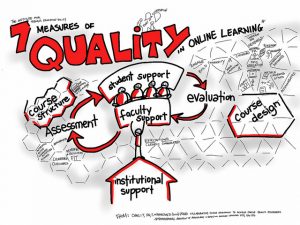
Image sourced from Flicker. (CC 0). Giulia Forsythe

Our team chose a modality of Educational Apps and the instance we selected was edX (and the edX app).  As edX is essentially a hub for Universities around the world to deliver MOOCs, I decided that for my individual critical inquiry I would investigate how quality assurance is handled at edX, and by extension MOOCs in general.

MOOCs, xMOOCs, cMOOCs…

First of all, it seems almost impossible to pin down what a MOOC specifically is, it is a moving target as they are fluid and their formats and delivery are ever changing.  One thing most scholars can agree on is that at it’s very basic level a MOOC is:

  • Massive – Meaning it is designed to attract and educate as many people as possible.
  • Open – Referring to removal of any and all academic barriers that would restrict participation.
  • Online – Essentially meaning that no element of the course would require participation at a physical location.
  • Course – it has a start and end date, it has a common theme or domain, and there is a progression of events related to the theme or domain  (Downes, 2016).

The next issue I came upon was to determine whether edX was delivering xMOOCs or cMOOCs, two terms that I had never encountered before.  Apparently a cMOOC focuses more on a connectivist learning environment as participants take on the role of both learner and teacher, it mirrors the openness of the web “because the educational content is continuously generated by the online community and shared with others in an open manner” (Admin, 2013).  The xMOOC uses a different format that resembles more of a traditional classroom structure instead of an open online community. Another notable factor that distinguishes an xMOOC is that there is usually a higher education institution behind it rather than, perhaps, a group of like-minded individuals building a cMOOC (D Morrison, 2013).

After navigating through edX, from what I have seen it is definitely a hub for xMOOCs.

Are MOOCs Up To Snuff?

My initial investigating turned up little  hard evidence on MOOCs and how quality assurance was being applied to them.  One study I did find was on applying the Quality Matters™ (QM) standard to various MOOCs that are delivered on various platforms. It studied two MOOCs delivered by Coursera, two MOOCs delivered by edX, and two MOOCs delivered by Udacity and determined that none of the courses received the required 85% to achieve QM standard.  The study did however note that some of the courses would have passed if certain standards had not been applied (Lowenthal & Hodges, 2015).  This idea of not applying certain standards to MOOCs got me thinking…should a traditional quality assurance process even be applied to MOOCs. Stephen Downes suggests that the determinant for success in a MOOC should be process defined and not outcome defined as they should be platforms for discovery and experience (Creelman, Ehlers, & Ossiannilsson, 2014, p. 81).  Martin Weller suggests that MOOCs should only be compared to each other rather than to traditional online courses since their development has been so recent  and their delivery is not the same (p. 84).  Some point to the fact that low retention rates amongst MOOCs indicate that the quality or learning must be suffering, however, Downes (2016) suggests that participants withdrawing from MOOCs are just a product of the design of MOOCs themselves, where learners slip in and out at their own learning leisure.

EdX’s Approach to MOOC Quality Assurance

Although deeper investigation is required into what EdX’s expectations are for the development and delivery of its MOOCs, I was able to find a general checklist for educators and institutions on basic expectations for MOOC development.  The MOOC development checklist (EdX MOOC Development Checklist, 2018) closely resembles many standards that are in the QM rubric for online quality assurance (Higher Ed Program, n.d.).  I have been QM trained and am very familiar with the expectations of courses that achieve the QM standard, and as such I am planning on contacting edX to see to what extent they utilize the QM standard.

What’s next?

I had many questions when I started to research the topic of quality assurance in MOOCs, and now that I have conducted a little research the number of questions I have has grown:

  • What type of quality assurance process does edX employ, if any?
  • If there is a required quality assurance process, does edX require institutions to fall in line with its processes?  The institutions quality assurance processes? A combination of both?
  • Should I expand my research to include other MOOC delivery platforms such as Udacity and Coursera?
  • Should MOOCs even be put through a ‘traditional’ quality assurance process, or should they exist outside any traditional quality assurance process?
  • Should I do a comparative study on how an institution (such as Harvard or UBC) approaches quality assurance in courses they deliver on edX as compared to how they approach quality assurance to online courses delivered internally?
  • Should I apply a proven quality assurance program (such as QM) to a few edX courses and see how they fare?
  • If I run these MOOC courses through QM, how do they compare against traditional online courses that have been run through QM?

These are just some of the questions, and it seems with every article I read more questions than answers come up.  I plan on approaching my inquiry with a simple Know-Wonder-Learn framework that I was introduced to by my team member Bobbi.  I like it’s simplistic approach that allows you to maximize your efforts on the research rather then trying to understand a confusing framework.

I welcome any comments that you have and feel free to add to my list of every growing queries.


References


Admin.  (2013, August 7).  What is the difference between xMOOCs and cMOOCs?.  [web log]. Retrieved from http://blogs.onlineeducation.touro.edu/distinguishing-between-cmoocs-and-xmoocs/

Creelman, A., Ehlers, U-D., & Ossiannilsson, E.  (2014). Perspectives on MOOC quality – An account of the EFQUEL MOOC quality project.  The International Journal for Innovation and Quality in Learning.  3. 78-87.

D Morrison.  (2013, April 22).  The ultimate student guide to xMOOCs and cMOOCs.  [web log]. Retrieved from http://moocnewsandreviews.com/ultimate-guide-to-xmoocs-and-cmoocso/

EdX MOOC Development Checklist. (2018). Retrieved from https://courses.edx.org/c4x/edX/edX101/asset/edX_MOOC_Development_Checklist-a11y.pdf

Higher Ed Program > Rubric | Quality Matters Program. (n.d.). Higher Ed Program > Rubric | Quality Matters Program. Retrieved January 30, 2014, from https://www.qualitymatters.org/rubric

Lowenthal, P. R., & Hodges, C. B.  (2015). In search of quality: Using quality matters to analyze the quality of massive, open, online courses (MOOC’s).  International Review of Research in Open and Distributed Learning.  16(5).  83-101.

S Downes.  (2016, December 11).  The quality of massive open online courses.  [web log]. Retrieved from https://www.downes.ca/post/60468

Exploring Modalities: A Reflection by Team Awesome Sauce

Team Awesome Sauce are: Bobbi Donnison,  Krista Frate, Marshall Hartlen, Steve Minten, and Nicolette Young

After much discussion and mind changing, Team Awesome Sauce has decided to explore EdX, both as a massive open online course (MOOC), and as an educational app for Android or IOS. We will outline the beginning of our journey by using a classic k-12 learning modality: the know, wonder, learn (KWL) chart. A KWL chart is a way to guide inquiry. It assesses what you already know, (in this case our collective knowledge of learning modalities) what we wonder/want to know about our topic, and finally what we hope to learn in pursuing the inquiry further. For the purposes of this post, we applied this inquiry organizing strategy to three guiding questions:

  1. What type of modality did we choose?
  2. What question(s) would you like to pursue as you examine or experience the modality?
  3. What background reading did you do to learn more about the modality? (Blogs, websites, library journal articles). Write a summary of what you learned.

In each instance a degree of expansion and explanation is included, which, it is hoped will help keep all of us on track as we individually and collectively delve deeper into specific issues and aspects of our modality, and the instance of EdX in particular.

What we KNOW about this modality/instance: What type of modality did you choose?

EdX exists in the realm of MOOCs and is viewed by some as more exclusive than competing platforms due in part to the fact that the courses on offer are not necessarily free. It is also driven by prestigious US universities such as Harvard and MIT lending it a certain degree of prestige and legitimacy as well. Similar to other MOOCs, EdX offers the opportunity to upskill for employment, and offers a wide range of eclectic courses ranging from Civil War History, to R Programming basics. MOOCs are a relatively recent platform for learning and EdX is younger still, only coming online in 2012. Considering this relatively short time frame the range and quantity of courses they offer is impressive, as are the academic levels available ranging from self paced tutorials on specific software applications, to micro-masters courses (the latter of which we will revisit in the wonder section). We ultimately chose this modality as it afforded further inquiry more readily across all of our diverse personal contexts, and was also supported by a mobile applications, which extends further, the opportunity for inquiry.

What We Wonder: What question(s) would we like to pursue as we examine or experience the modality?

In the shared economy, traditional means of monetizing are disappearing in favour of pay per use subscription style services (e.g. Air BNB, Uber, Adobe Creative Cloud, Office 365). These services bypass the traditional economy in the same way that MOOCs bypass traditional education, but how can such an enterprise be economically sustainable? EdX is backed by traditional universities, but the cost is a minute fraction of what is available at the parent universities. If such platforms continue to gain traction, will they make the brick and mortar universities redundant? In wondering about this, we also question the legitimacy and quality of education received through such instances. Who will actually recognise an EdX degree, and given the flexible pace and restricted access to university research databases, how can the quality of inquiry possibly compare to similar offerings in more traditional educational settings?

An obvious advantage to learning in this manner is accessibility. EdX courses are available 24-7, restricted only by internet connectivity, but what other benefits are there to this modality? Cost is an obvious one, but again the question of quality persists, and what challenges do these observations present? From a pedagogical standpoint, we are curious to understand what constitutes best practice for course design and delivery? Current best practice traditional classroom teaching incorporates a variety of formative exercises to aid skill development and content knowledge, how does learning through a MOOC account for this and how does it engage the learner?

The opportunity to cater to individual learners seems vast, and we hypothesise that such modalities offer a decent coverage of content knowledge, but how effective are MOOCs at developing the soft skills of human interaction and collaboration, which are increasingly vital in the 21st century economy?

Finally, we wonder who this modality is targeting, and what uses are not currently being utilized, but that may be available in similar applications? If functionality is omitted, what is the rationale, and how does it make for a better learning experience. And perhaps most important of all, if qualifications become recognised as providing credit, how can EdX be assured the student is the student?

What we Learned (so far): What background reading did you do to learn more about the modality? (Blogs, websites, library journal articles).

We explored the basic history of MOOCs and educational applications in general, and then browsed articles pertaining to EdX in particular, including the site itself.

“Today’s online learners require flexibility, and mobile devices are a solution to remove the barrier of a fixed time, place, and mode of learning. Tailoring online education to meet the needs of those who wish to learn “anywhere, anytime,” however, will be an ongoing challenge” (Hutchinson, Tin, & Cao, 2008). MOOCs, on the surface, appear ready to meet this challenge, but the question of feasibility may lie outside of their realm of control. Ultimately for such learning modalities to become truly advantageous, they need to be accepted by the 21st century economy. It seems that some progress is being made in this regard, as some employers who struggle to find candidates with the necessary skill set to be an effective employee, are turning to individuals who have completed coursework, through MOOCs like EdX (Carapezza, 2017). With viability and legitimacy seemingly underway, MOOCs seem like at the very least a supplemental source of learning/upskilling. Team Awesome Sauce plans to continue learning first hand the true value of MOOCs, EdX in particular as we audit various courses currently offered.


References

Carapezza, K. (2017, February 15) These Top Schools Are Offering Big Savings On Master’s Degrees, But There’s A Catch. NPR Ed. Retrieved from https://www.npr.org/sections/ed/2017/02/15/504478472/how-to-get-20-000-off-the-price-of-a-masters-degree

Hutchison, M., Tin, T. & Cao, Y. (2008). Chapter 8: “In-Your-Pocket” and “On-the-Fly:” Meeting the Needs of Today’s New Generation of Online Learners with Mobile Learning Technology. In T. Anderson (Ed.), The theory and practice of online learning (2nd ed., pp. 201-219). Edmonton, AB: AU Press.