Behaviorism, Cognitivism, and Constructivism Explained…finally…kinda…

Source: Flickr.com CC BY-SA 2.0

After completing Ertmer and Newby’s (2013) reading on behaviorism, cognitivism, and constructivism two things became more apparent to me:

  1. How one shouldn’t marry themselves to a particular learning theory as different theories of learning should be applied in various situations
  2. How the hell haven’t I wrapped my head around these theories!…We are 8 months into the program!

Let’s focus on point #1 first…

Although as we move through this program I find myself leaning towards a constructivist way of teaching and learning, this reading solidified my beliefs that one needs to be adaptable depending on the context, environment, and stage of learning that the student is in.  The authors note that we should recognize stages of knowledge (they draw our attention to Jonassen’s three stages of knowledge acquisition: introductory, advanced, and expert) when we are designing learning and base our design on these.  A focus on a behaviorist and cognitivist would be more appropriate for introductory knowledge, and as the learner moves on the continuum towards expert knowledge acquisition a focus on constructivist approaches may be more appropriate.   This thought had been in the back of my mind for a while as some of the content I teach is very introductory and a stimulus-response approach seems very applicable and effective.  However, as the content moves towards more mastery of skill my approach becomes much more based on immersing my students in real-world experiences.  The authors note that using an apprenticeship approach (which I do in our carpentry class) aligns with constructivist theory well.

Now point #2…

This may sound strange but I feel a little lost, although I’m not?  Just when I think I have a handle on theories and such, I read another article that slips me up a bit.   This reading did help clarify the differences between behaviorism, cognitivism, and constructivism, but it opened a new can of worms and got me thinking that I should be reviewing all learning theories(not just these three) as I design my classes.  Considering each one would be way too time-consuming as I can barely keep ahead just thinking about one learning theory.

I am open to any suggestions of a solution that would help save time in this?


Resources

Ertmer, P., & Newby, T. (2013 Online). Behaviorism, Cognitivism, Constructivism: Comparing critical features from an instructional design perspective. Performance Improvement Quarterly, 26(2), 43-71.

Unit 2 Activity 3 – Understanding Design Principles

CC0 – Pixabay

My Case

At the college I work we have been moving very quickly it seems in our adoption of mobile technologies.  Administration from the outset basically said ‘this was happening, so hopefully you will get on board or be left behind’.  While I personally see advantages to teaching and learning with tech (increased engagement, opportunity to create richer learning environments), many felt that it was forced upon us.  I believe that as a result of this there is pushback from faculty and resistance to adopting more new technology as it continues to evolve.  

Every new technology advancement presents an opportunity to engage our learners, however we need a mechanism to also engage our faculty in becoming leaders in the field of ed tech.

My Design Principles

Below is my list of proposed design principles that I feel are key to creating a consistent experience for the project team and end users (not listed in order of importance, they are intended to all work together).

  • Make it adaptable– Ensure that all elements of the design allow for changes in technology and pedagogy that will inevitably arrive in the future.
    • Innovation- incorporating adaptability will allow future iterations of a selected project to be improved upon
    • Impact on learning- technology is constantly changing, as are the skills required in the workforce, being adaptable will improve future learning opportunities
    • Reliance on technology- making sure things are adaptable will assist any future technological changes that are sure to occur
    • Usability- Adaptability will allow incremental changes to be easily incorporated into the project
    • Risk- Adaptability will ensure that financial and time investments will not be wasted as needs evolve
    • The value proposition of innovation in design- Investment in adaptability will ensure future costs are kept to a minimum as small changes will only be necessary, not complete redesign
  • Ensure authenticity– Making the project authentic for the end user is paramount.  The product should mimic real-life situations as closely as possible.
    • Innovation- Real-world scenarios could potentially be brought into the workforce and spur innovation
    • Impact on learning- Learning as close to real-life as possible will better prepare users and allow them to experience things they will encounter in the workforce
    • Reliance on technology- Using authentic technology will better prepare users
    • Usability- Making sure things are authentic in the design will not necessarily make things easier to use, but it will prepare users for what to expect
    • Risk- An authentic experience will prepare users for a real workplace experience and could save time and money in the future
    • The value proposition of innovation in design- Authentic design that replicates real-world scenarios will improve workforce performance.
  • Involve all stakeholders– Having all of the stakeholders involved at key stages will ensure that the end product will suit everyone’s needs (For example, in online course design involve faculty, students, IT, ID’s, administration…).  A caution for this is to make sure there is a clear leader in the process who will make final decisions as too many voices and opinions could slow down the process if not facilitated properly.
    • Innovation- By having all voices heard, a more complete, well rounded and progressive product will be developed
    • Impact on learning- Involving many knowledgeable individuals will build a better product and therefore enhance the learning experience
    • Reliance on technology- Shared experience from the team will inform technological decisions
    • Usability- More people involved in the process will allow for more diversity in technological proficiency and will help in designing a product that is user-friendly
    • Risk- Having a well-rounded team will lessen the potential for future redesigns of the product
    • The value proposition of innovation in design- All individuals invested in the project should be happy with the end product as they all had a hand in its design
  • Ensure that there is a constant, feedback loop– By making sure that edits and suggestions are being made and incorporated on an ongoing basis, there will be a steady workflow to the project.
    • Innovation- By keeping the feedback constant and up to date, improvements can be made quickly and efficiently
    • Impact on learning- Deadlines can be met more constantly and all feedback will be incorporated on time creating a superior product
    • Reliance on technology- By using elements of collaborative software in the design to improve efficiency the project will move at a more consistent pace
    • Usability- Any improvements to ease of use of the project will be incorporated quickly
    • Risk- Accelerations in schedule and project development can be realized through incorporating feedback efficiently
    • The value proposition of innovation in design- Faster integration of feedback, suggestions, ideas will not only lead to a better product, but time can be removed from the project development schedule
  • Check your sensitivity at the door– While ensuring that the feedback one provides to fellow team members is sensitive, be honest and direct with giving feedback.  When receiving feedback do not take things personally as varied opinions will lead to a better product (be hard on the issue, not the individual).
    • Innovation- Being honest and not holding back opinions on the product more opportunity for progressive change can happen
    • Impact on learning- A better product will be developed when all ideas are brought to the table, this will in turn improve the learning experience
    • Reliance on technology- If team members express their abilities in regards to technology in an honest and forthright manner, gaps can be identified and dealt with at the outset of the project
    • Usability- Direct and honest feedback to the team when one questions the ease of use of the end product will benefit the user’s experience
    • Risk- Resolving differences of opinion and incorporating ideas in a timely manner rather than stressing about them will save time and money
    • The value proposition of innovation in design- An understanding at the outset that any constructive feedback will be handled in a professional manner will improve the efficiency and effectiveness of the team
  • Always keep the end user in mind– At every point of development in the project make sure that things are being looked at from the perspective of the end user (if possible incorporate the end user into the design team).
    • Innovation- By designing the product from the perspective of the end user the potential for creating an improved experience is greater
    • Impact on learning- Focusing on the end user will enhance and simplify the learning experience
    • Reliance on technology- Knowing the environment in which the end user operates will lead to an appropriate technological design
    • Usability- Keeping the end user in mind will ensure that the product is consistent with their abilities
    • Risk- A product that is appropriate for the end user and that they are happy with will not require as much redesign
    • The value proposition of innovation in design- Keeping the end users needs in mind during design will ensure a better suited product and a better user experience
  • Bring solutions to the table, not problems. – In my opinion, it cannot be understated how important this is to a successful team project
    • Innovation- By asking the team to bring solutions to the table, more ideas will be brought forward and spur on more innovation
    • Impact on learning- More variety of solutions will lead to a better product and learning experience for the user
    • Reliance on technology- Any technical issues can be resolved quickly as solutions to tech problems will be researched by all team members
    • Usability- Issues with ease of use will be brought forward alongside solutions to these issues.  Items can be proactively dealt with
    • Risk- Time and money will be saved as solutions to problems will not lag and affect the project schedule
    • The value proposition of innovation in design- By having all team members in the mindset of bringing solutions to the table, an environment of creativity will be created and fostered
  • Prototype the product- Once initial design is complete, take it for a test run.
    • Innovation- Discrepancies can be identified early and changes can be made before the product is officially ‘launched’
    • Impact on learning- Improving the product before it is launched will lower rates of frustration when things don’t flow properly
    • Reliance on technology- Flaws in technological design can be fixed before utilization
    • Usability- By performing a test run of the product, issues with user interface and ease of use can be identified early on
    • Risk- Although initially this may increase cost and development time slightly, this will serve a long-term benefit of not having to redesign early and have a better product initially produced
    • The value proposition of innovation in design- This important final step in the design will allow the team to remove any technical ‘bugs’ and also allow for a fresh perspective from someone outside the team (preferably an end user).


References

Hess, W.  (2013, July 10).  20 Guiding principles for experience design.  Retrieved from http://www.designprinciplesftw.com/collections/20-guiding-principles-for-experience-design

Monash University. (2017). How to write the case study.  Retrieved from http://www.monash.edu.au/lls/llonline/quickrefs/27-case-study.pdf


Unit 2, Activity 2 – New or renewed learning practices

CC0-Pixabay.com

LP#1-Faculty Leaders in Ed Tech Adoption

At the college I work we have been moving very quickly it seems in our adoption of mobile technologies.  Administration from the outset basically said this is happening so hopefully you will get on board or be left behind.  While I personally see advantages to teaching and learning with tech (increased engagement, opportunity to create richer learning environments), many felt that it was forced upon us.  I believe that as a result of this there is pushback from faculty and resistance to adopting more new technology as it continues to evolve.  

Every new technology advancement presents an opportunity to engage our learners, however, we need a mechanism to also engage our faculty in becoming leaders in the field of ed tech.

LP#2-Ensuring Quality Online Course Design

Advancements in technology have enabled online learning to become a legitimate alternative in almost any field of study.  Our college has invested in online course development via software (Articulate), hardware (VR/AR), and staff (ID’s, developers).  We have discovered that while all of these investments are important in online course design, having the subject matter expert (often the faculty) trained in what makes a course successful is just as essential.  Content knowledge in their field is not enough to make sure that a course is designed properly.  

Training all of our faculty externally in online course design is an expensive proposition and not likely feasible.  Developing an in-house online training program that can be easily accessible for those who are involved in online course design.

Conclusion

After reflecting on both of the above issues, I believe that investigating faculty leaders in tech adoption will in the end yield more applicable results.  While the online course design is also an important issue within our college, focusing on having faculty leaders in ed tech may result in a solution that solves both issues.

Resources

Dron, J. (2014). Innovation and Change: Changing how we Change. In Zawacki-Richter, O. & T. Anderson (Eds.), Online distance education: Towards a research agenda. Athabasca, AB: AU Press.


Innovation, Renewal, and Change

Image  Courtesy of Wesley Fryer (CC BY-SA 2.0 CA)

Labels, Labels, Labels…

As educational technology has advanced, so has our understanding and expectations of how it can (and should) be applied to online (distance) learning.  The pedagogy that has been applied to distance learning has evolved as well.  Early generations (single-mode, such as radio or print) of of distance learning used a cognitivist/behaviourist approach focused on how each individual learns; second generation (mixed-mode-such as CD-ROM’s) followed a social constructivist model and was built around the belief that our knowledge is constructed socially and that others input and views help develop our own understanding; the third generation (social modes, such as social media, LMS’s) employs a connectivist model in which the knowledge is in the network and the learning comes from making sense of that network, both people and technology (Dron, 2014).  With technology advancing at such a rapid rate and new technologies now available (such as AR/VR) that can potentially transform distance learning, my question is why are we always trying to fit what is going on into a theoretical box?  Every individual is unique, so can we not design a system for distance education that allows them to follow the model that best suits them (I have no idea how to do this by the way, just wishful thinking)?  If I learn best in a cognitivist environment, then that would be the path I follow.  I think by putting a pedagogical label on things we run the risk of narrowing the views of both our teachers and learners.  It seems to me that overthinking every aspect of learning can be helpful for analyzing learning trends, but can also be detrimental and stifle innovation.


App Smashing.

Dron (2014) writes at length on the idea that developments and innovations are built on the backs of those that came before them and that any innovation is just an extension of an earlier idea but just presented differently or improved upon.  New possibilities are opened up by technological advances which spurs creativity, and things snowball from there.  This idea sounded very familiar to me and upon reflecting on it I realized why.  It sounds very similar to the concept of app-smashing, the idea that if one app cannot perform the task you want, then use several apps in combination to get the job done.  I was first introduced to this concept at an Ed-Tech workshop that I attended in Chicago about 8 years ago.  It is a fairly simple concept but really opened my eyes to the idea of customizing one’s learning and not letting perceived barriers get in the way.  I have used this in the classroom and it has been fairly successful.  For example, I asked my students to produce an annotated video on tool safety in our carpentry shop.  They had to select a tool, take a safety video, and annotate it using arrows, words, images, etc.  Other than providing a rubric and telling them that it would take two or more pieces of software or apps to create this project I did not give them further instructions.  The projects that came back were stellar, some used video in conjunction with iMovie and Youtube, others used Thinglink along with Explain Everything, some even used 4 apps to complete the project.  The only thing I would change in the future would be to make the grading more about the process rather than the end product.


Technology Adoption

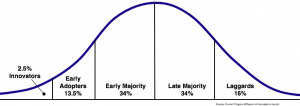
Another part of the Dron (2014) reading that grabbed my attention was Rogers’ innovation diffusion theory.  I researched further into this and found an article that elaborated on the idea that when technology is adopted there are 5 general categories; innovators, early adopters, early majority, late majority, and laggards (Rogers, 2003).  This pattern followed very closely to the implementation of our mobile learning initiative at Lambton College.  As we started to take the college down the path of every student and teacher using technology for teaching and learning, we found that there were very few innovators (2.5%), followed by a few early adopters who saw the value in the initiative (13%), soon after an early majority got on board after they saw the success of the early adopters (34%), followed soon after by the late majority of faculty (34%), and the inevitable laggards (16%) who just seem resistant to change (Rogers, 2003).  Now, most of the college is engaged in mobile teaching and learning and as new technology is developed, innovation and integration with new concepts and tools seems to be a daily occurance.


As Technology marches on, I think that we need to embrace the possibilities for education, and rather than focus on labelling what theoretical category it should fall under, more time should be spent on using it to enhance learning and engage our participants.


Resources

Dron, J. (2014). Innovation and Change: Changing how we Change. In Zawacki-Richter, O. & T. Anderson (Eds.), Online distance education: Towards a research agenda. Athabasca, AB: AU Press.

Goldman, S., Maureen, C. P., Kabayadondo, L. B. C., Royalty, A. W., Roth, B., Swee, H. K., Kim, J.  (2012). Assessing d.learning: Capturing the journey of becoming a design thinker. In H. Plattner, C. Meinel & L. Leifer (eds).  Design thinking research: Understanding innovation. (pp. 13-33). Berlin: Springer.

Rogers, E. M.  (2003).  The Diffusion of innovations.  (5th ed.).  New York, NY: The Free Press.


Assignment 1 Part A – Design Thinking

CC0 – Pixabay

Our Issue

A common issue in both our places of work is how we can encourage learners to become more engaged in the online learning environments we design.  We were challenged with how to encourage and sustain a community of practice where learners can support each other and share knowledge across their respective fields, thereby providing a heightened level of engagement as well as encouraging intellectual risk-taking amongst the group. In Steve’s situation, the issue is taking the theory portion of a carpentry apprenticeship course online.  Andrea’s current issue is training franchisees on a new computer software program that will run their business in an online environment. In both cases, the learners were generally not tech-savvy, were resistant to change, were unwilling to share knowledge to benefit the group, and seemed very reluctant to ask questions for fear of others perceptions of them.

Our Method

As we embarked on our design challenge using the Stanford University Institute of Design’s (2016) design thinking process our area of focus was to create a space in which the learners were engaged in the learning process; where they were comfortable to share knowledge in this online space; where they felt supported by the instructor and other learners; and to develop a real sense of community in the online environment. We looked at the issues through the lens of the learner and dug deep into some of the uncomfortable feelings that arose for the learner in these online settings. Rather than trying to solve the ways in which our courses were designed, we thought more about how we could train differently to encourage participants to be more engaged in the learning. “There is always more than one explanation for a wicked problem, with the appropriateness of the explanation depending greatly on the individual perspective of the designer” (Crichton, S. & Carter, D., 2017, p.25).

Our Solutions

Working in pairs for this design challenge allowed us to look at the issue from two different perspectives.  After we reflected on our positions, we compiled our respective resolutions and negotiated to arrive at the following solutions:

  1. Foster a Community of Practice – Introduce a live synchronized icebreaker session at the outset of the course to make students feel comfortable with each other and with the instructor.
  2. Utilization of Case Studies – All course materials would be based on a real-life situation; encouraging engagement and sharing of professional knowledge.
    • Steve-Online course structured around the building of a new house
    • Andrea-Online training structured around the opening of a business
  3. Incorporate Storytelling – Share awkward situations during every major phase of the case study/course. Instructor shares an embarrassing moment/mistake related to that particular phase of the course.  Encourage participants to tell their stories to the group.
  4. Encourage Collaboration –  Have participants work through solutions sharing challenge that mimics a real-life scenario. As a group, try to discuss their shared life experiences while encouraging them to draw on their intellect to contribute to the solution (maybe use Design Thinking process as a way to work through the problem).

Conclusion

Creating a community of practice draws on Garrison and Vaughan’s community of inquiry; creating a solution sharing challenge aligns with problem-based learning; and having participants share their stories based on their experiences in the field takes a constructivist approach to teaching and learning (Thomas, 2010).  We also tried to encourage a growth mindset in our learners by having them embrace our solutions sharing challenges, having them take inspiration by others life experiences, and having them recognize that there is a direct correlation between hard work in the online learning environment and success both in school/training and in their workplace (Crichton & Carter, 2017).

References

Crichton, S. & Carter, D. (2017). Taking making into classrooms toolkit. Open School/ITA.

Stanford University Institute of Design. (2016). A virtual crash course in design thinking.

Thomas, P. Y. (2010). Learning and instructional systems design. Towards developing a web-based blended learning environment at the University of Botswana. (Doctoral dissertation).


Design, Constructivism, and Contradiction


CC0-Pixabay

Before I got through reading the first two pages of Bates’ (2014) blog post on ADDIE in the digital age, I immediately got the feeling that a framework such as this is way to prescriptive for someone designing a course and learning environment.  I think it is great to keep a framework such as ADDIE in mind to keep you on track, but in my experience as a carpenter, teacher, and manager, the moment you define a process for someone to follow you stifle creativity as the individual will become to focused on the framework rather than the journey and the end result.  I probably feel this way as I fall in the constructivist field of thinking when it comes to course design.  Bates (2014) notes that the ADDIE model indeed has been criticized by constructivists as it does not specifically refer to the importance of the interaction between the learners and instructors.  Many other instructional design models exist, but I think that if you choose to follow any of them and build a constructivist learning environment, you should keep a process such as Design Thinking (Scheer, Noweski, & Meinel, 2012) in your mind as you work through it.  Design Thinking is based in constructivist theory and focuses on training certain learning skills such as exploration and critical thinking.  It supports several competencies and follows a cyclical process of understanding, synthesizing, ideating, prototyping, testing, and iterating.

One thing that caught my attention early on in the Thomas (2010) doctoral dissertation was that there were many definitions and explanations provided of various design processes and instructional design models, and they all seem to aspire to a practice in which a superior product can be achieved.  This seems contradictory to me in a sense because while each model or process touts its ability reach a desired goal, in reality the only way to achieve your desired result would be to treat each design situation as unique.  The context for the course design and the makeup of the learning community is different for every design therefore a prescriptive instructional design model wouldn’t be the best approach.  I realize that instructional design models are just guides but I think more attention needs to be drawn to the uniqueness of each situation.


References

Bates, T. (2014, September 9). Is the ADDIE model appropriate for teaching in a digital age? [Blog post]


Scheer, A., Noweski, C., Meinel, C.  (2012).  Transforming constructivist learning into action:  Design thinking in education.  Design and Technology Education:  An International Journal.  17(3).  8-19.


Thomas, P. Y. (2010). Learning and instructional systems design. In Towards developing a web-based blended learning environment at the University of Botswana. (Doctoral dissertation).

Activity 8 – Learning Styles…What’s the Deal?


Creative Commons CC0

In his article Kirschner (2016) argues that there is no scientific basis for the argument that; a learner has no optimal learning style; there is no valid mechanism to measure one’s learning style; individuals are not aware of their own learning style; instruction should not be built around learning styles.  One of his main arguments is that self-reporting using instruments to assess one’s learning style is not a reliable way to actually determine a learning style.  He claims (and cites many other studies) that learners are not always willing to be truthful when taking a learning styles assessment.  Another key point he makes is that even if the learner was to be truthful in their assessment, this does not mean the learning style they have selected is necessarily the best one for them to learn with.  For example, just because they prefer an auditory learning style, it does not mean that is how they will gain the most knowledge, they may benefit more from a kinesthetic learning approach.


When I finished reading this article I was torn, on one hand I have in the past been a big supporter of teaching to your students individual learning styles and have even administered a couple of workshops on learning styles.  On the other hand, Kirschner makes some compelling arguments that have caused me to rethink my position.  I dug a little deeper and read a few of the articles that Kirschner had referenced and one caught my eye.  Massa and Mayer (2006) conducted a study in which they studied aptitude-treatment interaction (the idea that depending on a learner’s specific abilities, some instructional strategies are more effective).  After conducting experimental research on visual versus verbal learners they concluded that there was no significant difference in their performance and suggested that learners need not be exposed to different learning methods based on their perceived learning styles.


After further investigation I am now on the fence in regards to the validity of teaching to one’s learning styles, I do however feel that their is still validity in recognizing learning styles.  Whatever side of this argument one is on there is still a strong argument to be made that understanding that people learn in different ways can only strengthen your teaching practices.


Resources

Kirschner, P.A.  (2016).  Stop propagating the learning styles myth.  Computers and Education 106(2017), 166-171.

Massa, L. J., & Mayer, R. E.  (2006).  Testing the ATI hypothesis:  Should multimedia instruction accommodate verbalizer-visualizer cognitive style?  Learning and Individual Differences, 16, 321-336.

The Influence of Media on Learning

By: Mary Ellis, Krista Frate, Marshall Hartlen, Steve Minten, and Nicolette Young

How people learn is constantly up for discussion, and debate. And every few years a new theory is advanced often identifying previous theories as flawed. In a similar vein, the influence of media on learning has also been debated. Academics like Clark (1994) maintain that media will never have a significant impact on learning, while contemporaries like Kozma (1994) argue that with the continued advancement of technology, it is time to revisit the argument. The following post explores four articles that explore the scope of the debate, and add to the continuing discussion.

Five Ways to Teach Students to be Future Ready

Article Link

Matt Miller’s (2017) article entitled “5 Ways to Teach Students to Be Future-Ready” provides five changes that a teacher can make to their classroom that will help students learn better and be more prepared for the workforce. Miller claims that the students of today will enter a workforce that is technology infused and filled with innovation. He encourages them to use a medium that suits their learning in order to communicate their ideas in a more succinct fashion. He also encourages educational institutions to ensure that students are creating content that matches their unique skills and notes that the medium they choose is not as important as the actual creation process itself.

Miller’s article contrasts Kozma’s (1994) position that the medium can influence learning as long as it is linked to the instructional method. Firstly, Miller (2017) makes no connection between the medium and the method, Within the article, he does not once link any one medium to being required to achieve the goals of creativity, collaboration and creation. . Secondly, in several instances he states that many mediums may be selected to encourage learning for the students. If learning happens for the students no matter which medium is used, as Miller suggests, then one can infer that the medium is not the primary factor in learning.

How has Technology Changed Education?

Article Link

In an article published on the Purdue University Online website, the author (unknown) claims technology has profoundly impacted education and enabled new ways of learning (How has Technology Changed Education, 2015). This contradicts Clark’s assertions that media has “…differential economic benefits but no learning benefits.” (Clark, 1994). Clark (1994) suggests asking whether or not a similar set of attributes as those under scrutiny would lead to similar results. In the article linked, the authors give an example of students in rural U.S. following blogs and connecting in video conference with scientists in the arctic. The article states “The walls of the classrooms are no longer a barrier as technology enables new ways of learning, communicating, and working collaboratively.” Clark might suggest the impacts of the technologies enabling learning are economic; that learning is more accessible and cost effective, but could have taken place without the aid of these specific technologies.

The Purdue University article also claims roles of teacher and learner have been changed by modern technology, suggesting access to abundant content has given students more responsibility over their learning and changed the role of teacher from “sage on the stage” to “guide on the side” (How has Technology Changed Education, 2015). This claim aligns with Kozma’s view that media and method have an integral relationship; a medium’s capabilities enable methods and must be confounded (Kozma 1994). Clark suggests that, because various attributes of various media can accomplish similar learning (see studies cited by Clark, 1985; Clark & Sugrue, 1988, as cited by Clark, 1994) the “attributes must be proxies for some other variables that are instrumental in learning gains.” (Clark 1994)

Though the article states clearly that today’s technology “enables forms of communication and collaboration undreamt of in the past,” (para. 3) it does not clearly identify specific attributes as unique to particular technologies (How has Technology Changed Education, 2015). Therefore, the article could be interpreted to be aligned with Clark’s view. However, it is implied by reference to abundant content and video conferencing that the arrival of the internet has changed learning. It is hard to imagine a world with the same learning results afforded by the communication and collaboration taking place online, but Clark insists we do imagine it, or ask ourselves “if another (similar) set of attributes would lead to the same learning result” (1994). By separating medium and method, Clark insists, we can better focus on various methods which adequately meet learning requirements and choose the most economic option (1994).

Teaching in the Digital Age: How Educators use Technology to improve Student Learning

Article Link

In Teaching in a digital age: how educators use technology to improve student learning, authors McKnight et al. (2016) discuss the findings of their case-study exploring how teachers’ perception of technology in the classroom has helped their methods. In interviewing teachers and administrators, issuing an online survey, and observing classrooms, the authors determined that teachers use technology in a variety of contexts, including: providing instantaneous feedback to students, and creating interactive and self-paced lessons. Despite the creativity using technology can inspire, teachers from low socioeconomic schools indicated that the lack of a computer at home and inadequate access at school impeded their ability to take advantage of the options technology-enabled learning provides. McKnight et al. also indicate that technology improves learning when it helps change “learning routines, cognitive processes, problem-solving, and teacher roles” (p. 5), they argue that it is effective when it enables course content to be delivered more efficiently. However, technology should not be a distraction from the course content being delivered .

McKnight et al.’s case-study neither contradicts nor affirms arguments regarding the influence or lack of influence media has on education made by Kozma (1994), nor Clark (1994) respectively. McKnight et al.’s case-study neither contradicts nor affirms Kozma’s argument that media changes the way we learn (1994), nor Clark’s argument that media will never change how we learn (1994).

Although their research indicates that teachers appreciate using technology in the classroom, and feel fairly comfortable developing their technological skills, which indicates a willingness to integrate technology in the classroom. McKnight et al. caution that the technology, or medium, used to deliver courses ought never take the focus away from the content. Until such time that technology reshapes “learning routines, cognitive processes, problem solving, and teacher roles” (p. 5), they claim technology will not change how we learn .

Teachers Explain why VR is more than a Buzzword

Article Link

According to several educators in Gallagher’s (2017)’s column “Teachers explain why VR is more than just a buzzword”, technology may have caught up to what Kozma was waiting for in the great “media debate”. Kozma(1994) argued that “if there is no relationship between media and learning it may be because we have not yet made one” ( p. 2). In 2017, the VR experiences for three instructors (Gallagher, 2017) claim that a relationship between VR and learning may now exist.

In Gallagher’s (2017) column, the first teacher’s experience is that virtual reality movies are more immersive than other media and aids students to “learn with all the senses” (para. 4). She observes that virtual reality movies allow the content to be experienced, rather than just watched. The second instructor piloted Google Expeditions (Link) – interactive field trips using VR. She corroborates Gallagher’s observation of the first instructor’s experience, stating that VR’s power is in the quality of the experience, not the content..

These statements contrast with Clark (1994)’s view that there is no evidence that “media or media attributes influence learning in any essential and structural way” (p.5). In allowing a student to experience their learning in a separate, realistic and reactive environment where they can use multiple senses, the educators give evidence that VR is influencing learning in a essential and structural way – in terms of the experience it enables. This differentiates it from other media as the instructors describe the VR itself as the experience that impacts learning, not the content.

Another of Clark (1994)’s assertions is contradicted by these experiences – that learner benefits are derived from content and instructional strategy, not the media itself. After using a graffiti art VR simulation with her students, a third instructor discusses the higher motivation and engagement that VR enables. This is in direct contrast to Clark’s (1994) view that media is not “directly responsible for motivating learning” (p. 2).

Instead of the truck just delivering our groceries, Clark’s metaphorizses that media is solely the deliverer of instruction (groceries) and not achievement. In this way, the VR truck is bringing us directly to the farm where the meat and vegetables grow – letting us walk around, smell, listen and experience where these groceries came from, but does not necessarily help us to understand how they grow.

Not considered in either Clark (1994), or Kozma’s (1994) arguments is the fact that both were writing at the dawn of the internet age. Clark may be correct in identifying that no specific research has accurately concluded the successful influence of media on learning, but the media he wrote of in 1994 is vastly different than what exists today. Constructivist learning theory, was likewise starting to gain popularity at the publication of both author’s work. As Kozma (1994) observes “learning is an active, constructive, cognitive and social process by which the learner manages resources to create new knowledge by interacting with information in the environment, and associating it with previous knowledge. Here too, further inquiry is required as to the specific information is required to effect of 21st century media on learning.

References

Clark, R. E. (1985). Evidence for confounding in computer-based instruction studies: Analyzing the meta analyses. Educational Communication and Technology Journal, 33(4).

Clark, R. E. (1994). Media will never influence learning. Educational Technology Research and Development, 42(2), 21-29.

Clark, R. E. and Sugrue B. M. (1988). Research on instructional media, 1978-1988. In D. Ely (Ed.), Educational Media Yearbook 1987-88. Littletown, CO: Libraries Unlimited.

Gallagher, K.. (2017, April 12). Teachers explain why VR is more than just a buzzword. [Online column within information resource site and community]. Retrieved from https://www.edsurge.com/news/2017-04-12-teachers-explain-why-vr-is-more-than-just-a-buzzword

Kozma, R. B. (1994). Will media influence learning: Reframing the debate. Educational Technology Research and Development, 42(2), 7-19.

McKnight, K., O’Malley, K., Ruzic, R., Horsley, M. K., Franey, J. J., & Bassett, K. (2016). Teaching in a digital age: How educators use technology to improve student learning. Journal of research on technology in education, 48(3), 194-211. Retrieved from https://pdfs.semanticscholar.org/1143/6d1f5dd47529b666a1c4bfdd720d681305b8.pdf.

Miller, M. (2017, August 10). 5 ways to teach students to be future ready. EdTech Magazine. Retrieved from https://edtechmagazine.com/k12/article/2017/08/5-ways-teach-students-be-future-ready

Purdue University Online. (2017). How has technology changed education? Retrieved from: http://online.purdue.edu/ldt/learning-design-technology/resources/how-has-technology-changed-education


Activity 5 – Theoretical and Pedagogical Reflection

Creative Commons CC0

For activity 5 we were asked to reflect upon the Ertmer & Newby (2013) and Merrill (2002) readings and investigate how they apply to our work.  After selecting a theoretical position we were asked to explain why we felt it resonated with us and describe how it applies to our work.  

I found this task challenging as I think it is hard to completely align with only one theoretical position.  I believe it is not only human nature to have various thought processes that include many theoretical positions, but it makes for a better and more well rounded teacher (and learner).  Ertmer & Newby (2013) describe in detail behaviourism, cognitivism, and constructivism from an instructional design perspective and as I read through the author’s descriptions of each, I found myself thinking that I could relate my teaching to behaviourism and constructivism.  Merrill (2002) describes several instructional theories and again I found myself connecting to Jonassen’s Constructivist Learning Environments and Schanks Learning by Doing (pp. 55-56).

In behaviourism I can relate to doing an assessment of a learner before starting a task, making sure that they master each step before moving on to the next, and providing constant feedback to ensure that their performance improves (Ertmer & Newby, 2013, p. 49).  This sequence is very similar to how I teach a lesson in our carpentry lab.  First I would do an assessment of the learners safety and skills on the tools, then provide detailed step by step instructions of the task ensuring that they check in with me at each critical point, all the while providing feedback to ensure that they maximize their potential.  

Learning by doing is an important part in any trades training.  Learners are constantly encountering new situations in carpentry as no two jobs are exactly the same.  As such, we teach them to draw on past lessons (cases) that resemble the new one and apply their existing knowledge to the new lesson (Merrill, 2002, pp. 56-57).

Ok, time to stop dithering…if I had to pick a camp I would place myself in the area of constructivism as I believe that creating meaning in your learning is essential to one’s growth.  In my classroom, the best learning experiences are when I can equate the content to a real life situation that the students have experienced.  Having others share how their previous life experiences relate to the content also helps the students to interpret ideas and apply them to their own experiences (Ertmer & Newby, 2013, p. 55) creating a deep learning environment.  I constantly set up assignments that maximize the student’s opportunity to experience learning (often physically rather than only mentally) and provide them with time to reflect on that learning.  For example, rather than lecturing to them about concrete columns, I put them into teams and have them do a scavenger hunt around the college searching for four different types of columns (and have them take pictures with their phones or iPads).  Upon return to the class they make a quick presentation describing the characteristics and functions of the columns and share it with the class.  Before finishing the lesson we have a group discussion on the subject as a whole.  This type of lesson could easily be taken from on-ground to blended or online format.

Although I find myself favouring constructivism, I can honestly say that I can find elements of my teaching in most, if not all, of the theories in these readings.  

References

Ertmer, P., & Newby, T. (2013). Behaviorism, Cognitivism, Constructivism: Comparing critical features from an instructional design perspective. Performance Improvement Quarterly, 26(2), 43-71.

Merrill, M. D. (2002). First principles of instruction. Educational Technology Research and Development, 50(3), 43-59.


A MALAT Student Blog