Image Courtesy of Wesley Fryer (CC BY-SA 2.0 CA)
Labels, Labels, Labels…
As educational technology has advanced, so has our understanding and expectations of how it can (and should) be applied to online (distance) learning. The pedagogy that has been applied to distance learning has evolved as well. Early generations (single-mode, such as radio or print) of of distance learning used a cognitivist/behaviourist approach focused on how each individual learns; second generation (mixed-mode-such as CD-ROM’s) followed a social constructivist model and was built around the belief that our knowledge is constructed socially and that others input and views help develop our own understanding; the third generation (social modes, such as social media, LMS’s) employs a connectivist model in which the knowledge is in the network and the learning comes from making sense of that network, both people and technology (Dron, 2014). With technology advancing at such a rapid rate and new technologies now available (such as AR/VR) that can potentially transform distance learning, my question is why are we always trying to fit what is going on into a theoretical box? Every individual is unique, so can we not design a system for distance education that allows them to follow the model that best suits them (I have no idea how to do this by the way, just wishful thinking)? If I learn best in a cognitivist environment, then that would be the path I follow. I think by putting a pedagogical label on things we run the risk of narrowing the views of both our teachers and learners. It seems to me that overthinking every aspect of learning can be helpful for analyzing learning trends, but can also be detrimental and stifle innovation.
App Smashing.
Dron (2014) writes at length on the idea that developments and innovations are built on the backs of those that came before them and that any innovation is just an extension of an earlier idea but just presented differently or improved upon. New possibilities are opened up by technological advances which spurs creativity, and things snowball from there. This idea sounded very familiar to me and upon reflecting on it I realized why. It sounds very similar to the concept of app-smashing, the idea that if one app cannot perform the task you want, then use several apps in combination to get the job done. I was first introduced to this concept at an Ed-Tech workshop that I attended in Chicago about 8 years ago. It is a fairly simple concept but really opened my eyes to the idea of customizing one’s learning and not letting perceived barriers get in the way. I have used this in the classroom and it has been fairly successful. For example, I asked my students to produce an annotated video on tool safety in our carpentry shop. They had to select a tool, take a safety video, and annotate it using arrows, words, images, etc. Other than providing a rubric and telling them that it would take two or more pieces of software or apps to create this project I did not give them further instructions. The projects that came back were stellar, some used video in conjunction with iMovie and Youtube, others used Thinglink along with Explain Everything, some even used 4 apps to complete the project. The only thing I would change in the future would be to make the grading more about the process rather than the end product.
Technology Adoption
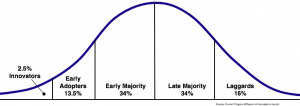
Another part of the Dron (2014) reading that grabbed my attention was Rogers’ innovation diffusion theory. I researched further into this and found an article that elaborated on the idea that when technology is adopted there are 5 general categories; innovators, early adopters, early majority, late majority, and laggards (Rogers, 2003). This pattern followed very closely to the implementation of our mobile learning initiative at Lambton College. As we started to take the college down the path of every student and teacher using technology for teaching and learning, we found that there were very few innovators (2.5%), followed by a few early adopters who saw the value in the initiative (13%), soon after an early majority got on board after they saw the success of the early adopters (34%), followed soon after by the late majority of faculty (34%), and the inevitable laggards (16%) who just seem resistant to change (Rogers, 2003). Now, most of the college is engaged in mobile teaching and learning and as new technology is developed, innovation and integration with new concepts and tools seems to be a daily occurance.
As Technology marches on, I think that we need to embrace the possibilities for education, and rather than focus on labelling what theoretical category it should fall under, more time should be spent on using it to enhance learning and engage our participants.
Resources
Dron, J. (2014). Innovation and Change: Changing how we Change. In Zawacki-Richter, O. & T. Anderson (Eds.), Online distance education: Towards a research agenda. Athabasca, AB: AU Press.
Goldman, S., Maureen, C. P., Kabayadondo, L. B. C., Royalty, A. W., Roth, B., Swee, H. K., Kim, J. (2012). Assessing d.learning: Capturing the journey of becoming a design thinker. In H. Plattner, C. Meinel & L. Leifer (eds). Design thinking research: Understanding innovation. (pp. 13-33). Berlin: Springer.
Rogers, E. M. (2003). The Diffusion of innovations. (5th ed.). New York, NY: The Free Press.