
Tag Archives: Leadership

Unit 2 Activity 1 – Managing Change for Learning in Digital Environments

Source: Maryanne Ventrice, Flickr.com CC BY-2.0
(https://creativecommons.org/licenses/by/2.0/)

The unit 2 readings certainly expanded my understanding of leading change in an organization and the history behind organizational development (OD).  Al-Haddad and Kotnour (2015) give a thorough summary of the history of change giving particular focus to Kurt Lewin, who conducted research on change in the fields of sociology and psychology in 1946 and began the movement of OD and change management.  In terms of changing in our ever evolving digital environment, I think that Feldstein (2017), who writes about achieving an interoperable digital learning platform to replace (or at least have a symbiotic relationship with) learning management systems, makes some very salient points that can be applied to the larger issue of leading change in the digital age.  He notes that our understanding of digital environments has evolved to a point where a there is an expectation that any technologies we use should not only work together, but should complement each other.  This means that any method for change that is adopted should be open ended and allow for the integration of future advancements.  Although this is a fantastic idea, I’ll bet it has IT directors pulling their hair out on a daily basis.

After reviewing the many theories that were part of the readings, I find myself leaning towards the Six Step and the Six Sigma systematic change methods (Al-Haddad and Kotnour, 2015) as I generally don’t like to over complicate things.  These two theories have more generalized steps but still encompassed most of the elements of more complicated theories such as the nine steps of Process Reengineering (Al-Haddad and Kotnour).  For example, the first four steps in the Process Reengineering model are all about identifying the process and defining the problem in your organization.  This to me is too prescriptive and might pigeonhole your thought process.  In contrast, the first step in the Six Sigma method is to define the the issue you would like to repair in your organization and seems to incorporate the first four steps of Process Reengineering.  Although this is very broad, your direction is left more open and I believe this allows for more independent thought and exploration.  It also does not surprise me that the theories I selected were both systematic approaches to change as I tend to like a more structured framework rather than a conceptual one.

Leadership plays an important role in managing change and the first step in this is making sure your organization is ready for change.  Two critical aspects of this are to make sure your organization has a shared resolve and the collective capacity to do so (Weiner, 2009).  Having the shared resolve means motivating people to be committed to pursuing the courses of action required to implement the organizational change.  Collective capacity (change efficacy) refers to the individuals shared beliefs that they have the collective ability to organize and execute those courses of action (p. 2).  Another important aspect is to make sure that the change you are planning to make is not vastly different from the existing organizational culture.  If it is too much change all at once disconnects will be created, employees will not believe their leaders and this will result in an unsuccessful implementation (Biech, 2007).  

Weller and Anderson’s (2013) discussion regarding resilience was intriguing to me as the thought of measuring a system’s capacity to “absorb disturbance and reorganise while undergoing change” (p. 3) never really occurred to me.  They go on to further place emphasis on the fact that the ability to retain identity and function is a key piece to a systems digital resilience.  Reflecting on this I realized that our colleges recent transition to mobile learning could be a resilience test.  Even though resilience was not formally investigated, our college underwent a major change to move to teaching with technology and the result seems to have been a success.  We utilized technology to change some of our teaching practice, but retained the the underlying foundations of teaching and learning (p. 3).  The only thing that scares me a little bit about our colleges transition is I am not sure that resilience was consciously thought of from our leaders, the change seemed to be motivated because going mobile was cutting edge at the time.  I am not sure that any thought was given to maintaining the core foundations of teaching and learning…I hope I am wrong about that though…


Resources

Al-Haddad, S., & Kotnour, T. (2015). Integrating the organizational change literature: a model for successful change. Journal of Organizational Change Management, 28(2), 234-262.

Biech, E. (2007). Models for Change. In Thriving Through Change: A Leader’s Practical Guide to Change Mastery. Alexandria, VA: ASTD.

Feldstein, M. (2017, May 28). A flexible, interoperable digital learning platform: Are we there yet? [blog post].

Weiner, B. J. (2009). A theory of organizational readiness for change. Implementation Science, 4(67).

Weller, M., & Anderson, T. (2013). Digital Resilience in Higher Education. European Journal of Open, Distance and E-Learning.
 

Leading in the Digital Age

Leading in the digital age requires an individual to have the constitution to allow their team to attempt to incorporate ever-changing technologies and make mistakes doing so.  A successful leader in any digital environment also has to understand what makes individuals hesitant to embrace digital change and be able to respond to those fears (Sheninger, 2014).

Although leading in digital learning environments has unique considerations, especially given the constant rate of change with educational technologies, traditional leadership theories can be applied to any digital learning environment by adapting them to each situation.   

My Leadership Approach

My approach to leading has been formed by my work life experience.  Leadership for me in the workplace began by operating my own contracting company, having to manage a project in an adaptive style of leadership for my own employees and sub-trades where workers were rewarded monetarily for their performance (Khan, 2017).  I moved on to teaching students at the college level and found myself employing a servant-leadership style (O’Toole, 2008) that focused on helping my students to successfully gain employment after graduation.  As our college moved towards implementation of digital teaching and learning campus-wide, I accepted successive positions as a Faculty Mentor for teaching and learning with technology responsible for faculty professional development, and eLearning Manager responsible for all development of blended and online learning.  While working with faculty in these roles I found myself utilizing a team or shared leadership style.  I would provide guidance where necessary, but allow team members to share their influence and take the lead when warranted (Northouse, 2016, p. 365).

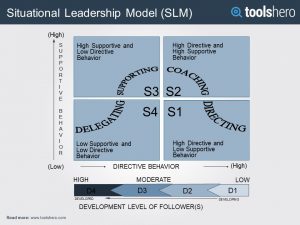
A constant throughout all of these leadership roles has been the ability to adapt to each situation and to understand where faculty, students, or individuals within my team fall on a continuum of development (Northouse, 2016).  Figure 1 illustrates the four categories of directive and supportive behaviours of delegating, supporting, coaching, and directing.  A delegating style of leadership would allow the individuals to lead and take responsibility for achieving a goal.  A supporting style of leadership would allow individuals some measure of control over the project, but the leader would always remain available to help out.  A coaching leadership style requires a leader to involve themselves in the project and provide encouragement while offering solutions to problems.  In the directing leadership style, a leader provides close supervision and clear instruction (Northouse, 2016, pp. 94-96).

Figure 1.  Situational Leadership Model.  This figure illustrates the four categories of directive and supportive behaviours (Situational Leadership Model, develop your leadership styles, n.d.)

As I encounter individuals inside and outside the classroom with varying ability and understanding, I believe adapting my leadership technique to match their style maximizes the potential for a mutually beneficial working or learning experience.

In my experience in a leadership role, I have noticed two things that stand out that are required to be successful in a digital environment.  The first is to allow people to feel safe in attempting and failing at integrating technology.  As Huggins, Klar, Hammonds, & Buskey (2017) note, “you’ve got to allow people the opportunity to make some mistakes [and] learn from those mistakes” (p. 9).  A learning or workplace environment must allow individuals to take risks as a learning opportunity in order to further their growth.  The second thing that I have noticed is that it is important to allow individuals to grow by increasing their capacity to do things on their own.  It is critically important that members within a classroom or organization be tasked to develop their own personal capacities in order to not only further their own growth but also to contribute to the overall success of a project (Huggins et al., 2017).

Leading in the Digital Age

As someone who is engrossed in technology and is always interested to experiment with new advances, digital technologies have provided me with the opportunity to step up in leadership roles.  Sheninger (2014) provides a succinct summary of what traits are important for a leader in the digital age.  He provides a list of seven pillars of digital leadership in education; communication, public relations, branding, student engagement/learning, professional development, re-envisioning learning environments, and opportunity.  I believe these pillars transcend not only education but also digital environments.  One can take any of these pillars and apply them to a workplace and connect them to a successful leadership practice.  For example, if one selected student engagement/learning and changed it to employee engagement/learning it would not be difficult to see how having employees engaged and committed to learning would contribute to the overall success of any organization.  Conversely, if one selected a leadership theory that predated the digital revolution it would not be a challenge to apply its main tenets to leading in the digital age.  For example if one selected the skills approach to leadership, which places an emphasis on abilities that can be learned and has been identified and studied since 1955 (Northouse, 2016, p. 43), one could take the three general administrative skills of technical, human, and conceptual and apply them to leading in the digital age.  Technical skills are the proficiency at a specific type of work, this could easily be applied to one’s technical proficiency (p. 44).  Human skills are the ability to work with people and in any digital leadership environment managing people is critical (pp. 44-45).  Conceptual skills are the ability to work with ideas and concepts and in the digital age, new technologies are always expanding the possibilities for new advances.

Conclusion

I truly believe that leadership has to be an individualistic approach.  What works for one individual’s personality style might not work for another.  Contextual factors such as where we are employed and our position within an organization also play a part in our leadership style.  Identifying what style of leadership you employ can help you recognize both your strengths and weaknesses as a leader and provide you with a first step towards becoming a more effective leader.


References

Huggins, K., Klar, H. W., Hammonds, H. L., & Buskey, F. C.  (2017). Developing Leadership Capacity in Others: An Examination of High School Principals’ Personal Capacities for Fostering Leadership. International Journal of Education Policy and Leadership, 12(1).  

Khan, N. (2017).  Adaptive or Transactional Leadership in Current Higher Education: A Brief Comparison. The International Review of Research in Open and Distributed Learning, 18(3).  

Northouse, P. G. (2016). Leadership: Theory and Practice (7th ed.). Thousand Oaks, CA. Sage Publications.

O’Toole, James (2008). Notes Toward a Definition of Values-Based Leadership. The Journal of Values-Based Leadership, 1(1).  

Sheninger, E. (2014). Pillars of digital leadership. International Centre for Leadership in Education.

Situational Leadership Model, develop your leadership styles. Retrieved from https://www.toolshero.com/leadership/situational-leadership-hersey-blanchard/