The issue that needed to be addressed at my workplace was (and still is) to move several courses from an on ground delivery to an online delivery. This was mandated from administration and faculty were asked to volunteer if they thought that their course would be well suited to move to an online delivery. Their were two major challenges with this initiative, the first being the obvious challenge of physically (or virtually) building these courses successfully into an online format. The second major challenge was that faculty we not trained in either online course development or delivery.
Stakeholders
There were several stakeholders involved in this project who had various levels of involvement and most of them stood to benefit in some way from this undertaking.
Administration
The upper administration at our college communicated to the faculty that their wish was to find on-ground courses that were well suited for online learning and convert them. They were very clear in communicating that time off would be given if your course was selected to be changed to an online format. I believe they underestimated the time it took to convert a course and also the expertise that was required to move a course to an online format. The benefit to administration was that this would ease some strain on physical classroom spaces within the college.
Faculty
Faculty that decided to convert their course were given a course release for one semester and teamed up with and instructional designer and project developers that were to assist them with the technological aspect of this transition. In retrospect many of the faculty that accepted this transition said that the time it took to convert to online was way more than one course release. They also noted that they wished they could have received some more formal training on the expectations and process for building an online course. The benefit to faculty was that this provided more options for students.
Information Technology Department
The Information Technology Department (IT) were integral in the implementation of this project. Not only did they have to procure software technologies to build these online courses, they also need to integrate them into the learning management system. IT worked closely with administration and the instructional designer throughout this process to ensure that there would be no surprises once the courses went live. The only benefit I could ascertain is that more online courses meant more job security for those working in IT. This project caused much more work for them.
Union
The Faculty Union was very involved in this project. They were worried that moving courses online could eventually lead to asynchronous courses in which the role of the faculty would be diminished. If a benefit was to be found for the Union it was that students from other colleges may be able to take these classes online as a general education credit and this in turn would mean more work for its members.
Instructional Designer and Developers
The instructional designer and developers were in charge of converting the faculties knowledge and ideas into an engaging online format. They worked closely with the faculty and met regularly to provide pedagogical and technical support in the course development. As developing these courses was a new undertaking, successful courses would benefit their careers.
Students
Last but not least, the students. Having engaging online courses provided the students with an option to take the course more or less on their own schedule. It removed the geographical barrier and allowed many of them to learn the content at home, or on the bus, or on break, etc. They are the end consumer and at the end of the day it was the students that were driving this change.
Project Plan
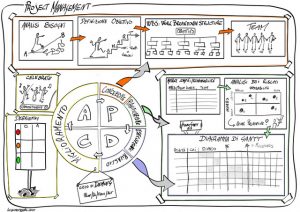
At the time of this project I was seconded from faculty into the role of eLearning manager and as such I was in administration. Although I did not directly develop the project plan and can’t be sure if a formal project plan was undertaking in the early going, I was a key member on the team. I recognize several key pieces of managing a project that we were conscience of; cost, scope, quality, risk, resources, and time (Watt, 2014, pp. 13-14).
Cost – As with any project, we were given a budget to work with and had to ensure that our project was completed within that budget.
Scope – Before the project was started we decided how many courses we could develop into an online format.
Quality – We decided to incorporate Quality Matters ™ into our course design as a standard for quality that we wanted to aspire too.
Risk – We recognized that there could be potential issues with the Faculty union not buying into this project and also that there could be a challenge in hiring enough skilled developers within our project timeframe.
Resources – We identified and repaired gaps in our technical software in order to ensure that we had the proper tools to build the courses.
Time – We were given a finite amount of time (24 months if my memory serves) in order to complete the project and developed a schedule based on this.
I think that we underestimated the amount of time it took to bring the faculty, instructional designer, and developers up to speed on the project. By this I mean we failed to bring them together as a team soon enough and as a result the development lagged. We should have provided more front end training (especially for the faculty) on development and delivery of online courses.
Conclusion
Although our online course development project was somewhat successful, I think more forethought should have been put into it. I think part of the problem was that we viewed the project as a tame problem that had a fairly linear path to success (Conway, Masters, & Thorold, 2017, p.16). We could have considered it a wicked problem as the boundaries of what the courses could become were hard to define and as noted above there were many stakeholders with different roles within the education system.
References
Conway, R., Masters, J., & Thorold, J., (2017). From design thinking to systems change: How to invest in innovation for social impact. Royal Society of Arts, Action and Research Centre. Retrieved from https://www.thersa.org/globalassets/pdfs/reports/rsa_from-design-thinking-to-system-change-report.pdf
Watt, A. (2014). Project Management. Victoria, BC: BCcampus. Retrieved from https://opentextbc.ca/projectmanagement/front-matter/introduction-2/