Research Dissemination – George Veletsianos

As part of the research dissemination, George Veletsianos answered a few questions from students about his experience with research. A few key takeaways included:

  • Pick something you are genuinely interested in researching and learning more about.
  • Forumulate questions based on answers you trying to find. 
  • Consider examining relationships between variables as part of your research question. 
  • When doing background research, start by what you know and what you’ve come across on the topic thus far, then proceed to explore relevant databases.


Research Dissemination – Melanie Wrobel

As part of the research dissemination activity, the Royal Roads University copyright officer, Melanie Wrobel, shared some important information on copyright law. There were a few points that stood out to me through her presentation being both a graduate student and a member of large public corporation. My top 3 learnings are:

  1. Fair Deal Policy
    • This policy helps you identify if you’re using the work you’ve obtained in a fair way. The 6 point diagram is a great tool that asks questions to help identify if you are abiding by a fair deal policy.
  2. Assessing Risk 
    • For example, posting on a Moodle discussion board is considered low risk, whereas posting your thesis online could be high risk for copyright issues if permission is not requested or given.
  3. Law of the Land
    • Canada is part of the Bern Convention which means each of the countries involved are part of a basic copyright agreement. Law of the land means regardless of the origin of the document you are using, you must follow the copyright laws in your own country (Canada).

This presentation helped reinforce the need to CITE CITE CITE! It was enlightening to understand the difference between simply citing a source and identifying when you need to ask for permission from the copyright owner (using the RRU permission letter). Following the fair deal policy is as a good rule of thumb to help identify which path to take when using the work of someone else. 


Creation of Digital Identity – Plan

Goal and Purpose:

My goal is to create a sustainable digital identity that displays my professional achievements and knowledge of Learning and Technology. I want to ensure I stay relevant and “in the know” as digital environments evolve. 

Approach for Achieving this Goal:

It will be essential for me to step out of my comfort zone and begin to share my learning journey and knowledge within the industry with others. I often keep my life quite private and have a hard time sharing on social platforms (especially with relation to my career). LinkedIn and Twitter will be two platforms I will focus on to create my digital identity, and WordPress will be used strictly to develop my digital identity as a graduate student.

Skills and Knowledge Gaps:

I lack the skill set to navigate both LinkedIn and Twitter and leverage it to it’s effective potential. I am not used to sharing my opinions in a digital setting as it relates to my career and related industry topics. Articulating my opinions and writing professionally will be a learning curve for me. 

Strategy and Approach to Address Gaps:

Exposure to academic writing and research methods will be important as I begin to share information digitally. 

Measures of Success:

I will develop a functioning and informative WordPress site to share with my MALAT peers and begin to engage in meaningful discussions related to my industry on LinkedIn. 
Social Network Data

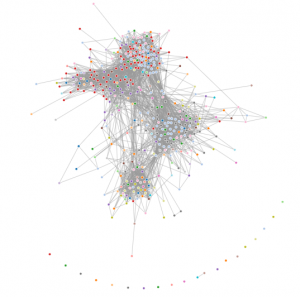
Using socilab.com I was able to gain insight into my social network data and analyze the connections I have through LinkedIn.

Key findings:

  •  When I first went to college, I took a specific program in Sporting Goods Business. This industry is very well connected and networking has been very important. The connections within that hub are very dense, where many of my contacts know each other. Most graduates of the program have left to work in the industry and have kept connected throughout the years, I was not surprised with this data.
  • Geographic clusters: By living in Montreal, Peterborough, Toronto, Ottawa and now Calgary, I have broadened my network throughout the country. Most of the dense clusters are collections of people I know from the specific jobs I had in each of those cities. 
  • Peripherals: Most of the individuals on the outside of my network are people I have met in courses, conferences, and in some cases are unknown to me. Friends and family are also scattered throughout the peripherals as many of them do not share career connections with me.