LRNT 523 Activity 5 – Reflection on Theoretical and Pedagogical Stance

When reviewing the theoretical positions outlined by Ertmer, Newby, and Merril, the position I align with the most at this time in my career is that of the constructivist theory. It might be because constructivism has gained popularity and has become a dominant theory within education, that I feel it relates most to how my team and I approach our training methods (Ertmer & Newby, 2013). Or, it might be because I feel as though my tendency to learn is similar to the traits outlined in the constructivist theory, specifically when it comes to requiring realistic settings to create an understanding (Ertmer & Newby, 2013). I primarily work with a group that is responsible for building and evolving training content to support the needs of our internal customer (retail staff).

Over the past 5-10 years, we have seen a drastic shift in the demographic of our staff base and the large majority of our employee base now fits within the millennial generation, which has been stated as being anybody born after 1980 (Ng, 2010). Bednar et al.(as cited in Ertmer & Newby, 2013), states that constructivist theory is realised in learning when individuals create meaning  stemming from their experiences. At my workplace, in the past, we have taken a similar approach by facilitating in-person, experiential training events that encourage our staff to experience product and activate in it. The intention of hosting such events was to give staff the opportunity to truly understand how the products they were to sell, worked first hand, ultimately giving them more credibility and authenticity on the sales floor.

Looking ahead, Prensky (as cited in Ertmer & Newby, 2013), acknowledges that young people are deeply savvy with technology and that they prefer to learn in different ways. For this reason, it will be important for my team to continue to consider the perspectives stated within the constructivist theory and determine how it can be applied as we transition towards a digital training strategy. Key factors like learners wanting content that is relevant to real-life situations and requiring training methods that explore different and complex environments (Ertmer & Newby, 2013) align with how we are moving our strategies forward. Basic product knowledge will always be provided to our staff through various training platforms, however, the ability for us as trainers to create complex customer scenarios and various in-store situations in a digital format will be critical for us moving forward. The goal will be for our staff to be able to use their basic product knowledge and personal experiences and make recommendations based on the needs and requirements of their customers. Their abilities to be agile and pull on information and apply it to a variety of different situations and customer profiles will ultimately create a better experience for customers and drive sales. Lastly, from the viewpoint of constructivism, I think the final step our team should consider when developing a digital training strategy, will be to create a platform for our young learners to validate their knowledge through social interactions and relevant scenarios (Ertmer & Newby, 2013). Ideally this will create an environment for constant learning and conceptualization of how training content is interpreted and shared amongst their peers.

Ertmer, P., & Newby, T. (2013). Behaviorism, cognitivism, constructivism: comparing critical features from an instructional design perspective. Performance Improvement Quarterly, 26(2), 43-71.

Ng, E. S. W., Schweitzer, L., & Lyons, S. T. (2010). New generation, great expectations: A field study of the millennial generation. Journal of Business and Psychology, 25(2), 281–292. https://doi.org/10.1007/s10869-010-9159-4

Instructional Design and Instructional Media – The Past to the Present

Reiser (2001) made various assumptions and depicted the history of both instructional design and instructional media and how they differ yet in some cases align through the evolution of educational technology.

Two lessons from the past that resonate to my work are:

In regards to instructional design, subject matter experts were often times responsible for creating and delivering training content. Reiser (2001) suggests that subject matters are not necessarily as effective at creating and meeting the learning objectives therefore the need for instructional design expertise was necessary. In my line of work, we have traditionally used subject matter experts to oversee all training strategies and content building. As a result, we have an abundance of content; however it is not packaged or delivered in a way that is well received from our millennial learner. This lesson in addressing the need for that liaison in between the subject matter expert and the learner is valuable insight to take back to my workplace.

Another lesson I found to be relevant and meaningful to my line of work is the notion that online programs cannot just be replicas of the design used for classroom or typical instructor to learner designs (Reiser 2001). Content and formatting needs to be tweaked in order to be effective online. In my department, we are in the transition of taking our training strategies from in-person classroom style training events to an online setting. This lesson is important for us to consider as we attempt to make relevant digital content. Again, we are stuck in a situation where we are trying to recycle or reuse old classroom instructional design methods and apply it to our digital platforms. This lesson will be important for us to consider as we explore not only our strategies for the next year but the talent pool we have to move forward.

A lesson that conflicts with my day-to-day work is the concept that students learn equally well regardless of the medium of the presentation (Reiser, 2001). We are consistently focused on the medium to which we are delivering content and feel as though it does have an impact on the learner. For example, we are exploring a mobile friendly training app to host training content to replace a traditional linear course that is housed on an LMS using desktop computer. Where I see the contradiction is that the means (or method) of delivering the content does have an effect on the ease and interest for the learner, in our case, the millennial learner. The results through test groups have shown that the content is viewed upwards of twice as much when it is accessible at their fingertips through a mobile device rather than the traditional use of a back office training computer.

Reiser, R. A. (2001). A history of instructional design and technology: Part I: A history of instructional media.. Educational Technology Research and Development, 49(1), 53-64.

Research Dissemination – George Veletsianos

As part of the research dissemination, George Veletsianos answered a few questions from students about his experience with research. A few key takeaways included:

  • Pick something you are genuinely interested in researching and learning more about.
  • Forumulate questions based on answers you trying to find. 
  • Consider examining relationships between variables as part of your research question. 
  • When doing background research, start by what you know and what you’ve come across on the topic thus far, then proceed to explore relevant databases.


Research Dissemination – Melanie Wrobel

As part of the research dissemination activity, the Royal Roads University copyright officer, Melanie Wrobel, shared some important information on copyright law. There were a few points that stood out to me through her presentation being both a graduate student and a member of large public corporation. My top 3 learnings are:

  1. Fair Deal Policy
    • This policy helps you identify if you’re using the work you’ve obtained in a fair way. The 6 point diagram is a great tool that asks questions to help identify if you are abiding by a fair deal policy.
  2. Assessing Risk 
    • For example, posting on a Moodle discussion board is considered low risk, whereas posting your thesis online could be high risk for copyright issues if permission is not requested or given.
  3. Law of the Land
    • Canada is part of the Bern Convention which means each of the countries involved are part of a basic copyright agreement. Law of the land means regardless of the origin of the document you are using, you must follow the copyright laws in your own country (Canada).

This presentation helped reinforce the need to CITE CITE CITE! It was enlightening to understand the difference between simply citing a source and identifying when you need to ask for permission from the copyright owner (using the RRU permission letter). Following the fair deal policy is as a good rule of thumb to help identify which path to take when using the work of someone else. 


Creation of Digital Identity – Plan

Goal and Purpose:

My goal is to create a sustainable digital identity that displays my professional achievements and knowledge of Learning and Technology. I want to ensure I stay relevant and “in the know” as digital environments evolve. 

Approach for Achieving this Goal:

It will be essential for me to step out of my comfort zone and begin to share my learning journey and knowledge within the industry with others. I often keep my life quite private and have a hard time sharing on social platforms (especially with relation to my career). LinkedIn and Twitter will be two platforms I will focus on to create my digital identity, and WordPress will be used strictly to develop my digital identity as a graduate student.

Skills and Knowledge Gaps:

I lack the skill set to navigate both LinkedIn and Twitter and leverage it to it’s effective potential. I am not used to sharing my opinions in a digital setting as it relates to my career and related industry topics. Articulating my opinions and writing professionally will be a learning curve for me. 

Strategy and Approach to Address Gaps:

Exposure to academic writing and research methods will be important as I begin to share information digitally. 

Measures of Success:

I will develop a functioning and informative WordPress site to share with my MALAT peers and begin to engage in meaningful discussions related to my industry on LinkedIn. 

Social Network Data

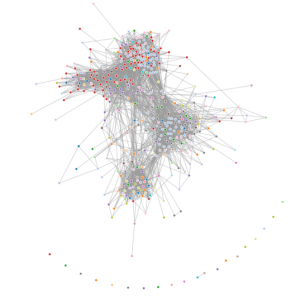
Using socilab.com I was able to gain insight into my social network data and analyze the connections I have through LinkedIn.

Key findings:

  •  When I first went to college, I took a specific program in Sporting Goods Business. This industry is very well connected and networking has been very important. The connections within that hub are very dense, where many of my contacts know each other. Most graduates of the program have left to work in the industry and have kept connected throughout the years, I was not surprised with this data.
  • Geographic clusters: By living in Montreal, Peterborough, Toronto, Ottawa and now Calgary, I have broadened my network throughout the country. Most of the dense clusters are collections of people I know from the specific jobs I had in each of those cities. 
  • Peripherals: Most of the individuals on the outside of my network are people I have met in courses, conferences, and in some cases are unknown to me. Friends and family are also scattered throughout the peripherals as many of them do not share career connections with me. 

Virtual Symposium Reflection

This assignment was eye opening for me. At the time I wrote this, I was in the mindset of simply sharing my opinions and thoughts, not fully understanding the scope of what APA was or how to use it. As I read through this again and hear “how do you know this to be true?” ringing in my ears, I feel that my path to becoming an academic writer is starting to move in the right direction!

The symposium was a very enlightening and encouraging collection of information. I felt that it completely aligned with the direction my organization is taking towards an open learning environment. The “cluttered and messiness” of online communities spoke all too well to the learning curve I am having with this shift in corporate training. This was the first time I was introduced to the concept of “Rhizomatic” learning and found it very intriguing. I like the notion of considering learning as an on-going process with no real beginning or end. In my field I do not oversee structured training (like health and safety or first aid etc.) so I have the opportunity to look at how a rhizomatic learning process could benefit the audience I create and manage content for. A few of the current students shared their research as it relates to corporate training and specifically when it comes to knowledge retention through face-to face training versus E-Learning . The exploration in how effective the different strategies are and how to maximize effectiveness resonated with me as I am currently working on how to redesign our corporate training strategy to best suit our millennial learner.

I agreed with the concepts discussed in the presentation from Dr. Roland Van Oostveen about Teacher Control versus Learner Management. This is something I have been researching and discussing quite often in my workplace in terms of how our internal learning management system will (or will not) evolve. I believe that the future engagement of learners will have a lot to do with how much control they have in their own learning journey, especially when it comes to the digitally savvy millennial learner. The concept I agree most with is that self-directive and collaborative learning will encourage a lifetime of learning and information retention.  The evidence in my workplace is that we are seeing a lack of interest in our formal mandatory course path. Our young, busy, and highly stimulated learner has expressed that the long, drawn out training video format we have used in the past, simply does not interest or encourage them to continue watching (or to retain the information). The approach we have started to move towards has been around short digestible “just in time” training video segments that are posted in a timely and relevant manor and no longer deemed as mandatory. These segments are no longer than 90 seconds long and always have a clear and relevant message. Our internal customer (retail sales staff), now have the opportunity to watch as they wish and create their own “playlist” or “training journey” to suit their needs. We have seen an extraordinary amount of trackable views and interactive participation from the group. The retail staff can ask real time questions and interact with their colleagues through chat function that compliments the video portal while creating their own training schedule and mode of ingesting content. There is however, an opportunity I see for my workplace after listening to some of these presentations, which is to create the opportunity for the learner to produce content and share it with their peers. This would essentially give them the opportunity to be invested not only in their learning journey but also those of others. This supports the notion discussed in the symposium about instructor control vs learner management and how giving the learner the opportunity to be part of their learning journey and also interacting and collaborating with others throughout the process. By removing all power from the teacher (in my case corporate trainers), the audience can become more engaged with the material.

Welcome to your site!

WordPress logo

This is your WebSpace powered by WordPress site. It will be the home for your journey through the MALAT program, and you can customize it to meet your needs and reflect your style.

Use these tutorials to learn more about customizing your WordPress site.

Navigating the Dashboard

Customizing the Appearance of your WebSpace

Themes

Creating Content, Pages and Posts

Security and Visibility, Restricting Access to your WebSpace

All WebSpaces powered by WordPress tutorials