
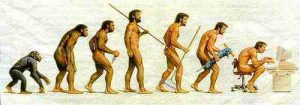
Dyson, E. (2005). Evolution [Photograph]. licensed under CC By-NC-ND 2.0
When reading through this week article, it is interesting comparing the evolution of technology over the years as discussed by Weller (2018) and Reiser (2001a, 2001b).
One of the main points that stood out to me in Weller’s (2018) article was in his conclusion, where he succinctly stated that in the advancement of edtech, it is the tech(nology) that has been changing, not the ed(ucation). I find this very interesting as a online secondary school teacher. The technology that has advanced in education has given me a job that did not even exist that long ago, but what I teach, and a lot of the way I instruct or assess has not changed. There are still tests, but instead of being written by hand on paper, they are done on the computer. This is in agreement with what Weller was discussing.
In Reiser’s articles (2001a, 2001b) he discusses the history of instructional design and technology up to his publication date of 2001. Reiser discusses how instructional television was not adopted for a few reasons; including, the resistance to change, the expense of new technology, and that the technology is only a educational enhancement (2001a, p. 59). Although in many ways I agree with these statements, in the last few years technology has been able to do more than just be an educational enhancement. With the increase in technology used in distributed learning, we are now able to reach more students who would not have been successful ( for one reason or another ) in the traditional classroom. For them, the growth in technology means that they can still continue their education, and is much more than just an enhancement.
Overall, I have to agree with Reiser in that throughout history, we have had a tendency to jump into new technology bandwagons. The potential that they were originally sold us on, was not lived up to and often the technology ends up being abandoned. It is interesting to think of how fast technology is currently changing, and assuming we are going to be following similar trends, where we might end up in only a few short years.
References:
Reiser, R. A. (2001a). A history of instructional design and technology: Part I: A history of instructional media. Educational Technology Research and Development, 49(1), 53-64.
Reiser, R. A. (2001b). A history of instructional design and technology: Part II: A history of instructional design. Educational Technology Research and Development, 49(2), 57-67.
Weller, M. (2018). Twenty Years of Edtech. Educause Review Online, 53(4), 34-48.
Amanda, thank you for sharing your perspective. As a person who teaches online, you must see the impact technology has on a regular basis. While I agree that sometimes we move to technologies that do not live up to what they promise, I have also observed technology that does meet the requirements; however, users are not trained to use it to its full capabilities. Do you think that providing adequate training opportunities to employees using the technology could result in the technology being adopted by more users?