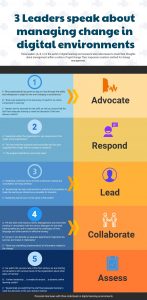
Change management, in a culture of rapid transformations, was the topic during three separate interviews with leaders in digital learning environments (DLE). Two of the three leaders came from the same organization, similarities in all three responses to change management were obvious. The results of the interviews created a five-step process in change management: advocate, respond, lead, collaborate and assess (see Figure 1). I will describe this process and address any connections to established change management methods here.
All three leaders reported, identifying a need and advocating a shift in practice is the first step in their process of change management (see Figure 1). They emphasized how needs and challenges are identified not in isolation by management, but by people on the ground. Aligning with Beer, Eisenstat and Spector’s Six step method (Al-Haddad & Kotnour, 2015) who claim, people who find themselves confronted with a problem are also the ones able to identify the challenges and find solutions. Kotter’s Leading change method addresses this role of frontline workers who can initiate change through the creation of a sense of urgency. Luecke’s Change method (2003) addresses a sense of urgency as a motivator used by management to introduce change (p. 34). Interviewed leaders agreed, how an organization responds to change is an important next step in change management, and positive outcomes are due to this responsiveness (see Figure 1). One participant’s response reflects Luecke’s method when they describe their organizations “willingness to adapt to new and changing circumstances” (as cited in Figure 1). Particularly, the identification of a need was highlighted, supporting Luecke’s claim that joined identification of a problem results in a shared vision and solution finding (Al-Haddad & Kotnour, 2015). How change is advocated for, and ultimately responded to, form the first two steps in change management.
The next two steps are to lead and collaborate (see Figure 1). Participants spoke about a strong presence of leadership when introducing new methods of teaching and engaging in ongoing decision making and discussions. Identified as a significant element for change, is the belief by leadership that change was necessary (see Figure 1). Luecke’s Change method identifies this leadership as an important element in change management (Al-Haddad & Kotnour, 2015). He describes leaders as defenders of a shared vision, highlighting the importance of “buy-in” (as cited in Figure 1). Collaboration and the creation of supportive teams, as a vehicle for change, is emphasized by Hamel’s Insurrection model and Kotter’s Leading change method (Al-Haddad & Kotnour, 2015). Interviewed leaders agreed, a need for collaboration between different departments is important. One, in particular, spoke about Human Resources being “heard by Senior Management” (as cited in Figure 1) as a deciding factor during their project implementation. Although, Luecke (2003) disagrees with this as he states not to be “tempted to put the human resources department in charge” (p. 39). He claims, even though Human Resources is an expert in staff-related issues, they have no experience in the running of an organization. However, he also states collaboration cannot happen within a hierarchy or top-down approach, therefore supporting the participant’s experience of a bottom-up approach of collaboration between management and various departments. Leadership and a bottom-up approach in collaboration, form important steps in the process of change management.
The final step in change management is identified as assessment (see Figure 1). This is seen as assessing to measure final project outcomes, monitoring needs during the project and anticipating the need for future projects (see Figure 1). Hamel’s Insurrection method and Luecke’s Change method highlight this need for assessment as necessary final steps of change management (Al-Haddad & Kotnour, 2015). Luecke addresses the monitoring of processes and the need for responsiveness to any challenges arising during implementation. All participants addressed ongoing responsiveness as an integral part for the future success of a project and the ability to recognize if further changes need to be implemented (see Figure 1). This assessment is seen by Hamel as a cyclical process in change management (Al-Haddad & Kotnour, 2015). Thus continuing a responsive process in the renewal of digital environments.
In conclusion, change management is identified by three leaders in DLE as a five-step process: advocate, respond, lead, collaborate and assess (see Figure 1). Each step is supported by several established change methods, with a pronounced alignment to Luecke’s Change method (Al-Haddad & Kotnour, 2015). This gives validity to these leader’s experiences and views and supports the implementation of Luecke’s Change method as a process for change management in DLE.
References
Al-Haddad, S., & Kotnour, T. (2015). Integrating the organizational change literature: a model for successful change. Journal of Organizational Change Management, 28(2), 234-262. Retrieved from https://doi.org/10.1108/JOCM-11-2013-0215
Luecke, R. (2003). Managing Change and Transition. Boston, MA: Harvard Business School Press.
