
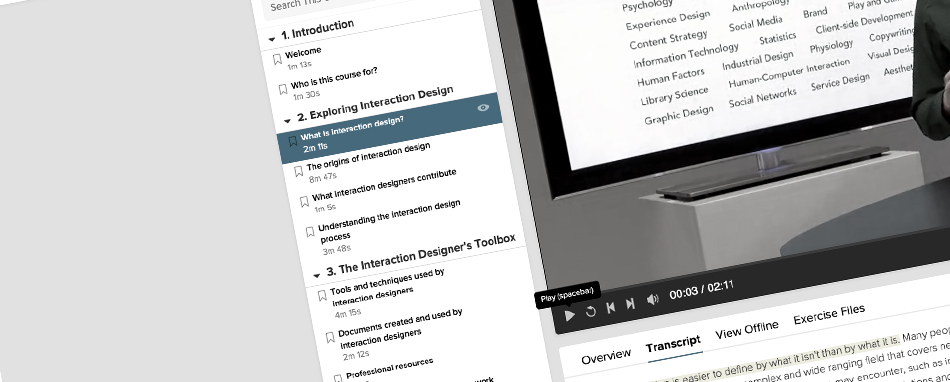
The interactions between student and teacher are fundamentally changed in video-based learning. Assessing cognitive load and whether learning has taken place and maintaining student engagement is imperative in determining whether a curated video library can be a viable source of learning either as a primary or as an additional resource. Reading 30+ articles I found that a number of factors contribute to balance the cognitive load in video-based learning: length (Brame, 2016); instructor presence in the video (van Wermeskerken & van Gog, 2017; Wang & Antonenko, 2017); graphics, animations (Wong, Leahy, Marcus, & Sweller, 2012); text and audio narration (Clark & Mayer, 2011); interactivity through questions and challenges (Vural, 2013); video lecture types (Chen & Wu, 2015); scaffolding (Cojean & Jamet, 2018); teaching declarative or procedural knowledge (Hong, Pi, & Yang, 2018); prior knowledge (Kalyuga & Singh, 2016); design elements.
My research topic is instructor presence in videos, but I am suggesting Lynda.com video tutorials to my students for information seeking (IS) in addition to Google (our “best friend” in web development).
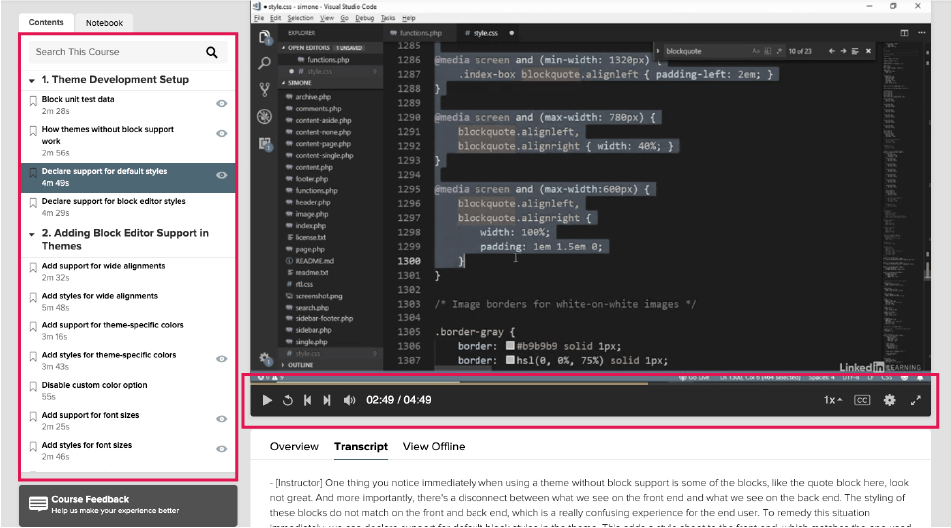 Scaffolding is “providing tools that increase users’ comprehension” (Cojean & Jamet, 2018, p. 961). The goal is to find the relevant information in an efficient and effective way. Play, pause, forward, rewind, and segmentation are micro-level activities and result in microscaffolding, while structuring and providing a table of content are macro-level activities and result in macroscaffolding (Cojean & Jamet, 2018). Cojean & Jamet (2018) described that scaffolding a video helped students to engage in efficient IS, but they had less accurate mental representations of the video. When scaffolding is missing, users are more likely to develop a relevant mental model of the video content. In short, scaffolding enhances IS but does not allow the provided external conceptual model to be internalized as a mental model. Video‐based environments are used not only for IS tasks but also for learning contexts, though according to Cojean & Jamet (2018) IS and learning are closely linked, as information processing begins with the localization of the relevant information.
The illustrations are created by the author.
References
Brame, C. J. (2016). Effective educational videos: Principles and guidelines for maximizing student learning from video content. CBE—Life Sciences Education, 15(4), es6. https://doi.org/10.1187/cbe.16-03-0125
Chen, C.-M., & Wu, C.-H. (2015). Effects of different video lecture types on sustained attention, emotion, cognitive load, and learning performance. Computers & Education, 80, 108–121. https://doi.org/10.1016/j.compedu.2014.08.015
Clark, R. C., & Mayer, R. E. (2011). E-learning and the science of instruction: Proven guidelines for consumers and designers of multimedia learning (3rd ed.). San Francisco: Pfeiffer.
Cojean, S., & Jamet, E. (2018). The role of scaffolding in improving information seeking in videos. Journal of Computer Assisted Learning, 34(6), 960–969. https://doi.org/10.1111/jcal.12303
Hong, J., Pi, Z., & Yang, J. (2018). Learning declarative and procedural knowledge via video lectures: cognitive load and learning effectiveness. Innovations in Education and Teaching International, 55(1), 74–81. https://doi.org/10.1080/14703297.2016.1237371
Kalyuga, S., & Singh, A.-M. (2016). Rethinking the boundaries of cognitive load theory in complex learning. Educational Psychology Review, 28(4), 831–852. https://doi.org/10.1007/s10648-015-9352-0
van Wermeskerken, M., & van Gog, T. (2017). Seeing the instructor’s face and gaze in demonstration video examples affects attention allocation but not learning. Computers & Education, 113, 98–107. https://doi.org/10.1016/J.COMPEDU.2017.05.013
Vural, O. F. (2013). The impact of a question-embedded video-based learning tool on e-learning. Retrieved April 7, 2019, from https://eric.ed.gov/?id=EJ1017292
Wang, J., & Antonenko, P. D. (2017). Instructor presence in instructional video: Effects on visual attention, recall, and perceived learning. Computers in Human Behavior, 71, 79–89. https://doi.org/10.1016/J.CHB.2017.01.049
Wong, A., Leahy, W., Marcus, N., & Sweller, J. (2012). Cognitive load theory, the transient information effect and e-learning. Learning and Instruction, 22(6), 449–457. https://doi.org/10.1016/J.LEARNINSTRUC.2012.05.004
I would agree, there are many factors in the use of video in learning, and they’re not always easy to correlate with learning. I suspect there is much interaction between them. The scaffolding vs learning discussion would make sense since IS tends to be more learner-controlled, and thus in service of their own goals and interests, vs a more passive immersion mode where the video’s intrinsic narrative is (assuming competent production) building towards a coherent picture or mental model for the learner.
The scaffolding vs learning is an interesting direction and a definite gap for research.
It is all about how the users are using these tools, in my case, Lynda.com videos. A classmate mentioned in an earlier comment that they used the Lynda.com video library for many years without completing a full course. Their experience was similar to many of my students’ practice. We used the video repository many times for information seeking. I would assume Lynda.com instructional designers know this as the service is easily searchable, allowing users to locate relevant courses and video segments according to their topics of interest (Morin, 2017).
We need to research the users and serve them from a usability point of view. We can shape some of their habits and create some new services hoping to create demand, but primarily, they will use the service however they want.
I found some similarity during my print vs digital reading (comprehension and preference) research with this information seeking and learning on video-based learning. The claims are in line with the findings of Cojean & Jamet described in the above short post.
Learners enjoy the convenience of digital readings, especially the ability to quickly search and find particular words and phrases but also suggests that these features lead to “using” the digital text as opposed to actually reading (Baron, 2017). The challenge of reading attentively on digital platforms is that people mostly use digital devices for quick action, thus hard to switch the mindset for something substantive (Jabr, 2013). Baron (2017) and Jabr (2013) also claim that most digital readings with the search/scroll/tap forward features interfere with the document navigation as they require continuous focus on both the text and its movement, which can prevent from mentally mapping passages as they distort people’s sense of place and leave less capacity for comprehension.
References
Baron, N. S. (2017). Reading in a digital age. Phi Delta Kappan, 99(2), 15–20.
Jabr, F. (2013). Why the brain prefers paper. Scientific American, 309(5), 48–53.
Morin, J. C. (2017). Flipping the classroom with Lynda.com. Academy of Management Learning & Education, 16(4), 627–629. https://doi.org/10.5465/amle.2017.0283
Hi Beata –
The angle of scaffolding vs learning is an interesting topic. I had not made the connection to similarities in digital reading either which does raise questions about the implications on our ability to process information cohesively.
Through James and Cojean’s (2018) perspective that “relevant mental model of the video content” is less with scaffolding, my question is what implications does that hold for applied learning? In my case, when I went through other Lynda videos, I rarely watched the entire video because not all the segments were relevant to my needs but my perception is that I did not need to watch all of it to get a comprehensive perspective or be able to apply my learning. However,reading a digital article feels different. Video-based content, as you mentioned, the social presence of the instructor along with the factors related to cognitive load better support my ability to learn (my perception) and comprehend…going back and forth to re-watch a particular topic is more convenient and easier to process than going back and forth through at least a digital reading… interesting to think about!
Thank you, Mel, for thinking about it. As Irwin mentioned above after my long list of parameters influencing cognitive load and learning, that “there are many factors in the use of video in learning, and they’re not always easy to correlate with learning. I suspect there is much interaction between them.”
I would assume that your prior knowledge of the topic also influence how much you learn and retain the content. And the experience is different whether you compare the same information from a video and a digital article or a different topic.
Scaffolding in digital readings vs video-based learning seems to work quite similar. If there is a TOC or segments are provided or play/forward/tap to next page is added they help information seeking but might not help the presented external conceptual model to be internalized as a mental model.
Your question: “Through Jamet and Cojean’s (2018) perspective that “relevant mental model of the video content” is less with scaffolding, my question is what implications does that hold for applied learning?” I do not know the answer, as I have not found too much research on it so far, and they also called for research (in 2018), as it is a gap. My totally unsupported thought is that there should be a sweet spot, a right balance, where some micro- and microscaffolding is provided but does not prevent the mentioned mental model creation.
Hi Beata – I see what you mean about the TOC and segments effective for information seeking…and therefore not being able to support internalization as a mental model. You are pursuing an interesting line of inquiry, especially when thinking of the users and what usability features can best serve them. That sweet spot you mentioned is the jackpot…perhaps another good topic for future research!?