
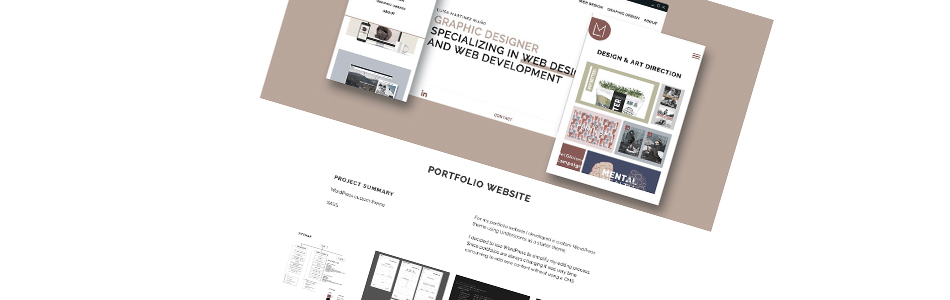
My design challenge is how to ensure the web developer students spend valuable and efficient time on planning and developing their professional portfolio website geared toward their after-program goals, provide the guidance what they look for, without overwhelming them with information and resources.
The Portfolio Website module is a ten-day course over seven-eight weeks, and in parallel, the learners work on their capstone project. Students are to plan, design, develop and publish a professional-level portfolio website, to showcase all their digital work in a fully functioning publicly accessible website to apply for web development related jobs. The learners do not meet me every day, and I am not able to see their progress and keep up their engagement in person. I guide the students and provide them with feedback in between the course days on different platforms. The recently graduated class was the first when I run the module in this hybrid format and as everything after the first run needs improvement.
The web/app development field heavily relies on understanding the user. To design and develop any digital solution, one must delve into the target audience. Coming from a design, development and service development background, I have had a few opportunities to become familiar with various methods to help to better understand the user.
Audience: web developer students reaching the final modules of their web development certificate program.
Main parameters:
- Age is mainly between 25-40, with the occasional just out of high school participants and a few more mature students (40-55).
- Have a few years of work experience.
- Most students are in transition to a new career field.
- Some are new to Canada and pursue either a new career or a local certificate.
Main stakeholders in the learning module:
- Current students.
- Potential employers/industry people in case of desired employment.
- Clients/small businesses in case of pursuing freelancing business (this is rare right after the program).
- Program instructors.
- Experts, such as career advisor who facilitates IT related resume and interview skills workshop.
- Graduated students who experienced the hiring process with similar knowledge and work experience.
- I, who supervises the curriculum of the program and facilitates the Portfolio Project module.
In reviewing the empathy methods as described in the Bootcamp Bootleg (Stanford University Institute of Design, 2016) and the Design Kit (IDEO, 2015), I believe that a combination of methods is the best to establish empathy with my audience and stakeholders.
Facilitating the previous intake’s portfolio course and experiencing and solving the issues, as well as continuously receiving feedback from the students, provided me with a lot of insights, observations and ideas on the possible changes in the module. I observed the students as they approached the different stages of the project. I also went through a similar experience as the students when I launched my web developer career a few years ago. Therefore, I’ve already made use of what IDEO (2015) describes as peers observing peers, and immersion. I also have a few years of experience in coaching and mentoring subordinates and students.
For the LRNT-527 course assignment, I plan to contact the following stakeholders:
- A program graduate, who also teaches the capstone project in the program while the students work on their portfolio site. His experience and observations can be highly beneficial.
- An alumna who participated in this recent “hybrid” version of the Portfolio Website module.
I plan to observe their reaction and spark a dialogue with them individually for 40-60 minutes. I intend to use either conversation starters or card sort to engage them (IDEO, 2015). Both methods are about getting a reaction and sparking dialogue. In Conversation starters, the idea is to suggest a number of ideas around a theme to the audience and then see how they react and encourage creativity. Card sort is a quick and relatively simple way to start a conversation about what matters most to the audience. A deck of cards is involved, each with a word or single image, and then ask them to rank them in order of preference, to gain insight into what counts. Both methods are widely used in user experience design to understand the desired message of a website/app and create the architecture of the site.
- A plan to chat with the career advisor, who we hire in the program to facilitate the resume and interview skills workshops, to conduct a short so-called expert interview. Experts in the involved fields can “get us up to speed quickly on a topic, giving the key insights into relevant history, context, and innovations” (IDEO, 2015, para. 1).
- I can also conduct secondary research, to learn about the broader context and the innovations in this area. Although secondary research is time-consuming but can validate ideas, assumptions and input from the stakeholders.
Necessary resources: The resources required to complete the empathy phase of the exercise involving participants from the target audience and stakeholders, as well as compile my observations and conduct secondary research is a meeting room, pencils, paper, iPad + Apple Pencil, and computer.
Challenges / Constraints: I anticipate a few challenges and potential constraints. It is summer time and the recently graduated students who experienced this hybrid format already left. Same timing challenge applies to the previous graduate/instructor, who just left for his holiday. The upcoming class did not reach this module yet and have not learned anything about the portfolio.
Countless activities, features and information could be useful for the Portfolio Website module’s digital learning resource which could engage the students. However, the module has only ten face-to-face days with six hours each and the other days, the learners are occupied with a different project. Therefore, the time for the face-to-face activities is limited and it is also important to reserve significant time for 1-on-1 meetings for verbal and personalized feedback for the students.
The main goal of instructional design in multimedia learning is to reduce the unnecessary cognitive load and maximize the cognitive capacity to help the learners to reach the learning outcomes (Kruger & Doherty, 2016). Cognitive load (CL) is the total load placed on working memory by instructional information. The solution for my challenge must be focused and to the point in the digital learning resource and leave only the necessary elements to balance the cognitive load and avoid hurting learning (Clark & Mayer, 2011).
The illustrations are created by the author.
References
Clark, R. C., & Mayer, R. E. (2011). E-learning and the science of instruction: Proven guidelines for consumers and designers of multimedia learning (3rd ed.). San Francisco: Pfeiffer.
IDEO. (2015). Design Kit – Methods. Retrieved from http://www.designkit.org/methods
Kahneman, D. (2011). Thinking, fast and slow (E-book). New York: Farrar, Straus and Giroux.
Kouprie, M., & Visser, F. S. (2009). A framework for empathy in design: stepping into and out of the user’s life. Journal of Engineering Design, 20(5), 437–448. https://doi.org/10.1080/09544820902875033
Kruger, J.-L., & Doherty, S. (2016). Measuring cognitive load in the presence of educational video: Towards a multimodal methodology. In Australasian Journal of Educational Technology. Retrieved from https://repository.nwu.ac.za/bitstream/handle/10394/24668/2016Measuring_cognitive.pdf?sequence=1
Stanford University Institute of Design. (2016). bootcamp bootleg. Retrieved from http://dschool-old.stanford.edu/wp-content/uploads/2013/10/METHODCARDS-v3-slim.pdf
Hi Beata, a very thorough description of your design challenge and your engagement with the empathy phase. As you explain you have already engaged in several empathy methods prior to this design challenge and your selection of methods moving forward all seem appropriate and useful for your task at hand. You address the challenges of ‘timing’ as you explain “It is summer time and the recently graduated students who experienced this hybrid format already left. Same timing challenge applies to the previous graduate/instructor, who just left for his holiday. “ I find myself in the same situation, additionally I am in a very rural remote area, so conducting person to person interviews would be either very time consuming or near impossible. I am curious if you would be able to reach your chosen stakeholders using a simple survey such as Monkey Survey. I have had great success eliciting feedback from the filed using this program. I realize that you have chosen methods for the interview that may not lend themselves as easily to a remote electronic format, but it may be possible with an informational video introducing, for example, the card sort and then having the participant rank the cards in the survey. You have chosen a complex design challenge and I look forward to seeing how you solve it.
Hello Anita – Thank you for your thoughtful comment. I was also considering the survey solution, but from experience, I have gained fewer results from a survey than from an in-person session or immersion or observations. From my brand management “past” the surveys were only useful to provide for smaller changes.
I am currently reading the IDEO’s founder, Tim Brown’s (2009) book: Design for change, and he also mentioned similar things: ‘The basic problem is that people are so ingenious at adapting to inconvenient situations that they are often not even aware that they are doing so: they sit on their seat belts, write their PINs on their hands, hang their jackets on doorknobs, and chain their bicycles to park benches. Henry Ford understood this when he remarked, “If I’d asked my customers what they wanted, they’d have said ‘a faster horse.’” This is why traditional techniques such as focus groups and surveys, which in most cases simply ask people what they want, rarely yield important insights. The tools of conventional market research can be useful in pointing toward incremental improvements, but they will never lead to those rule-breaking, game-changing, paradigm-shifting breakthroughs that leave us scratching our heads and wondering why nobody ever thought of them before’ (p. 62).
I am not saying that my observations or the in-person session will lead to game-changing 😀 results but I do hope to create something much better for the hybrid format.
Reference
Brown, T. (2009). Change by Design: How Design Thinking Transforms Organizations and Inspires Innovation. NY: HarperBusiness.
I really enjoy your concept and how you’re approaching it Beata. I have worked in this field and also in teaching these topics so I can understand and (ironically for this post) empathize with the challenges you are facing.
Knowing that summer is a time when it’s more difficult to connect with students I think your combination plan sounds like a much more reasonable way to gain a better understanding and to overcome the challenges. I wonder if there may be a community outside of the main users who may be able to provide input. This topic is a very common one in post secondary so potentially you could connect with instructors and instructional designers from other post secondary schools.
I also found your focus on reducing cognitive overload very interesting. I have often found it difficult to estimate the cognitive load when teaching these subjects because I have done them so long. I’m interested to see what you may come up with to help reduce the load but also to help measure the load.
RE: “I also found your focus on reducing cognitive overload very interesting. I have often found it difficult to estimate the cognitive load when teaching these subjects because I have done them so long. I’m interested to see what you may come up with to help reduce the load but also to help measure the load.”
The reason I brought up cognitive load with my DLR is that the whole web development program is a fast track, immersive experience. Not as immersive as a bootcamp though. The students learn to code and create websites and part of it every weekday (and weekend :-)) for 23 weeks. It is quite easy to overload them, and I am not sure they are not overloaded already…
I have a continuous and constructive argument with some of my instructors in the program on adding more info vs removing some elements. We need to teach specific skills, but at some point, it is just merely dumping information on the learners, which is neither effective nor practical.
To go back to your point, Jeff, namely, how to measure cognitive load, or instead, how to measure the success of this tool. I will base the success determinants on the results of the needs assessment. In general, the goal is to provide the learners well organized, timely, not overwhelming assistance to plan and develop the portfolio site to apply for field related employment.
I will be able to see the first results at the end of October, as the next class starts this module at the beginning of September. I will also ask their feedback and use my and my colleague’s observations on the improvements and adjust the tool accordingly.