
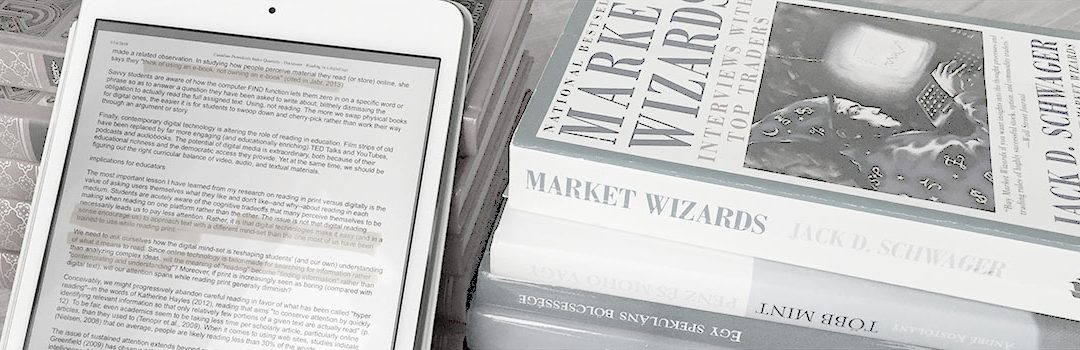
E-books and e-readers make it possible for millions of people to have access to texts that would otherwise be beyond their reach (Sackstein, Spark, & Jenkins, 2015) and their popularity is rising within education as schools worldwide have been moving to paperless classrooms over the years, and provide digital reading materials (Baron, 2017; Jabr, 2013). Wolf (2018), a neuroscientist made her case that deep, immersive reading is possible and much needed in our digital world. The fundamental question is how the use of such a device and digital reading materials and the digital mindset potentially alter perceptions of reading or reshape what it means (Baron, 2017), and whether students are able to read the different types of texts as effectively from screens as from paper. Research revealed that in general the reading speed and comprehension are not significantly hindered by the e-book format and the presentation device and that medium plays an influential role under certain text or task conditions, for certain readers (Margolin, Snyder, & Thamboo, 2018; Sackstein et al., 2015). According to Baron (2017), Jabr (2013) and Sackstein et al. (2015) students appreciate the lower cost, easier access, and convenience of onscreen readings, but print reading is perceived as having better cognitive or pedagogical outcomes, and the physicality of the paper is still preferred. These results demonstrate that e-books and e-readers are may be effective tools for reading and learning.
Margolin et al. (2018) and Sackstein et al. (2015) define the reading process where the words are physically perceived, mentally processed, then related to previous sentences and knowledge, to continuously update the content understanding and create a mental representation, so-called mental terrain of the passage based on the physical book corners helping the mind in the orientation and navigation (Wolf, 2007, as cited in Jabr, 2013). Literature also agrees that working memory plays a significant role in the reading process thus in both reading speed and comprehension (Margolin et al., 2018; Sackstein et al., 2015).
According to Jabr’s, people do not always invest the same mental effort into reading on screens, do not engage in “metacognitive learning regulation” (2013, p. 51) by setting goals or rereading difficult section which according to Baron (2017) provides an opportunity for reflection. Both Baron (2017) and Jabr (2013) claim that most digital readings with the search/scroll/tap forward/responsiveness features interfere with the document navigation as they require continuous focus on both the text and its movement, which can prevent from mentally mapping passages as they distort people’s sense of place and leave less capacity for comprehension. Baron (2017) and Jabr (2013) also state that dedicated e-readers’ e-ink reflect ambient light, but shining screens can cause eyestrain, headaches and blurred vision, making screen reading more mentally taxing and physically tiring, which might dull comprehension. Baron’s (2017) results verify that concentration is significantly better on print, and notes that the surveyed students reported that they read more carefully and remembered more thoroughly after print reading, were better in annotating and multitasked less; bells and whistles deflect attention away from the text content toward the device features, and readers spend more time browsing, scanning and searching for keywords.
Baron (2017) reveals that learners enjoy the convenience of digital readings, including the ability to quickly search and find particular words and phrases but suggests that these features lead to “using” the digital text as opposed to reading. The challenge of reading attentively on digital platforms is that people mostly use digital devices for quick action, describes Jabr (2013), thus hard to switch the mindset for something substantive. People might abandon careful reading in favour of what Hayles (2012, as cited in Baron, 2017, p. 19) called “hyper reading” which aims to focus attention on finding the relevant information and reading only a section of the text, as opposed to reading the whole. Baron (2017) openly asks whether the meaning of “reading” become “finding information,” and searching for information rather than analyzing complex ideas.
All authors list mixed, and non-conclusive findings from the literature on reading comprehension on different devices but suggest that based on the recent studies there is no significant difference between reading comprehension and memory on print and screen reading. Baron (2017) challenges the literature, claiming that the questionable circumstances – students tested with SAT-style comprehension questions – could lead to the mainly consistent performance across platforms, and results varied with altered conditions. Baron (2017) also found that with digital distractions under control, reading on screens or print is roughly the same; however, most readers still associate print reading with better cognition and learning outcomes as screen reading is reinforcing quick reading such as skimming and power browsing with less tolerance for longer texts. Sackstein et al.’s (2015) result verified that e-books do not compromise either reading speed or the levels of comprehension (literal, inferential, and evaluative) within an academic environment and reading speed does not necessarily affect comprehension. Margolin et al. (2018) took the next step in the research and clarify the conditions when reading comprehension may or may not be impacted by reading on an e-reader and find that e-reader is a good platform for longer narrative passages to garner thematic information, and the paper presentation is suitable for understanding detailed information, or longer expository text which requires more detailed processing. Margolin’s team also claim that when the influence of working memory is removed, the effects of presentation method and the type of questions disappear. Zeng et al. (2016) conclude that both screen size and file format can affect reading speed and reveal that EPUB format has a better-displaying effect on iPhone and Kindle and PDF file matches iPad and laptop slightly better. On the other hand Jabr claims that “plain text is not the only way to read” (2013, p. 53) and advises to test the interactive books: cinematic experience with embedded movies and audio. The increase in the availability and affordability of digital reading devices and the changing reading habits such as increased noncomputer use, varying device sizes (Wolf, 2018) also call for additional studies.
Conclusion
Margolin et al. (2018) and Sackstein et al. (2015) conclude that there are no significant differences in comprehension across devices and agreed, that e-reading in certain conditions will not significantly hinder reading speed and comprehension thus may be effective tools for reading and learning. However, their experiments were conducted in laboratory context with high-school/college students without distractions, and the tested medium was familiar and natural to the participants, which – as Baron (2017) also critiques – can affect the results. Baron (2017) also urges more research before drawing conclusions as teachers and students must understand how and when to employ digital reading, and she notes that how content is understood and retained in a non-academic setting is also vital. Both Baron (2017) and Jabr (2013) show some bias toward print reading but concede that attitudes towards digital reading are shifting while the mindset is changing. The paper format might be still preferred, but all reviewed authors agree that on-screen reading is here to stay as both print and e-formats have a place in literacy and learning.
E-reading is part of living in the 21st century, and immersive reading is vital but none of the reviewed studies consider young people with no or insignificant paper reading experience, where a print-digital reading comparison is not needed anymore, while educators need the guideline how to preserve deep reading processes in future iterations of the reading brain.
Read the preamble and see the annotated bibliography.
Illustrations are created by the author.
References
Baron, N. S. (2017). Reading in a digital age. Phi Delta Kappan, 99(2), 15–20.
Jabr, F. (2013). Why the brain prefers paper. Scientific American, 309(5), 48–53.
Margolin, S. J., Snyder, N., & Thamboo, P. (2018). How should I use my e-reader? An exploration of the circumstances under which electronic presentation of text results in good comprehension. Mind, Brain, and Education, 12(1).
Sackstein, S., Spark, L., & Jenkins, A. (2015). Are e-books effective tools for learning? Reading speed and comprehension: iPad®i vs. paper. South African Journal of Education, 35(4), 14.
Wolf, M. (2018). Reader, come home: The reading brain in a digital world (1st ed.). New York, NY: HarperCollins.
Zeng, Y., Bai, X., Xu, J., & He, C. G. H. (2016). The influence of e-book format and reading device on users’ reading experience: A case study of graduate students. Publishing Research Quarterly, 32(4), 319–330.
Your blogpost brought to my attention some of the latest research surrounding presentation formats and platforms on reading comprehension.
I connected my own practice when you stated:
However, their experiments were conducted in laboratory context with high-school/college students without distractions, and the tested medium was familiar and natural to the participants, which – as Baron (2017) also critiques – can affect the results.
Personally, my reading and learning styles at best would be described as “raccoon with shiny objects” referring to the fact I am easily distracted when reading or learning with a computer. Although I start with good intentions to meet specific outcomes, I tend to find too many opportunities to broaden my information rather than deepen my knowledge.
Another point that piqued my curiosity is where you brought the concepts of 21st C. e-reading and immersive reading as vital. You concluded your blogpost with:
E-reading is part of living in the 21st century, and immersive reading is vital but none of the reviewed studies consider young people with no or insignificant paper reading experience, where a print-digital reading comparison is not needed anymore, while educators need the guideline how to preserve deep reading processes in future iterations of the reading brain.
My thoughts went to a conversation with educators about when and how to effectively introduce social learning tools like Twitter, blogposts, and websites into learning environments. Interestingly, no one mentioned e-readers and e-books. After reading your blogpost, I recognize and acknowledge our conversation went directly to learners as producers rather than learners as content consumers.
I look forward to discussing your work, practices, and the potential impact of this research when choosing presentation formats and platforms for reading comprehension.
For this assignment, I reviewed a few potential topics related to history and changes in education.
I opted to find out more information and research on reading (comprehension, speed, working memory) because in the web development program what I lead and where I teach, I switched the books to e-books and included an iPad in the tuition for the students. We use the iPad for not only for reading but other web development related tasks as well. I also read 99% of my materials on computers or e-readers (mainly iPad, smartphone…). I reviewed more than 40 articles on this topic and two books, as it piqued my interest.
I recommend the books for everybody who is interested in how our brain and we behave when we read in general.
Baron, N. S. (2015). Words Onscreen: The Fate of Reading in a Digital World (1st ed.). New York: Oxford University Press.
Wolf, M. (2018). Reader, Come Home: The Reading Brain in a Digital World(1st ed.). New York: Harper
Maryanne Wolf has a previous book on this topic as well: Proust and the Squid: The Story and Science of the Reading Brain.
But back to the topic:
It is quite interesting that no matter of the platform, deep and immersive reading is possible, and people should be taught how to train themselves and pay attention no matter of distractions.
There was some research on reading comprehension, speed, and working memory and the pros/cons of the different platforms, and to be honest, there is no clear winner. There are directions which are better for one or another type of texts, BUT all of these experiments were on readers who had previous experience with print reading. This is changing; there are already young people who have now bias/prior knowledge of paper reading (for different reasons).