
After digging deeper into both academic and grey literature on the research of print and digital reading comprehension and learning to create practical guidelines, I see a pattern shining through for my choice of the research paper’s theoretical framework.
My primary choice is cognitive load theory. Cognitive load theory is a framework that outlines a construct of cognition and how humans process and store information based on the concept of limited working memory and processing capacity, which should be a major consideration in instructional design (Leahy & Sweller, 2016; Sweller, van Merriënboer, & Paas, 2019; Wong, Leahy, Marcus, & Sweller, 2012). Cognitive load is the total load placed on working memory by instructional information. The additive, interrelated components of cognitive load, are intrinsic load caused by the complexity of the materials to be learned, the extraneous load generated by processing unnecessary information which interferes with learning, and germane load prompted by the necessary cognitive activity that directly leads to learning (Sweller et al., 2019). Learning to occur, the sum of the three components should not exceed one’s working memory capacity; exceeding it results in cognitive overload (Figure 1) (Kruger & Doherty, 2016; Sweller et al., 2019).

Figure 1: Cognitive load theory. The illustration is created by the author.
Recall and comprehension comprise cognitive operations, such as selecting, attending, memorizing, retrieving, and reasoning (Niccoli, 2015). Therefore, I am considering drawing upon concepts, principles, and assumptions associated with cognitive information-processing. The cognitive information processing model is the prevailing theory in cognitive psychology, which includes three types of memory (sensory, short-term, and long-term memory) that interact to encode incoming information (Figure 2) (Khalil & Elkhider, 2016; Niccoli, 2015). I admit this theory might not be necessary, as the cognitive load theory builds upon this widely accepted model already.
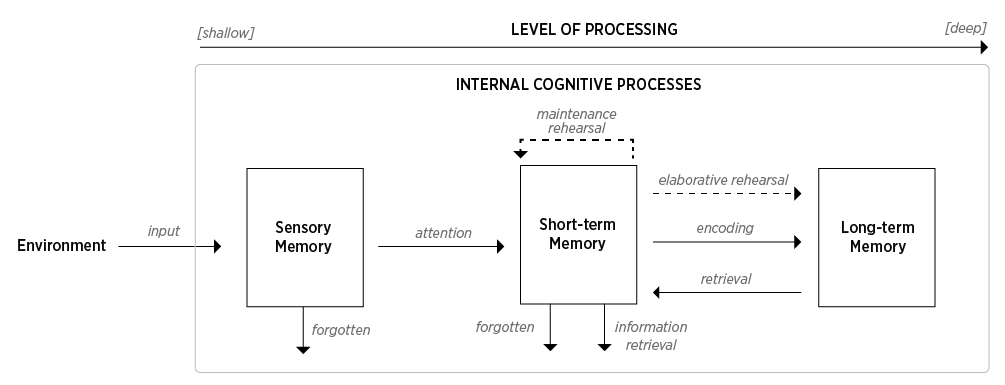
Figure 2: Relationship between the types of memories. The illustration is adapted from and adjusted based on “Applying learning theories and instructional design models for effective instruction” by M. Khalil & I. Elkhider, 2016, p. 148.
The third theory, which I consider using, and it is based on the cognitive load theory (and other cognitive theories of learning), is the Cognitive Theory of Multimedia Learning by Richard Mayer. Mayer refers to essentially the same types of cognitive load as those of cognitive load theory, however uses slightly different terminology: extraneous processing (equivalent to extraneous load of CLT), essential processing (equivalent to intrinsic load of CLT), generative processing (equivalent to germane load of CLT) (Mayer & Moreno, 2003). Mayer developed twelve principles of multimedia learning to facilitate the three types of processing. Although none of the gathered literature used it for reading comprehension research, I feel, some of the principles could provide for print and digital reading, such as the coherence principle, which describes that adding extraneous information can hurt learning (Clark & Mayer, 2011; Mayer & Moreno, 2003).
References
Clark, R. C., & Mayer, R. E. (2011). E-learning and the science of instruction: Proven guidelines for consumers and designers of multimedia learning (3rd ed.). San Francisco: Pfeiffer.
Khalil, M. K., & Elkhider, I. A. (2016). Applying learning theories and instructional design models for effective instruction. Advances in Physiology Education, 40(2), 147–156. https://doi.org/10.1152/advan.00138.2015
Kruger, J.-L., & Doherty, S. (2016). Measuring cognitive load in the presence of educational video: Towards a multimodal methodology. In Australasian Journal of Educational Technology. Retrieved from https://repository.nwu.ac.za/bitstream/handle/10394/24668/2016Measuring_cognitive.pdf?sequence=1
Leahy, W., & Sweller, J. (2016). Cognitive load theory and the effects of transient information on the modality effect. Instructional Science, 44(1), 107–123. https://doi.org/10.1007/s11251-015-9362-9
Mayer, R. E., & Moreno, R. (2003). Nine ways to reduce cognitive load in multimedia learning. Educational Psychologist, 38(1), 43–52. https://doi.org/10.1207/S15326985EP3801_6
Niccoli, A. M. (2015). The Effects of Reading Mode on Recall and Comprehension. NERA Conference Proceedings 2014, 2. Retrieved from https://opencommons.uconn.edu/nera_2014/2
Sweller, J., van Merriënboer, J. J. G., & Paas, F. (2019). Cognitive architecture and instructional design: 20 years later. Educational Psychology Review, 1–32. https://doi.org/10.1007/s10648-019-09465-5
Wong, A., Leahy, W., Marcus, N., & Sweller, J. (2012). Cognitive load theory, the transient information effect and e-learning. Learning and Instruction, 22(6), 449–457. https://doi.org/10.1016/J.LEARNINSTRUC.2012.05.004
Hello Beata,
I am responding to your blog not to provide suggestions but to comment on the idea that all three of your frameworks do indeed seem to support your research and all would seem to be strong support for your topic. I too discovered this overlap in theories while researching for my topic and was curious about this overlap. Is it necessary to choose one or is there strength using all of them to use as your framework? It also makes me curious if there are that many overlaps, how many other frameworks might also support this topic. I wonder if technology has blurred the lines of these frameworks? As I don’t feel confident enough to add suggestions, I add thoughts instead!
I agree with you, Danielle. I, too, feel that there is some overlap between the theories for my research, especially in the case of cognitive load theory (CLT) and cognitive theory of multimedia learning (CTML). It is not an accident in my case, as CTML is drawing on CLT.
I was thinking to use more than one theoretical framework, however, I am not familiar with how to use more than one for research. I found that using more than one theoretical framework is called theory triangulation 😃. It is using them as a different lens to analyze the same dataset; in my case, the research results for my topic. It might reduce bias, but increases variables. With only a few searches, I could not find a practical example for applying this approach.
Hi Beata,
Those all seem like good options for exploring your topic. I think there could be an interesting opportunity if Cognitive Theory of Multimedia Learning (CTML) has not been applied to eTexts before to look at in terms of reading comprehension, as I can see a lot of applicability. In fact, I would be very interested to see how Mayer’s (2009) 12 principles of CTML could be applied by those developing eReading platforms and interfaces. Perhaps there is also be an opportunity to look at whether the flexible options built into eReading platforms (change of text size, option to use text-to-speech, adding highlights and notes, etc.) support Mayer’s (2009) 12 principles for CTML?
In terms of the discussion you are having above with Danielle about adopting multiple theoretical frameworks, I had asked Deborah about applying multiple theoretical frameworks to my applied research project, and she mentioned, that three would be a lot for a Ph.D. thesis; so, I think the level of complexity and length of the research should likely be considered when deciding whether to apply multiple theoretical frameworks. I could see how applying too many theoretical frameworks could easily take over the bulk of the paper making the theoretical frameworks the topic as opposed to the underlying infrastructure. Perhaps though, it would be easier to apply two if they were related frameworks such as Cognitive Load Theory and CTML.
Reference
\Mayer, R. E. (2009). Multimedia learning (2nd ed.).New York: Cambridge University Press.
Thank you, Jessica, for your thoughtful comment. Also, thank you for sharing that piece of information about having more than one (let alone three 😃 ) theoretical frameworks for my research.
Since I published the blog post, I spent more time on the Cognitive Theory of Multimedia Learning (CTML) to see whether to run with it or stick with the Cognitive Load Theory primary and only bring up the relevant CTML principles to underpin my compilation (if any 😃 ).
The CTML is based on three principles. (1) The information processing system has two channels for individual processing of visual/pictorial information. (2) Each channel has limited processing capacity. (3) Active learning requires coordination of the cognitive processes (selecting and organizing relevant words and pictures and integrating them with prior knowledge). The dual-channel model includes text, images, and audio. These are part of multimedia learning, but I intend to focus on the reading (verbal channel). Both cognitive load theory and the cognitive theory of multimedia learning argue that poorly designed and constructed materials that increase working memory load will lead to ineffective learning. However, in my take, the CTML focuses on how multimedia materials can be best designed considering both channels and most of its principles are focusing on both channels and their interactions. The coherence principle (people learn better when extraneous words, pictures and sounds are excluded) where I see that I could focus on only the text; however, this overlaps with the CLT’s extraneous cognitive load.
All in all, I still consider the CTML principles whenever the research allows, but probably will use the CLT as my theoretical framework.
Concept sources
Ayres, P. (2015). State-of-the-art research into multimedia learning: A commentary on Mayer’s Handbook of multimedia learning. Applied Cognitive Psychology, 29(4), 631–636. https://doi.org/10.1002/acp.3142
Clark, R. C., & Mayer, R. E. (2011). E-learning and the science of instruction: Proven guidelines for consumers and designers of multimedia learning (3rd ed.). San Francisco: Pfeiffer.