
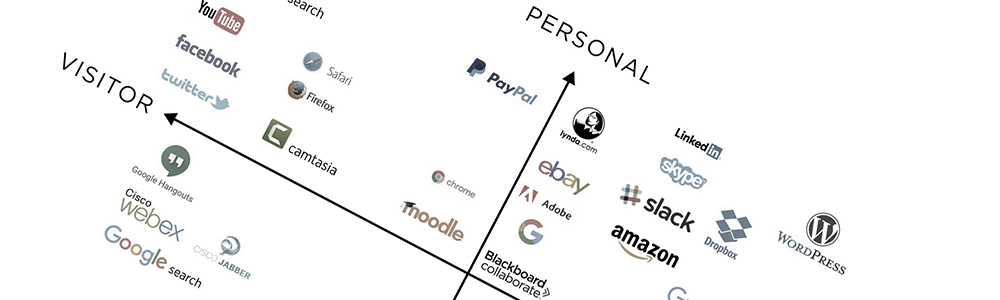
The visitor and resident continuum concept came as a reaction and alternative to Marc Prensky’s Digital Natives, Digital Immigrants categorizations. The digital natives, are those born after 1980, speak a different language, meaning they learn differently than digital immigrants because of technological immersion since birth. His recommendation, published in 2001, is for educators to learn the language of this century by listening to, and understanding, the ‘native dialect’. (Prensky, 2001)
Dave White took a different approach, suggesting mapping our use of digital tools on a continuum between visitor and resident. The visitors and residents continuum accounts for people behaving in different ways when using technology, depending on their motivation and context, without categorising them according to age or background (White, Le Cornu, 2011).
A visitor is regardless of age, may perform dozens of Google searches each day, but not engage with others, or create new learning destinations. Residents are simply living online, they ‘belong’ to virtual communities. To residents, the web is a place to express opinions, a place in which relationships can be formed and extended (White, Le Cornu, 2011, IV.2. Residents).
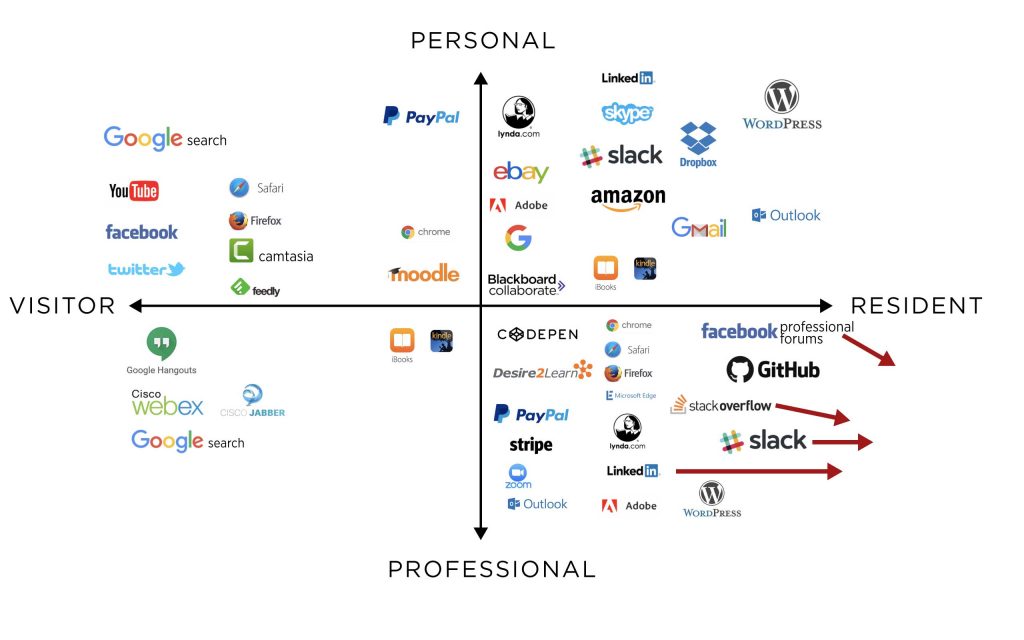
Creating a meaningful technology use map, using White’s continuum, required some time, review, analysis, and reflective thought, but maps have always fascinated me…
After finishing this exercise, it is quite visible that I am using ‘too’ many technology tools, even though I was not able to list all of them on the map. I assume it comes with the territory of working in web development and working with talented technology oriented adult students. (Update: After writing the post, I realized I even missed out the e-book reader software and few other web related tools from the map what I use in my professional life.)
I did not indicate my comfort level of the tools, by increasing or decreasing the size of their logos, it is already a crowded map. There are few tools what I use both professionally and in my personal life and they are listed twice and show what way I use them in that capacity.
Before reading the recommended related articles and watching the video, I was afraid that the goal of the “visitors” should always be to extend their skills to become “residents” and move to that side of the continuum. But White and Le Cornu’s article clearly describes that any individual’s approach to the web and technology is likely to change dependent on context.
Generally, I am more akin to be a “visitor” on the web and on all of the social media platforms, not leaving a “long” social trace, but in my professional life with the web-based technology tools I am comfortable to be “resident”.
Update:
I attempted to play with the Individual / Collaborative – Analogue / Digital pairs. I wish I could read all the yellow sticky notes on Dave’s photo. I did not find Dave’s tension pairs has to do anything with my digital literacy. For me it actually complemented the above posted V&R map results when I mapped them together.
I would approach Cormier’s (2018) opinion from a different angle: Is email ‘really’ a digital practice? Write a letter, send it to someone, wait for a response? Not so digital. Sending the email and waiting for a response is that much ‘digital’, but digital literacy is about using the tools and engaging. But if that email requests the recipient to send read receipts, and also engages the recipient to respond, or start a conversation or even arrange a meeting… In that case I would feel it touches the digital literacy.
All illustrations are created by the author.
References
Cormier, D. (2018). Digital Practices Mapping – Intro activity for digital literacies course. Retrieved from: http://davecormier.com/edblog/2018/03/31/digital-practices-mapping-intro-activity-for-digital-literacies-course/
Prensky, M. (2001). Digital natives, digital immigrants part 1. On the Horizon, 9(5), 1-6. doi:10.1108/10748120110424816
White, D. (2013, September 13). Just the Mapping. [Video file]. Retrieved from https://www.youtube.com/watch?v=MSK1Iw1XtwQ.
White, D., & Le Cornu, A. (2011). Visitors and Residents: A new typology for online engagement. First Monday, 16(9). doi:http://dx.doi.org/10.5210/fm.v16i9.3171