
As a web developer who switched career after twelve years of marketing and customer care leadership roles, I continuously rely on project management skills to manage work. This is how I approach my small or large projects as a program lead and what I teach to the web developer students. No matter a web developer works for an agency or as an in-house developer at a company developing a website is a project-based work which requires to deliver a product/service within schedule, cost, scope, and quality requirements (Watt, 2014). Developing a website (or anything) has the “triple constraint” (Watt, 2014, p. 14), or as we call it scope triangle or quality triangle.
The triangle illustrates the relationship between three forces in a project: time (available time to deliver the project), cost (available amount of money or resources) and quality (product to fulfil users’ requirements) (Project Management Triangle, n.d.; Watt, 2014). In a normal situation, one of these three factors are fixed, and the other two will vary in inverse proportion to each other. For example, when the time is fixed the end product quality will depend on the available money. However, when two of the points are fixed, for example, there is a budget, and a definite delivery deadline, then there is only one choice left – cut functionality. As long as the core requirements remain, additional functionality can always go into “the next release,” but without delivering the core functionality, there is no next release. Another example is the “scope creep” when a project has to accumulate new functionality. This is represented by the quality side of the triangle, representing the ability of the product to fulfil users’ requirements. At that point there are three options: add time, add cost or cut quality.
The learners aim to be front-end web developers, and they learn the steps of the full website development cycle including project management basics. They utilize all the learned knowledge during the industry project to develop a website for real clients. Even though they learn all the steps, but it is easy to start the project by falling victim to Nike’s “Just do it” slogan (Conway, Masters & Thorold, 2017, p. 6). Students are new to website development; they enjoy the design and coding steps; thus, they immediately try to jump into building a solution without a lot of consultation, gathering the requirements, understanding the users, the goals and the messages.
In web and software development the agile (actually mixed agile and waterfall) development method is used. “Being agile and responsive both when challenges present themselves and opportunities open up […] means being able and willing to iterate both product and strategy in response to circumstance” (Conway et al., 2017, p. 19). Agile methodology is an iterative approach to product development and an agile, collaborative environment allows for flexibility and creates the ability to be efficient and effectively meet the stakeholders’ changing requirements. A typical agile web development process is formed of a series of one-two week-long “sprints” (cycles) that involve discovery, design, development and testing (similar to different design thinking processes). Each sprint has a defined set of goals and a timeline and results in a ready and usable product and new information to guide the next sprint. For example, sprint one might be wire-framing, sprint two could be prototyping, and so forth. Agile relies heavily on stakeholder availability as sprints often involve daily reviews. With these sprints, the scope is not fixed for the entire project; it can be adjusted from sprint to sprint depending on user feedback and any user analytics. As Watt (2014) outlines, the implementation process needs to feature consistent feedback throughout the process, and this feedback needs to be acted upon. Similarly to course design, a website is a living entity; the web developers work is never done. A site must meet the needs of the target audience as a course needs to meet the learners’ needs. These needs are likely to be ongoing and often will change based on many factors. This doesn’t mean that one needs to redevelop a website constantly but will need to make some significant changes from time to time based on the user information.
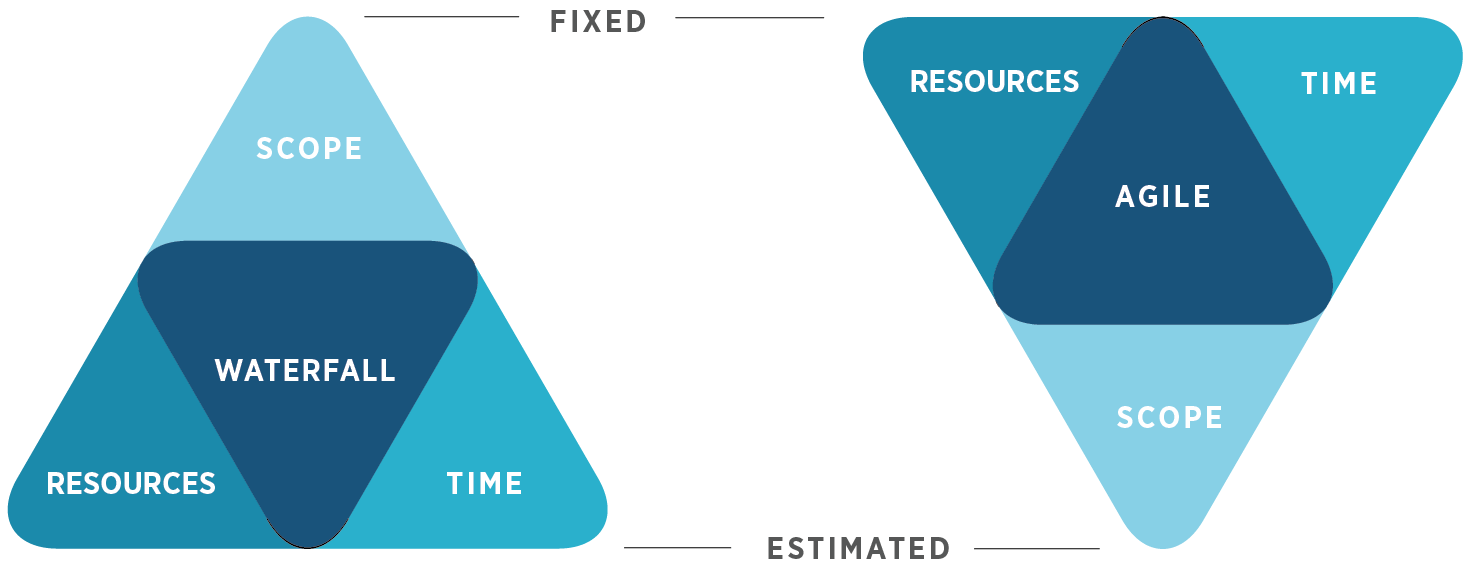
Illustration 1: Adapted from Atlassian (n.d). The iron triangle of planning [Blog post]. Retrieved from https://www.atlassian.com/agile/agile-at-scale/agile-iron-triangle
I am planning on consciously mixing and utilizing project management, design thinking and systems thinking methods. Systems thinking is the process of understanding how components of a system influence each other as well as influence other systems. Conway et al. (2017) note:
“Thinking like a system means taking a holistic view: viewing the problem as made up of a set of interacting components that continuously produce feedback. It also means accepting the situation as dynamic with the relationships between elements in the system as important as understanding how the system will behave as the component parts. The starting point to understanding these dynamics is to identify the dimensions of the problem” (p. 14).
Illustrations are created by the author.
References
Conway, R., Masters, J., and Thorold, J., (2017). From design thinking to systems change: How to invest in innovation for social impact. Royal Society of Arts, Action and Research Centre.
Watt, A. (2014). Project Management. Victoria, BC: BCCampus. Retrieved from: https://opentextbc.ca/projectmanagement/
Project Management Triangle (n.d.) Retrieved from https://en.m.wikipedia.org/wiki/Project_management_triangle