

Organizations, regardless of industry, are in a constant state of flux requiring adapting to shifting environments; more than ever, change has become an ongoing concern for organizations and can be related to any topic from regulations, fiscal reforms, organizational structure to learning management systems. The representation of change management models and theories have progressed over the past seven decades (Biech, 2007, p. 23). Biech (2007) described more current models for organizational change adapted from Lewin’s three-step model (unfreeze, movement, refreeze). The newer models are tailored to address contemporary contexts, streamlined to reduce the stages and allow for internal customization. This allows for the rapid changes that the world is experiencing within the field of technology, economics and society as a whole: “[o]rganizations of today must be agile and flexible” (Biech, 2007, p. 26).
Managing change in complex environments such as teams, businesses, or in my current case in schools can be difficult. I am going through a full program review of a web developer program applying both bottom-up and top-down methods to find the missing pieces, and I plan significant changes. Feedback from the students and alumni is paramount to help guide the changes of the program but grouping it with big picture view from outside stakeholders as well as from faculty, and the institution leadership is necessary.
I appreciate when I find fitting models that try to provide support for people who are executing the transformations. I found the Knoster model for managing complex change (Figure 1.) and valued it for a few reasons, but the two most important are (1) the provided five different criteria based on to create change and more importantly (2) the visual representation of the outcome that the lack of a specific element can have on the system. This latter is particularly useful in backtracking from the issue to the cause of it.
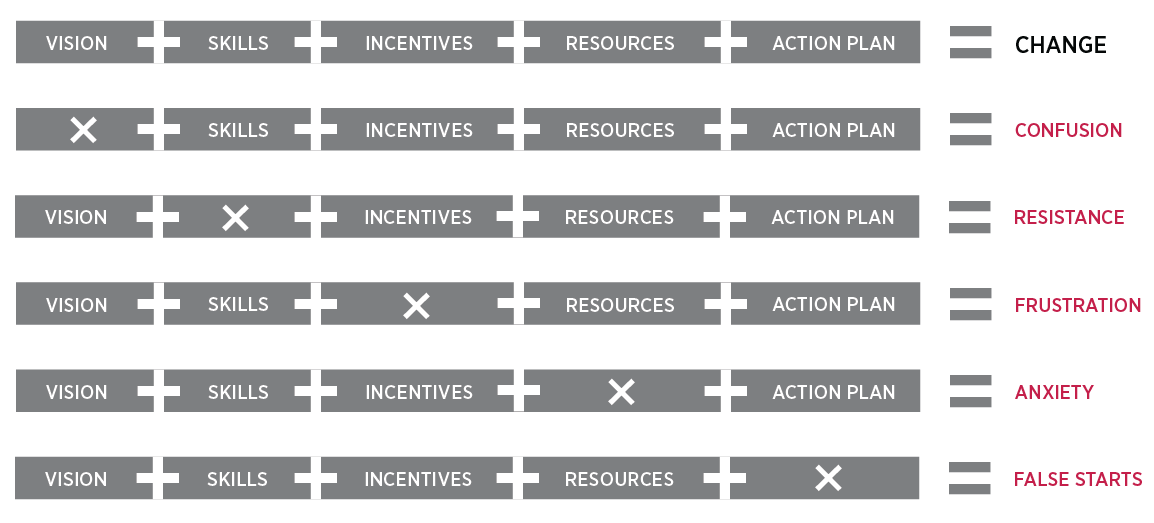
Figure 1: Adapted from Knoster, T., Villa, R., & Thousand, J. (2000). A framework for thinking about systems change. In R. Villa & J. Thousands. (Eds.). Restructuring for caring and effective education: Piecing the puzzle together. (pp. 93-128). Baltimore: Paul H. Brookes Publishing Co.
Confusion can be caused by lack of Vision or the lack of understanding of that vision, often due to poor communication and synchronization of the people involved. There are many factors involved in the success of a change process, and clear and open communication is one of them. All factors within a system are interrelated (Senge as cited in Biech, 2007). Biech’s (2007) change model talks about the need to harmonize and align leadership and Weiner (2009) also describes how leaders need to communicate and act consistently in support of a change.
Anxiety can be caused by lack of Skills, meaning that the stakeholders need to have the ability to do the transformation itself and be skilled enough to thrive once the transformation is completed.
Frustration can be caused by lack of Resources as sometimes people don’t have them to make the change. Lacking skills or resources slow down the process. Effective leadership for facilitating change will provide the skills, resources, and time needed for implementation (Weiner, 2009).
Resistance can be caused by lack of Incentives. Legacy, brand loyalty, and history can be what makes organizations successful, but can also hinder future progression if there is resistance to change while clinging to the past. Resistance is “the ease or difficulty for performing those modifications to the system; how ‘resistant’ it is to being changed” (Walker et al. 2004, as cited in Weller & Anderson, 2013, para. 7). People tend to resist a change for the fear generated by the unknown and if the change has no clear benefits for them. Al-Haddad (2015) states that “Luecke’s method stresses the importance of strong leadership in supporting change and motivating employees to accept change” (p. 250).
False Starts can be caused by lack of Action Plan as stakeholders don’t know where to begin or what to do next. The action plans don’t have to be overly complicated, as small transformative changes can be done with little structure, yet, the structure has to be there. Biech (2007) described the need for a plan as a key to success, which has to “translate the concepts into concrete steps so that employees can implement them” (p. 22). I agree with Biech (2007), that regardless of which models or theories an organization uses to manage change, success ultimately depends on having a plan and carrying it out.
In my opinion, this model doesn’t require all of the components. Change is still possible with a missing piece, though harder as one has to consider the effects and address it.
Change management starts taking place well in advance to the actual change itself being implemented. Based on Bandura, Weiner (2009) asserted that the commitment of people in an organization before starting the change process denotes ability and will to carry it on. From my experience, the lack of leadership support would guarantee a change project to fail. Some of the change methods described by Al-Haddad & Kotnour (2015) are identified as relying heavily on leadership and states that “[t]he entrepreneurship, creativity and innovation embedded in leadership are very important to successfully managing change” (p. 239). The rate of change within the digital learning environment will always present unique challenges that are hard to anticipate.

I believe that implementing change is a team process (Weiner, 2009). An executive sponsor needs to confirm full commitment in supporting the change initiative; committed people bring the change to live more easily (Bandura as cited in Weiner, 2009).
Illustrations are created by the author.
References
Al-Haddad, S., & Kotnour, T. (2015). Integrating the organizational change literature: a model for successful change. Journal of Organizational Change Management, 28(2), 234-262.
Biech, E. (2007). Models for Change. In Thriving through change: A leader’s practical guide to change mastery. Alexandria, VA: ASTD [Books24x7 database]
Knoster, T., Villa, R., & Thousand, J. (2000). A framework for thinking about systems change. In R. Villa & J. Thousands. (Eds.). Restructuring for caring and effective education: Piecing the puzzle together. (pp. 93-128). Baltimore: Paul H. Brookes Publishing Co.
Weiner, B. J. (2009). A theory of organizational readiness for change. Implementation Science, 4(67). 1-9. https://doi.org/10.1186/1748-5908-4-67
Weller, M., & Anderson, T. (2013). Digital resilience in higher education. European Journal of Open, Distance and E-Learning 16(1), 53-66.
Hi Beata,
Thanks for sharing this visual – it does a great job of showing the outcomes from some possible gaps in planning for a change initiative. You talked about the role strong leadership plays in successful change – sharing that vision, providing time and resources – but you also highlight that it is a team process. That got me thinking about what roles different team members have in helping change be successful. As a team member what responsibilities do I have to ensure success, if the change is something I feel would be beneficial? What if some of the elements you highlighted above are not in place – what can we do to help fill those in?
Hi Beata
I thoroughly enjoyed your post (as always). The image that you shared, adapted from Knoster, T., Villa, R., & Thousand, J. (2000), really helped visualize how important it is that all the necessary parts associated with change are in alignment. I resonated with each and every outcome in the puzzle you portrayed. I think it is safe to say that most of us have experienced the confusion, resistance, frustration, anxiety and false starts that inevitably come when a change in an organization or structure is handled poorly. If any of the pieces in the puzzle are missing it is difficult for leadership to get buy-in from their constituents. In order for change to be successful, the members need to see the value in the change. By making sure all the pieces of the puzzle are in place it is easier for the members to see how this will be valuable to themselves and the organization. As stated by Weiner (2009), “the more organizational members value the change, the more they will want to implement the change, or, put differently, the more resolve they will feel to engage in the courses of action involved in change implementation” (p.3).
References
Knoster, T., Villa, R., & Thousand, J. (2000). A framework for thinking about systems change. In R. Villa & J. Thousands. (Eds.). Restructuring for caring and effective education: Piecing the puzzle together. (pp. 93-128). Baltimore: Paul H. Brookes Publishing Co.
Weiner, B. J. (2009). A theory of organizational readiness for change. Implementation Science, 4(67). 1-9. https://doi.org/10.1186/1748-5908-4-67
I agree with your statement Chad: “I think it is safe to say that most of us have experienced the confusion, resistance, frustration, anxiety and false starts that inevitably come when a change in an organization or structure is handled poorly. If any of the pieces in the puzzle are missing it is difficult for leadership to get buy-in from their constituents.” Kotter (2007) also described the most general lesson to be learned from well-managed cases is that “is that the change process goes through a series of phases that, in total, usually require a considerable length of time. Skipping steps creates only the illusion of speed and never produces a satisfying result” (p. 97). John P. Kotter in his 2007 Harvard Business Review article, “Leading change: Why Transformation Efforts Fail” lists major errors with examples. Kotter (2007) also outlines eight critical success factors (eight steps to follow to transform an organization). I do recommend reading it if you have time.
Reference
Kotter, J. (2007). Leading change: Why transformation efforts fail. Harvard Business Review 85(1), 97-103.
It is interesting that most of the assigned literature is approaching the change from the leader point of view and less from the team members’ side.
I was chatting with my previous supervisor about change management this weekend, and he mentioned the following regarding the team members: “The change management team members should feel that they develop the change management strategy and plans and they are an integral part of enabling the success of the project. They should not feel isolated; they should be aware of their tasks.” During our discussion, Stephane brought up our shared experience with a significant organizational change at the Marketing and Customer Care Directorates. He described that a dedicated change management team ensures focus and keeps track of change activities; they are the point of responsibility and accountability. Basically the go-to people during the change process. The team needs to apply a change management methodology as change should not be managed in an ad hoc manner, it should be approached with purpose and intent. The team evaluates the size and the impact of the change and develops a strategy for managing the people side of the change initiative. Based on the strategy, the team creates the plans including a communication, coaching & training and even resistance management plan.
Hi Beata –
Great discussion on this thread! Your comments and conversation with a former supervisor about including team members as core change agents and involving them in the process really resonates With me. As you pointed out, much of the assigned literature presents change from a leadership perspective which is needed, but equally important is how change looks from an employee or team member perspective.
Antwi and Kale (2014), who wrote about change management in healthcare, argue that much of the change management literature focuses on ‘planned’ change based on Kurt Lewin’s theory of organizational change which is more management-leadership driven. Antwi and Kale (2014) suggested that planned change management models assume ‘change targets’ (employees) are often on board with proposed changes, which is often not the case. They propose emergent change management, a ‘bottom-up approach’, which involves employees in some of the decision-making with managers and leadership serving as facilitators in the change (Antwi & Kale, 2014, p. 3). This seems to align with the shared insights from your previous supervisor, along with the benefits you pointed out that come from involving teams.
Although, I believe there is not one model that fits all situations, integrating models such as emergent change management with other models in which employees and teams are included in decision making may offer an environment that is more conducive to change…something I would like to see more of in higher education!
Reference
Antwi, M., & Kale, M. (2014). Change Management in Healthcare: Literature Review, (January), 1–35.