
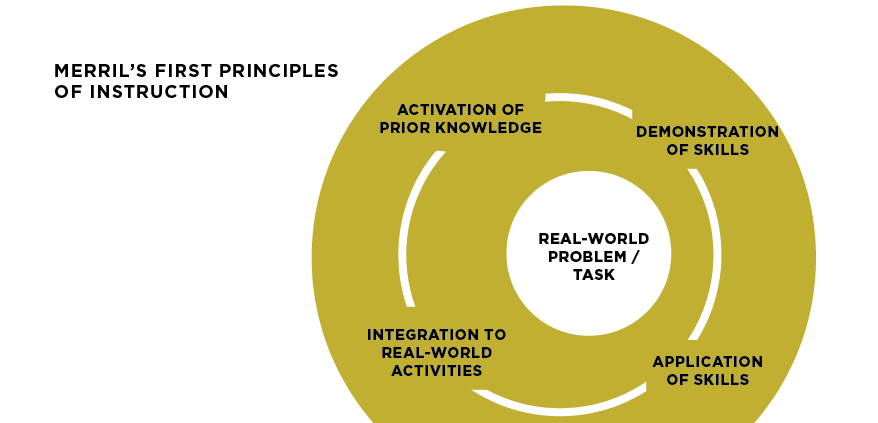
Ertmer and Newby (2013) reviews behavioural, cognitive, and constructivist learning perspectives and do an excellent job of breaking down their structure, while Merrill (2002) discusses the five principles that are common to various instructional design theories.
I had a hard time defining for myself the difference between an instructional theory and instructional model, and as sometimes the instructional theories have “learning” in their name, it occasionally confused me with learning theories. Oh well. After reading the two papers and researching a few other resources I compiled the following descriptions for my use to move forward:
Learning theory: descriptive thoughts and theories about how people learn. Learning theories provide instructional designers with verified instructional strategies and techniques for facilitating learning as well as a foundation for intelligent strategy selection (Ertmer & Newby, 2013, p. 43).
Instructional theory: thoughts, ideas and explanations focusing on how instructors should teach and how to create the conditions for learning; a framework for instructions. Instructional theories came out of synergies between learning theory, psychology, and media and communication studies.
Instructional design model: A guidance on how to build the instruction based on one or more instructional theories.
The three large learning families of thought (“Learning theory,” n.d.):
Behaviourism is interested in looking at behaviour and observable changes. Behaviourism in instruction focuses on generating new behaviour patterns.
Cognitivism is interested in looking at the thought processes behind the behaviour. Cognitivist learning theory stresses the acquisition and reorganization of cognitive structures, describes that education should be concerned about analyzing and influencing thought processes and that knowledge and tasks to be learned can be identified, and performance can be measured.
Constructivism claims that knowledge is constructed through the interplay of existing knowledge and individual and/or social experience. There are several variants, such as constructionism, constructivism and situated cognition. Constructivists believe that both learning and teaching is an open-ended process.
The two above listed articles apply to my own work in program and course development, facilitation, and creation of instructional media resources. In the web development program where I work, there are different underpinning learning theories for the program’s different sections/courses. I do agree with Snelbecker (1983) as it was cited in Ertmer et al. (Ertmer & Newby, 2013, p. 45) that instructional designers addressing practical learning problems should not restrict themselves to using one theory, they “are urged to examine each of the basic science theories which have been developed by psychologists in the study of learning and to select those principles and conceptions which seem to be of value for one’s particular educational situation.” There is no “one size fits” all theory or their combinations. All three major learning theories are essential to understand, and when deciding which strategies to use, it is important to consider: the level of knowledge of the learners; the thought processing demands; the desired outcome.
Some of the web development program’s courses lean heavily on the mix of behaviourism and cognitivism. They train the learners and provide a good foundation for being creative later on as they put emphasis on mastering early steps before progressing to more complex problems in the following courses. Behaviourism is not used solely; there is an emphasis on giving the students different examples and situations to make them understand “how to apply knowledge in different contexts” (Ertmer & Newby, 2013, p. 52). We try to include the learner to be an active participant in the learning process, make knowledge meaningful and help learners organize and relate new information to existing knowledge in their memories as it is described by Ertmer et al. (2013, p. 54).
For this specific activity, I decided to focus on the Client/Industry Project course, which is the culmination of the learned materials at the end of the program. Students work in teams, with real-life clients, and need to apply all their gained knowledge. As mentioned by Ertmer & Newby (2013), constructivism has been a method of choice for many in instructional design. The idea that “humans create meanings as opposed to acquiring it” (Ertmer & Newby, 2013, p. 55) is aligned with the goal of this capstone project.
According to studied social constructivists, Shieh (2010) described that learning takes place in a community setting, where the participants socially interact, actively engage in learning, and collaborate to construct meaning and knowledge of a topic from current and prior experience. A vital component of a successful constructivist learning environment is self-regulation, where learners set goals, build more in-depth understandings, develop action plans, and solve problems. The responsibility for learning is expected, but not enough, the presence of an online facilitator is described by Shieh as vital, which includes promoting participation, clear assessment guidelines, and timely feedback.
When supervising the student groups, I am not their 24/7 accessible and available problem solver. The constructivist frameworks, as explained by Ertmer & Newby (2013) and Ruey Shieh (2010), describe learners as constructing their knowledge based on their own perception of the material (solutions for the client’s requirements), environment (context and development environment), and prior knowledge (what they gained during the program). This means that each learner’s gain and result will be unique even by starting with the same information. I believe that there is a time and place for each learning and instructional theories and methods.
I enjoyed reading Merrill’s (2002) description of the five principles of instructions. Merrill’s 1st Principles synthesizes the key elements of many theories and models and boils them down to just five fundamental elements to help to create effective learning environments which can be applied in all learning design types (Merrill, 2002). It feels like both an instructional theory and an instructional design model. As an ID model, it seems like serving as a checklist to ensure the fundamental elements are all addressed.

Merrill cited Jonassen’s problem progression recommendation: “Start the learners with the tasks they know how to perform and gradually add task difficulty until they are unable to perform alone” (Jonassen as cited in Merrill, 2002, p. 55). This is similar what I applied in my courses and call it the “building blocks”: in a general coding course with more behavioural and cognitivist approach I lay down the foundations, and with a scaffolding tactic, I add more and more levels and steps with fewer and fewer instructions to lead to mastery. I become aware that I need to spend more time planning the Activation phase after re-reading Merrill’s (2002) instructional phases a few times. It is essential that instructional design lays a sufficient foundation for the learners; thus they can activate prior knowledge and build off of it.
All illustrations are created by the author.
References
Ertmer, P., & Newby, T. (2013). Behaviorism, Cognitivism, Constructivism: Comparing critical features from an instructional design perspective. Performance Improvement Quarterly, 26(2), 43-71.
Merrill, M. D. (2002). First principles of instruction. Educational Technology Research and Development, 50(3), 43-59.
Shieh, R. (2010). A case study of constructivist instructional strategies for adult online learning. British Journal of Educational Technology, 41(5), 706–720. https://doi.org/10.1111/j.1467-8535.2009.00965.x
Beata – Congrats on the great creative aspects of your blog and your detailed diagrams representing Merrill’s five principles of instruction. I appreciated the definitions you provided and reflecting on your stance looking back at your own experiences.
Have you used a specific ISD model in designing and developing your existing courses or are your thoughts reflect what you’ll be doing going forward after reading the two articles that may morph your future practices when you’ll design the next course?
Hello Dino – I took the activity to reflect on my existing courses / program. Before I started teaching at BCIT I had quite a few years of product development experience, and I also completed a Provincial Instructor Diploma, which provided practical guidance on developing courses.
Beata, great informational post. I’m wondering what type of work you do and where do you think you fit within the learning theories and teaching theories as well.. Do you develop programs? Which learning activities do you implement for those programs? It seems as though you have figured out what you can utilize to move forward but I am wondering what you already have in place.
Thanks for a great post
Hello Andrea, I am teaching and developing and leading the program where I teach. I also participate in a new 2-year program’s development, but only marginally. I used to align myself with theories (and I still favour a mix of few :-)), but I come to believe that I need to adjust my views depending on the audience of the program, the students. I teach adults, but even they require different treatment, different approach to be successful. We all prefer learning in different ways, and I think, depending on the options of the program the instructor should accommodate that.