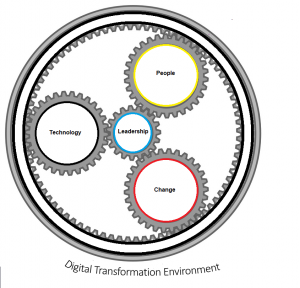
My current thinking on leadership in the digital environment is a planetary model where leadership has a direct interconnected relationship with the technology, people, and the change itself. Like its mechanical equivalent, one component failure is catastrophic can renders the system inoperable. I believe this is how change should be addressed. There should be a focus on the interconnections and relationships and how they impact the overall environment.
For Assignment #2 of LRNT 525: Leading Change in Digital Learning, I examined the results of an external scan of our colleagues surrounding their experiences with change management. My anonymous participants had extensive expertise in the education field. They had seen many changes, but I asked them to reflect on a change involving digital learning specifically.
I asked them to reflect on the following prompting questions from the assignment:
Can you provide examples of disruptive change related to digital learning that was successfully implemented?
What role did leadership play in the process?
What challenges did they encounter?
My first participant was a trade’s instructor in a sizeable Polytechnique located in western Canada. He articulated the implementation of blended learning programs in Trades training. This change, a rough transition despite the apparent benefit of access for the students. Blended learning had less validity than the tried and true mentorship models of face to face block release training. The challenges encounter were primarily about changing a culture derived from the craft guilds of the 12th and 13th centuries. Digital transitions need to respect the culture of the trades with the primary model of mentorship, and the tell, show, do pedagogy. Although blended models were successful in the business school of the institute, it was a challenge to adapt it to recognize the people and culture of tradespersons, as observed in Khan’s (2017) work on adaptive leadership. The role of leadership in the process is to effective communication and engagement of those impacted by the changes.
The second interview was with a peer in my current vocation as a business instructor. She spoke of the adaption of social media curriculum and the challenges of creating meaningful content. Schneider (2014) comments on the need for leadership imperative to provide relevant, useful, and applicable education. My interviewee spoke of the challenges with wanting to incorporate tools and social media tools and the risks of its implications of these social spaces. A question was posed as to what responsibility we have in managing conversations in these socially influenced digital environments. Mutual challenges we agreed considering the pace of change is how to best update the curriculum to be to remain relevant. There is considerable education lag to overcome, and “leadership is about action, not position.” Schneider (2014, para 3) Leadership itself has not changed; however, digital leadership is now about early adoption and adaption of relevant new tools.
Common themes noted in the two interviews were changes directed, and the benefits were not known or fully understood. The two interviewees both expressed a feeling of being underequipped to initiate a transformative change. The Prosci ADKAR Model (The Prosci ADKAR® Model, n.d.) addresses these missing elements leaders should be mindful of when embarking on digital changes. It is all about preparing, equipping, and communicating why the change is necessary. I learned from both of these employees is they would have benefited by leaders with the skill and knowledge to implement change successfully, starting with communicating the why.
References
Khan, N. (2017). Adaptive or Transactional Leadership in Current Higher Education: A Brief Comparison. The International Review of Research in Open and Distributed Learning, 18(3).
Sheninger, E. (2014). Pillars of digital leadership. International Centre for Leadership in Education.
The Prosci ADKAR® Model. (n.d.). Retrieved February 22, 2020, from https://www.prosci.com/adkar

Leave a Reply