Peak Experiences, Incubating Innovation & the Ecology of Distance Learning

Many of us can remember a moment of learning where our eyes and mind lit up with new understandings. A “deeply moving, exhilarating, elevating moment” (Maslov, 1964, p. 5) of transformed perception that psychologist Abraham Maslov (1964) calls “peak experiences,” author James Joyce (1969) refers to as epiphanies, Design Thinkers label “mindshifts” (Goldman, 2014), and cartoonist simply infer with a lightbulb materializing over our heads.

As a lifelong learning superfan (aka. a geek), I am an ‘aha!’ moment evangelist. As a community development and learning designer, I adore exploring how pedagogy and technology can be interwoven to increase access to “peak” and deep self-in-systems learning.

In this vein, Athabasca University’s Jon Dron (2014) gives a layered exploration of learning technologies’ creative tensions and possibilities for innovation. For Dron, open universities and the like are proven incubators for innovation. “This is a distinctly Darwinian evolutionary pattern,” Dron writes. “Like the species of finch evolving on different Galapagos Islands, parcellation enables a higher rate of evolution that may then spread to the broader population as links and isthmuses form” (p. 247).

Bringing new meaning to a ‘school’ of fish. Photo by Sagar on Unsplash.

Sagar

This concept of ‘innovation incubators’ and idea evolution that Dron describes are well known in the start-up world, where ‘makers’ play and rapidly prototype ideas through design thinking (Crichton and Carter, 2017; Goldman, 2014; ). So how can we experiment with those practices within personal leadership and distance learning?

Dron’s (2014) response returns us to the natural world for inspiration. Building on Otto Peters’ (1994) writings on systems perspectives in distance education, Dron advises learning designers to evolve in their generative understandings of the diverse systems that define next-generation education. Once again using ecological and system thinking language, Dron advises us to find equilibrium or balance between innovation and integration, soft and hard learning technologies, and change and change management. What this might look like in practice is not included in the scope of Dron’s exploration, inviting imaginative, innovative thinking to explore possibilities.

I’m always on the lookout exceptional distance learning design for deep learning and personal leadership. Have you ever experienced an innovation incubator as described by Dron (2014) that sparked a “peak” learning experience?


Crichton, S. & Carter, D. (2017). . Open School/ITA. Retrieved from http://bit.ly/2zFkUwo

Dron, J. (2014). Innovation and Change: Changing how we change. In Zawacki-Richter, O. & T. Anderson (Eds.), Online distance education: Towards a research agenda. Doi:10.15215/aupress/9781927356623.01

Goldman, S., Carroll, M., Kabayadondo, Z., Cavagnaro, L. B., Royalty, A. W., Roth, B., … Kim, J. (2012). . In H. Plattner, C. Meinel & L. Leifer (eds). Design thinking research: Understanding innovation. (pp. 13-33). doi-org.ezproxy.royalroads.ca/10.1007/978-3-642-31991-4_2

Joyce, J. (1969). Ulysses. London: Bodley Head.

Maslow, A. H. (1964). Religions, values, and peak experiences. Retrieved from www.bahaistudies.net/asma/peak_experiences.pdf

Peters, O. (1994). Distance education and industrial production: A comparative interpretation in outline. In M. Keegan (Ed.), Otto Peters on distance education (pp. 107–127). London: Routledge. Retrieved from https://journals.openedition.org/dms/

 

Empathy in Design, Imagination & Wicked Problems


Empathic Design: Is Empathy the UX Holy Grail?
Empathic Design

Empathic Design emerged from the difficulty to filter out the designer’s intentions and interpretations in user-centric testing. In turn, researchers looked to the principle of empathy, or the “ability to understand and identify with another person’s context, emotions, goals, and motivations” as a counterweight to this self-as-user bias (Quesenbery & Szuc, 2011, p. 51).

outline how throughout its progression from user-testing products to co-designing for larger systems solutions, four principals of Empathic Design remain:

  1. People give meanings to things and act on these meanings, and these meanings both arise and are modified in interactions.
  2. Because design comes by its meaning in real life, design research must be done in real life.
  3. Research methods should come from design and be visual and tactile, inspiration-enhancing, deliberately cheap and low tech, playful, tested in reality and targeted at the fuzzy front end of the design process.
  4. Analysis of the research seeks to explicate meanings for design—not to create explanations (2014, p. 68).

My personal interest lies most in empathic design for wicked problems.

According to wicked problems are:

social, cultural or environmental problems that appear impossible to solve because:
• there is incomplete or contradictory knowledge about the problem itself;
• the number of people and opinions involved and the potentially large economic burden add additional layers of complexity; and
• the actual problem is interconnected with other problems.

The concept of wicked problems comes from the grand-daddy of Issue-Based Information Systems (IBIS) and Dialogue Mapping – Horst Rittel (Conklin, 2010).

Image result for wicked problems UX

Having used Rittle’s IBIS & Dialogue Mapping for community research once or twice I am gripped at how empathic theory tools approach wicked questions with the nuance to match a situation’s social complexity.

These exercises in Dialogue Mapping and group facilitation typified what  described as the co-designing aspect of empathic enquiry. My experience with almost exclusively face-to-face, real-time iterations of co-designing makes it hard to imagine what that process looks like in digital communities.

How does one capture the synchronicity, ideation and, of course, empathy, of a room full of people in an online setting?

This, in fact, is the core question behind my interest in learning technology.

and company do not provide an answer, but rather deepen the question. Some of the most effective examples of empathic design they feature are open-ended communication formats (2014, p. 74). From community-based visualizing tools to debate-based prototyping, I struggle to reimagine the same human-centric techniques in digital formats.

How have you developed experiential, open, enquiry opportunities for online communities?


Crichton, S. & Carter, D. (2017).

Mattelmäki, T., Vaajakallio, K., & Koskinen, I. (2014).. Design Issues30(1), 67-77.

Quesenbery, W., & Szuc, D. (2011).  Global UX: Design and Research in a Connected World. Waltheim, MA: Elsvier.

ADDIE, ADDIE, Where will it lead us from here?

The title, paraphrased from Angie, by The Rolling Stones

Though the Rolling Stones may have been asking the question of Angie, the sentiment still applies to the ADDIE framework of learning design. Where does ADDIE lead us in a digital age?

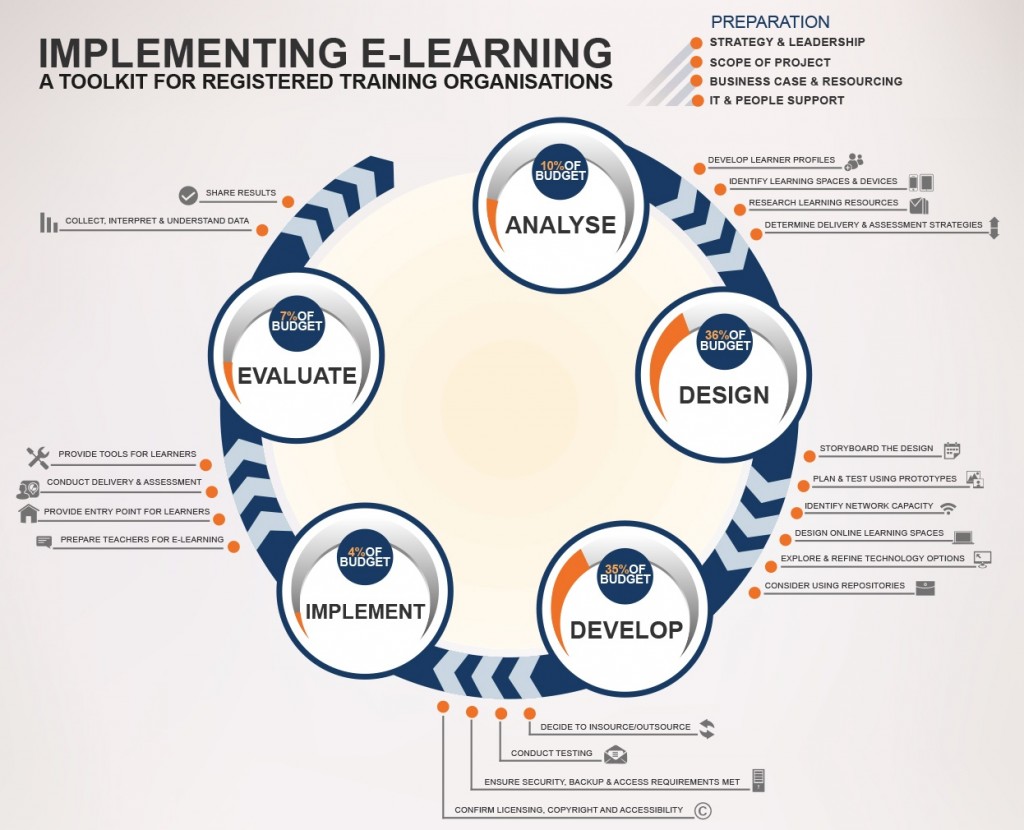
The ADDIE (Analyse, Design, Develop, Implement and Evaluate) model illustrated in Figure 1 is increasingly described as a relique of planning’s past (Bates, 2014).

© Flexible Learning Australia, 2014
Figure 1, ADDIE Infographic

I agree with my colleagues (Can Instructional Design Models Stand the Test of Time? Early Thoughts on ADDIE) that ADDIE’s formula front-loads the efforts of course creation, and prompts a heavy linear-thinking flow that reduces the reflexivity. According to Online Learning Research Associate, Dr. Tony Bates ADDIE privileges behaviourist over constructivist education theory by not factoring in learn-instructor interaction. (2014, p. 3). Moreover, there can be a certain clunkiness to ADDIE in practice. “If ADDIE is a 100-piece orchestra, with a complex score and long rehearsals, then flexible design models are a jazz trio who get together for a single performance then break up until the next time,” writes Bates (2014b, p. 2).  In an age where learning design has evolved to rightly priorities learning and student-centricity, age-old standards like ADDIE seem too inflexible to keep up with trending agile technology (An, 2004).

Where my opinions differ from Tony Bates’ critiques of ADDIE, is the underlying assumption that a solution to ADDIE’s dominance in Learning and Development is to replace it with a newer, tech-centric, model which plug the gaps in methodology. Bates’ deeper criticisms of ADDIE come from systems thinking, design thinking and agile methodology viewpoints. Paradoxically these paradigms of complexity theories, in themselves, oppose the binary of labelling “right vs. wrong” ways of doing things and reliance on technical problem-solving.

Many of the critiques of ADDIE which Flash Design or agile methodology solve are matters of parameters, stocks, delays, flows, feedback, and so forth. Whereas the underlying cause of these symptoms is, in fact, the “mindset or paradigm out of which the system — its goals, structure, rules, delays, parameters — arises” (Meadows, 1999).

The debate over ADDIE vs. flexible design is about process, not praxis.

Image result for praxis
Image from Anne Walker

And while process is important, especially for larger organizations, when considering base approaches for particular L&D projects, feedback loops and parameters do not inherently affect the systems change that flexible approaches try to champion. In fact, the false dichotomy between the two erodes the goal of education design which transforms perception, self and action beyond boundaries.


Bates, T. (2014, September 9).  [Blog post]

Bates, T. (2014b, November 26). ‘Agile’ Design: Flexible designs for the digital age 

Bates, A. W. (2015). . BC Campus.

Meadows, D. (1999). Leverage Points: Places to Intervene in a System. Retrieved from http://donellameadows.org/wp-content/userfiles/Leverage_Points.pdf

Stanford University Institute of Design. (2016). A virtual crash course in design thinking.

Thomas, P. Y. (2010).. In Towards developing a web-based blended learning environment at the University of Botswana. (Doctoral dissertation).

<script src=”//platform.linkedin.com/in.js” type=”text/javascript”></script>
<script type=”IN/MemberProfile” data-id=”http://www.linkedin.com/in/kate-nickelchok” data-format=”inline” data-related=”false”></script>