Perspectives and Interpretations of the History of Educational Technology

Comparing the opinions and evidential research presented in the respective papers of Weller, (2018), and Reiser, (2001); uncovered patterns of anticipation and anti-climatic stagnation when new technologies throughout history promised to revolutionize education, and then ultimately were followed by the next forecasted innovation.  Although written nearly two decades apart, both articles are relevant and have convincingly argued that although there have been significant shifts in educational practices, technology has been slow to make a substantial impact in the field.

In relevance to my own experiences adopting and incorporating innovations and technologies into my classroom, one “lesson from the past” that resonates after reading these individual pieces, is that “Patience is required: educational transformation is a slow burn” (Weller, 2018, p.28).  I have felt the excitement and anticipation of the promise of new technologies in my classroom, only to be let-down when the hype subsides, and the deciders have resolved to go with yet another new technology; as the cycle continues.  In addition to the disappointment that this recurring broken promise generates, this causes problems when designing the digital learning environment as it is challenging to maintain resources and assignments created for specific platforms and learning management systems if they are continually changing.  It would seem apparent that when adopting new technologies, instructional designers, instructors, and administrators will require stamina as “EdTech is not a game for the impatient” (Weller, 2018, p.48), and the next big technological innovation is yet to come.

References

Reiser, R. (2001). A history of instructional design and technology: Part 1: A history of instructional media. Educational Technology Research and Development, 49(1), pp. 53-64. doi-org.ezproxy.royalroads.ca/10.1007/BF02504506

Weller, M. (2018a). Twenty years of ed tech. Educause Review Online, 53(4), pp. 34-48. Retrieved from https://er.educause.edu/articles/2018/7/twenty-years-of-edtech

The Nebulous History of EdTech and Its Equally Hazy Future

Researching the history of educational technology is an interesting and interminable venture.  A simple internet search will turn up an endless array of articles, blogs, videos, podcasts, and other internet medias analyzing diverse topics related to the field of EdTech.  Although there is seemingly an endless amount of information on the subject; the topics, concepts, and frameworks (or lack of) can leave researchers with more questions than answers.  Perhaps the problem is that the history of the field is vast, nebulous, and to all appearances based on a variety of opinions on origin and definition.  Januszewski (1996, p.285) found that individual constructs varied in the field of educational technology, but that the plurality of histories provided more options to adopt EdTech for specific needs.  Nearly a quarter of a century later, the disparity in these histories has led to players without an instructional design background filling specific EdTech needs.  Collins and Halverson (2010) argued that new technologies have exploded, and companies are capitalizing on educational technology products that are targeting consumers with deep pockets and that schools are being left behind. They argued that if schools continued to be excluded from the technology discussion, they “may not be able to adapt and integrate new technologies, and the association of schooling with education, developed over the past 150 years, will dissolve into a world where wealthier students pursue their learning outside of the public school” (Collins, & Halverson, 2010, p.165).  In more recent publications, the theme of learning from our history, or lack of history to mold the future continues to be explored.  Macgilchrist, Allert, and Bruch (2019) speculated about the inherent characteristics of future students through three imagined futures influenced by the present-day policies of educational technology. The authors hypothesized that these social science fiction scenarios could inform future research in educational technology and guide the ID of digital learning environments, and after exploration of the nebulous history of EdTech and its equally hazy future I agree this is warranted; let us clean up the messy landscape now and create a solid history for the future.

References:

Collins, A., and Halverson, R. (2010). The second educational revolution: rethinking education in the age of technology. Journal of Computer Assisted Learning, 26,18-27. doi:10.1111/j.1365-2729.2009.00339.x

Macgilchrist, F., Allert, H., & Bruch, A. (2019). Students and society in the 2020s. Three future ‘histories’ of education and technology, Learning, Media and Technology, doi: 10.1080/17439884.2019.1656235

Januszewski, A. (1996). History in Educational Technology. Retrieved from http://search.ebscohost.com.ezproxy.royalroads.ca/login.aspx?direct=true&db=eric&AN=ED397800

Network Connections – A Graphic Representation

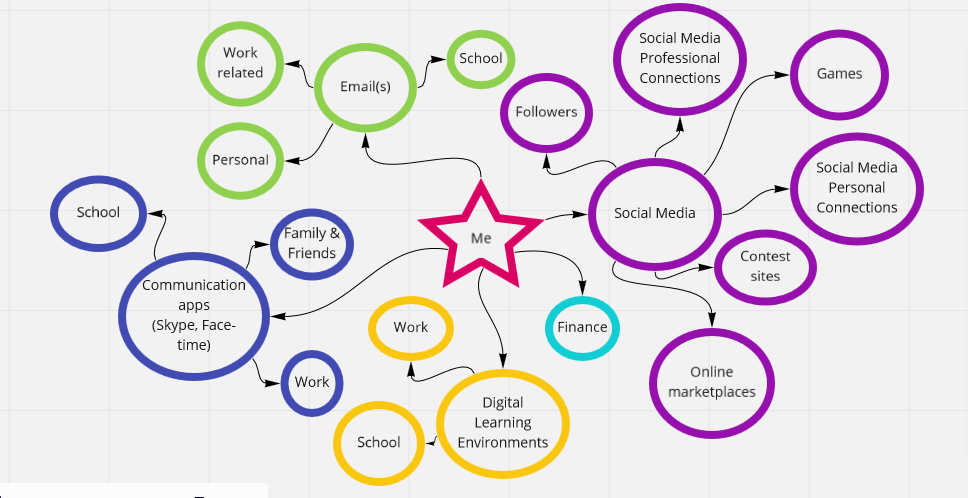
Contemplating digital presence this week has been a valuable exercise.  I have explored where I am spending my time when I am venturing into the digital world through a conceptual digital map and will add to this exploration with a graphic representation of my digital connections.

Similar to my digital map, this depiction is dualistic concerning professional and personal connections and relationships.  There is a fairly even balance between connections in my personal life and those that are related to work or school.  Some networks are used only for one or the other, but the majority are compartmentalized and managed with similar approaches and energies.  I have noted, as I had in my previous blog; that some of the connections are insubstantial and this inspired me to re-evaluate the necessity of such connections (or lack of).

Creating, Cultivating, and Reflecting on My Digital Presence

Upon reflection of my previously created visitor-resident typology, I was able to identify where and how I was allocating my time, and creating my digital presence.  Why was it important to me?  Was my image consistent?  What did I want that image to be?  Did I want to maintain my current affiliations?  Schryver (2013), poses similar questions in her New York Times blog post (The Learning Network) article

“What kinds of things do you tend to post online, and how much thought do you give to choosing or creating them?  What would you not post?  What mental processes do you go through in deciding what to post, when and how?  Do you have a different personality, presentation or persona on different sites or services?  If so, why, and how do they differ?  How do you think you are perceived online?  Why?”

Now that I have contemplated how I want to present myself online as a graduate student and beyond, I have identified three primary goals in cultivating an online presence:

  • To increase the quality of my contributions
  • To join the online scholarly community
  • To increase my awareness of changes concerning digital learning environments

This shift will take a conscious effort, and will require constant reflection as a digital presence is fluid.  “Search for yourself online. Are you proud of your digital presence?  Will you be proud of it in ten years?  Are there things that are untrue or pertain to someone with the same name?  What can you do about that? (Schryver, 2013).

In addition to recurring pause and reflection, I am eager to acquire as much knowledge as I can through educational, professional, and personal learning opportunities that arise; and I anticipate that many will with the emergence of more and more online opportunities.  As I develop and nurture my presence, and except for prescribed institutional apps and software; I will be mindful that the luxury of online self-reinvention is always within my grasp.  “Membership, frequency, and extent of participation in virtual communities is driven by volitional choice, and may be terminated by the member relatively effortlessly” (Park & Floyd, 1996).

Looking back, and looking forward, I am excited to begin consciously molding my digital identity.

Schryver, K. (2016, February 5).  Who Are You Online? Considering Issues of Web Identity [Blog post]. Retrieved from https://advance-lexis-com.ezproxy.royalroads.ca/api/document?collection=news&id=urn:contentItem:57NS-B791-DY2M-W4PJ-00000-00&context=1516831.

Park, M., & Floyd, K. (1996). Making friends in cyberspace. Journal of Computer-Mediated Communication [Online], 1 (4).  Retrieved from http://www.ascus-c.org/jcmc

Conceptual Map of Digital Technologies Using the Resident-Visitor Typology

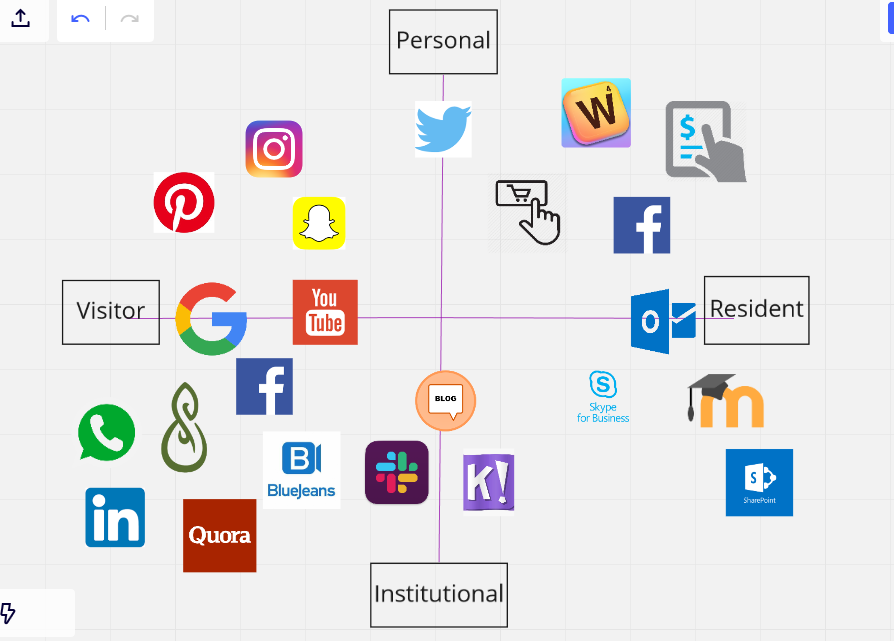
Creating a digital map using the visitor-resident typology (White, & Le Cornu, 2011), allowed me to reflect on my digital presence and where I am dividing my time when contributing in and on social media, online platforms, and applications.  I observed that within my personal digital presence, I am often a visitor when perusing recreational apps that serve no other purpose than to entertain or amuse.  As a visitor within the institutional context, I noted that the majority of items being mapped in this area were utilized for communication or acquiring information and were much more purposeful in nature.  The items that fell under the resident designation were starkly different from the two perspectives, with my personal use being related to day-to-day tasks such as online banking and shopping and interactions with friends and family; as opposed to the institutional presence consisting of prescribed platforms that support my faculty role. I plan to revisit my digital presence throughout my graduate studies and anticipate that these classifications will oscillate in relation to my learning experiences.

White, D., & Le Cornu, A. (2011). Visitors and Residents: A new typology for online engagement. First Monday, 16(9). doi:10.5210/fm.v16i9.3171

Teaching and Learning with Purpose – A Virtual Attendees Reflection

  Virtual Symposium Critical Academic Reflective Blog Post – Unit 1 | Activity 3

          Attending a variety of recorded sessions through the virtual symposium was an excellent preface to the MALAT program and provided me with an opportunity to reflect on my knowledge concerning digital learning environments.  I was amazed at the diversity of speakers in the series and the multifaceted topics.  Each stream of the symposium provided fresh perspectives from diverse lenses and backgrounds which provided intensive exposure to current practices and theories in digital learning.  As a virtual attendee, this provided many opportunities for pause and reflection.  The presentations created by students who were nearing the end of the program were significant, as I was able to extrapolate from their experiences and apply them to my learning journey.  The most insightful recording I viewed challenged the purpose of online learning and reinforced some of my own musings.

            As I reviewed the recordings, I was astounded by the vast terminologies being coined in the field of digital education.  One particular thread that materialized was the need to distinguish the term open which must be interpreted contextually.  Cormier (2017) compares open to a rhizome, difficult to contain with implications only limited to its habitat.  “Open can get really messy, you do get the learning all over you” (Cormier, 2017, 26:55).  Viewing this presentation allowed me to reflect on just how open I had been in my practice, which was not something I had previously considered.  The concept of open within the context of teaching and learning was explored by multiple presenters.  “Most good educators are open educators even if they don’t know that they are open educators because at the heart of education is this willingness to share your knowledge, your skills, your information with learners” (Lalonde, 2018, 10:20).  This allowed me to reflect on the notions of open and how I could best implement some of these ideas within my practice. 

            Especially intriguing were the concepts presented surrounding purposeful content design and delivery. “Students need help to become independent learners, so they’re still gonna need instructors and teachers; and my worry is that this is a move to just put content up on the web and call it online learning” – in reference to the Ontario K-12 online strategy (Bates, 2019, 13:20).  This statement resonated with my recent experience undergoing curriculum development.  What was the motivation?  Was it to be more cost-effective?  Alternatively, was it to provide a better education for our future students?  Was it purposeful?  With limited time release and no additional funds in the coffers, it certainly did not appear purposeful; the hurried instructional design was resulting in a repository of information; with negligible interaction and support from instructors or peers.  Bates (2019) also questions the claims that online learning can be delivered more cost-effectively than learning that occurs on campus, and believes there is a place for both models and that neither should be forced; content should be delivered in the format best suited to learning.  From an ethical standpoint, I agree that designing an online curriculum for cost recovery (or profit) is a poor pedagogy and misguided.  “Curriculum design should be viewed as a process, rather than a product” (Masten, 2015).

                  I was captivated when watching the student research presentation Supporting Volitional Competency in Online Students. (Darbyson, 2018).  According to Darbyson’s research, students are constantly disrupted by life’s circumstances and can find it challenging to maintain motivation.  Persistence and effort are required to achieve success, and there has been little research to show how volitional strategies can be incorporated into the instructional design to support student motivation.  (Darbyson, 2018, 06:45).  I am eager to engage in further readings on volitional strategies that may be of use in my future studies, and that can also be incorporated into my teaching practice.

            The threads presented within the virtual symposium raised substantial and provocative questions that shall be further explored throughout my educational journey within the MALAT program.           


References

Bates, T. (2019). Rethinking the Purpose of Online Learning [Video file]. Retrieved July 14, 2019, from https://ca.bbcollab.com/collab/ui/session/playback

Darbyson, R. (2018). Supporting Volitional Competency in Online Students [Video file]. Retrieved July 16, 2019, from https://ca.bbcollab.com/collab/ui/session/playback

Lalonde, C. (2018). Into the Great Wide Open [Video file]. Retrieved July 15, 2019, from https://ca.bbcollab.com/collab/ui/session/playback

Masten, M. (2015, October 24). 8 Barriers to Curriculum Design [Blog post]. Retrieved from http://inservice.ascd.org/8-barriers-to-curriculum-design/
Welcome!

 Welcome to my blog! An exploration of teaching and learning in the digital age. I am an educator, Teaching and Learning with Technologies Strategist; and a graduate student who is passionate about pedagogical innovation.  

What Makes a Good Research Question?

  • Focused

“A good question focuses on only one issue and doesn’t try to fit in too much It requires analysis and thinking, and doesn’t have an obvious yes or no answer”  (Laurier Library, 2017)

  • Interesting

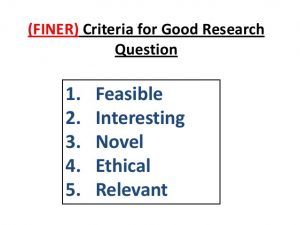
“A good research question should pass the “so what?” test. Getting the answer should contribute usefully to our state of knowledge. The acronym FINER denotes five essential characteristics of a good research question: it should be feasible, interesting, novel, ethical and relevant” (Hulley et. al, 2013)

REFERENCES:

Hulley, S. B., Cummings, S. R., & Browner, W. S. (2013). Designing clinical research. Retrieved from https://ebookcentral-proquest-com.ezproxy.royalroads.ca

Laurier Library [Producer]. (2017, Dec 20). Developing a Research Question [Video file]. Retrieved from https://youtu.be/1oJNO6PYZe4