Reflections on Digital Facilitation
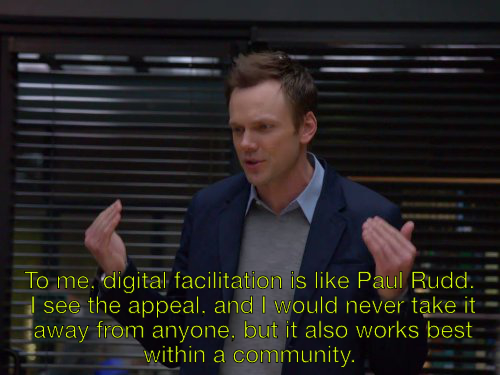
Reflecting back on my initial post about Community of Inquiry (CoI) after having spent some time the past several weeks as both facilitator and as a student, I believe that the initial post still holds true even after these experiences, particularly those observations regarding using CoI within mental health and addictions courses. Based on these experiences and using the 3-2-1 structure noted for this week’s activity, in this blog post I will go over the following:
- 3 thoughts or ideas you have about digital facilitation based on your course experience.
- 2 questions you have about digital facilitation based on your course experience.
- 1 metaphor or simile about digital facilitation based on your course experience. This can be text or an image, but should be something that metaphorically captures and represents your own thoughts on digital facilitation.
To begin, having spent some time on digital facilitation, one thing I believe we experienced was how course creation and the facilitation process can benefit from aspects of CoI, as well. For instance, while facilitation often might be a solitary proposition (i.e. only a single facilitator), throughout the entire process our team bounced ideas off one another, each person choosing roles that worked to their strengths, something that allowed us to work toward the common goal of the course. This team aspect while building and facilitating a course, the sense of community among facilitators and/or the instructional design team, appears to mirror the social presence aspect of CoI given that we worked in a trusting environment to communicate purposefully while being ourselves (CoI Framework, n.d.).
In addition to having an amazing team, I think the amount of discourse and discussion on Mattermost was a real highlight for me. To see virtually the entire group, facilitators and students alike, discussing experiences and debating the various prompts was fantastic. While I believe this was certainly guided by the prompts themselves and the work of the facilitation team, what I found fascinating was to see how there was a real level of curiosity and community fostered within Mattermost. Discussions would often go in different directions than I anticipated and, as a co-learner, I enjoyed seeing how much engagement there was with both the content and the community.
Finally with regard to thoughts or ideas on digital facilitation, it’s important to realize that not everyone will have the experience that you might intend and that this should be used to improve any future experience(s). In our case, one student experienced difficulty navigating the Adobe Spark platform, while another student felt that the course created was not rigorous enough for the intended audience. While we had discussed navigation concerns, our facilitation team worked to create a button structure that was as clear as possible despite having no ability to edit the visual look of buttons. Similarly, due to our knowledge of our cohort feeling rather burnt out, we decided to focus on ensuring a light workload in an attempt to minimize this effect. Despite our best intentions these concerns arose and, as experiences of the intended audience, provide excellent feedback from which to improve future course iterations, perhaps by adding additional and optional content on a different, more Ed Tech-specific platform such as Moodle.
Moving forward to questions, as discussed above it was helpful to have elements of CoI represented among facilitators within both facilitation and course creation processes. This makes me curious: Is it possible to share the benefits of CoI as a facilitator, even in the design process?
Lastly, I am cognizant about the pre-existing community that we have had almost two years to cultivate. As such, we as facilitators benefited from a clear sense of community and safety when seeing our prompts discussed within Mattermost. Given that the courses I am currently working on in mental health and addictions offer far shorter time-frames in which to build communities, how practical is it to expect community within these spaces. Likewise, how might we foster safe and productive community spaces in which to discuss such sensitive topics?
References
CoI Framework (n.d.). Retrieved April 10, 2021, from https://coi.athabascau.ca/coi-model/
You make some excellent observations and points, Jean-Pierre. I appreciate you acknowledging that your cohort has had almost 2 years to gel and bond and develop your own Community if Inquiry (which is an explicit design feature of the cohort-baaed program). Time does help, but it can still reap great benefits to spend some time focusing on those CoI elements even in short term projects and especially where there may need to be sensitive conversations. Thanks for your comments and consistent commitment to the course these past months.