Unit 2 – Personal Resident-Visitor Typology Map
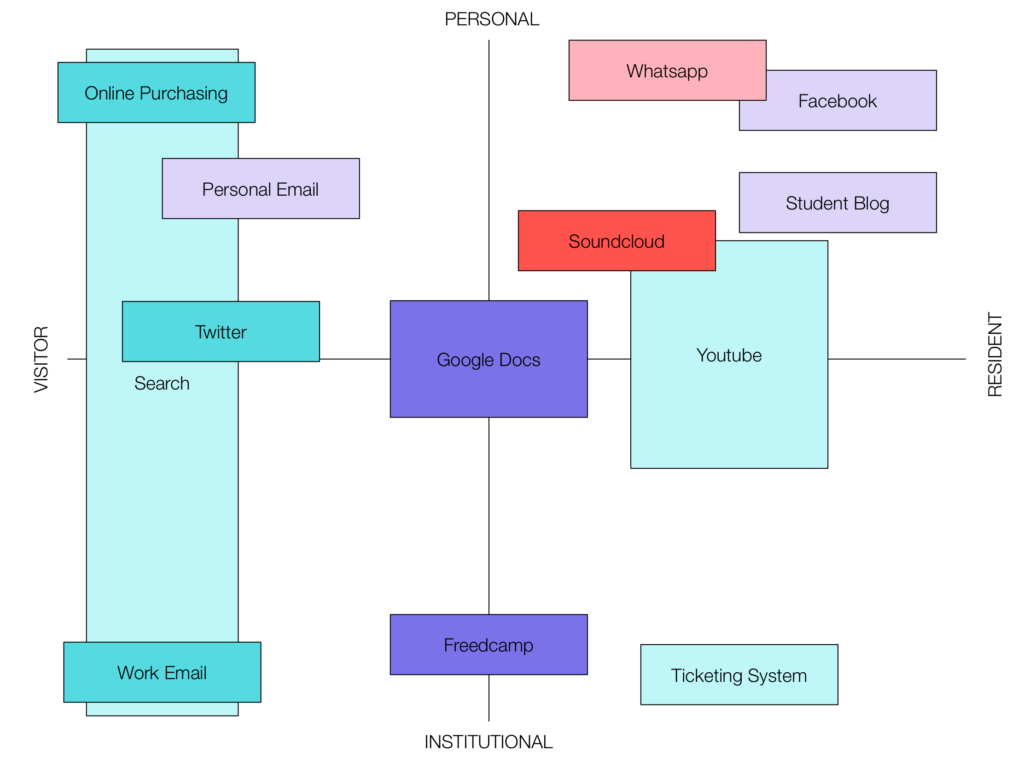
Above is a typology map for my personal use of technology. (White, 2013) In placing my most used services and technologies, my thought process was as follows:
- Creating content services are closer to “RESIDENT”
- Consumed content services are closer to “VISITOR”
- Work-related services are closer to “INSTITUTIONAL”
- Personal and/or private are closer to “PERSONAL”
Once placed, this was colour-coded as follows:
- Shades of blue are where I engage using written content
- Shades of red are where I engage using multimedia (i.e. memes, graphics, video, audio, etc.)
- Shades of purple are intersections between the two of these mediums
What is not easy to represent on here is the amount of content consumed and/or created as this is not a linear graph.
Reflecting on digital vs. analog
In reviewing Dave Cormier’s post on this same process, he notes that this map, “sets the digital apart as something that either ‘is digital’ or ‘is not digital’” and that he, “was looking for something that looked at the whole of someone’s practice rather than just the digital stuff.” (Cormier, 2018, para. 9)
The strange thing that I find is that, while I love the idea of analog, I find that (with the exception of some scribbles and initial diagramming), I work entirely digital. Currently, with COVID-19, I’m working remotely, something I did in my previous job, as well. Everything needs to be shared cross-teams and across countries and continents, so working “analog” hasn’t even been a something that is practical or even realistic for me.
I do think that the idea of looking at individual vs. collaborative is useful, though from a perspective of data breaches, online privacy and digital rights I’m not sure it’s not a moot point. Many of these collaborative tools are terrible with regard to that and, if you want privacy, you have to pay for it. As an introvert, or even just as someone who sees the value in that delineation, it’s an odd dynamic to be okay with. From that regard, keeping things on local storage and local devices seems to be a requirement for private data and only use online tools if/when you want to collaborate.
In summary, even if it’s not for me, I do like the discussion on analog vs. digital. If we’re looking at including analog as privacy, digital as less, and online digital as openly accessible, then this does make a great thought experiment. As someone who works almost or essentially digital-only, it doesn’t really change the above usage. It does, however, make me wonder if there might be some point in adding analog into my process for those stages I’d prefer to keep private.
References
White, D. (2013, September 13). Just the mapping [Video]. YouTube. https://www.youtube.com/watch?v=MSK1Iw1XtwQ
Cormier, D. (2018, March 31). Digital Practices Mapping – Intro activity for digital literacies course. Dave’s Educational Blog: Building a better rhizome. http://davecormier.com/edblog/2018/03/31/digital-practices-mapping-intro-activity-for-digital-literacies-course/
What’s ticketing system ?
Looking at your map, I realized I forgot to add Whatsapp, we use it at work as a group chat, but since rarely anything great or productive happens there, it slipped my mind.
Hi, Denys. Thanks for the reply.
Re: ticketing system, as some of my work is currently in customer service, I work with a large volume of customer emails (tickets). 🙂
Re: Whatsapp, that’s actually pretty interesting. I haven’t found it to be much of a thing here, whereas in South Africa it was pretty big and virtually everyone used it to communicate. As a result, both my wife and I have a good amount of family and friends from there who use it, so it’s pretty much a staple.