
Photo by Hans-Peter Gauster on Unsplash
This post was prepared in collaboration with David Piechnik.
“Collaborative learning is when you can achieve something with some help from your group and then work independently with what you‘ve learnt.”(Gratton, 2019, p. 258)
Context & Problem Statement
David and Vanessa are educators in post-secondary education, where David teaches in the field of design and Vanessa in digital technology. The design thinking challenge allowed us to take an empathic approach to gain critical insights into our learners’ needs. A significant body of research has documented many benefits for learners who participate in group work. For example, learners working in groups can achieve academic learning outcomes and gain deeper comprehensive educational experiences than learners working individually (Smith, 1996; Roseth et al., 2008; Wilson et al., 2018). As such, group work is part of many of our course curriculum and programs. However, in Step 1 (d.School, 2016) of the design process, we have identified a significant gap in offering learners a safe, collaborative space to practicing social competency, enhancing interpersonal and critical thinking skills. These skills are essential for learners to have a positive learning experience in any collaborative environment in education and in the employment sector upon graduation.
Moreover, these skills are no longer perceived as an asset but rather a requirement for success (Riebe et al., 2016). As we dove deeper into Steps 2 & 3 (d.School, 2016), we synthesized that teamwork capacities are repeatedly highlighted, but group projects can often go amiss when they are not designed to foster learning, supervised, or assessed in a way that promotes meaningful group work and deep collaboration. Through the design process, strong commonalities were discovered, which led us to the development of three problem statements in Step 4 (d.School, 2016):
Problem Statement #1: Learners are at different life stages and intercultural contexts; they do not have an equal level of motivation, communication, and collaborative skills.
Problem Statement #2: Learners need a safe space to learn how to work in a group, foster and nurture their communication and collaborative skills.
Problem Statement #3: Free-riding. Equal grades to group members are not reflective of equal learning or contribution.
According to a survey conducted by Wilson et al. ( 2018), 93% of learners believe that teamwork skills are essential for their future careers. However, only 60% believe that they are well equipped. Furthermore, Riebe et al. (2016) built upon the narrative of dissonance in education:
“There is now a more explicit expectation among employer groups and governments that higher education (HE) institutions will provide students quality training in teamwork skills and capabilities to ensure graduates are better prepared to work in teams when commencing employment.” (p.620)
Prototype Solution & The Theory Behind the Model
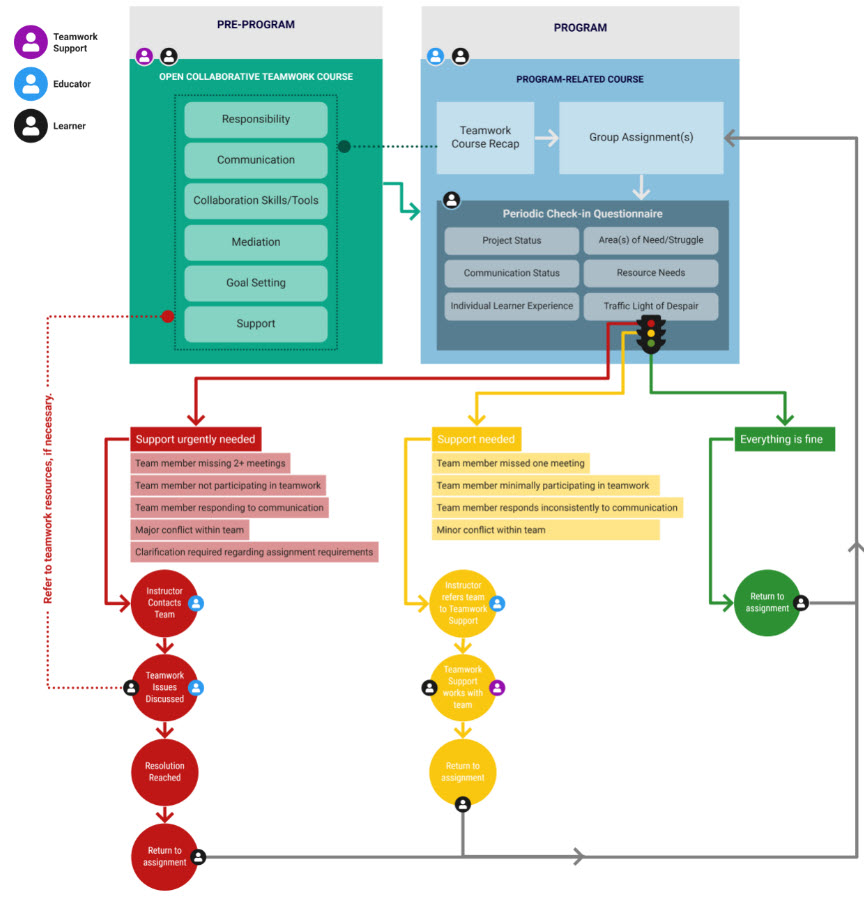
Through Steps 5, 6, and 7 (d.School, 2016), we determined that HE institutions need a systematic approach to include teamwork pedagogy as part of the curriculum. Our prototype model, Open Collaborative Learning (OCL), is grounded in the Principles of Instructions identified by Merrill (2002) and employs support protocols for both learners and educators (see Figure 1). OCL design model is a prerequisite course for all learners at the program level to uphold a universal standard. Following Merrill’s first principle of instructions, OCL provides learners with the opportunity to engage in a real-world problem. Thus, the curriculum teaches group responsibility, communication, and collaboration skills; provides exposure to collaborative tools; and offers learners the chance to practice mediation, goal setting, and support to help them navigate various behaviours associated with working in groups.
Figure 1
Open Collaboration Learning Model
Please click on the image to view the interactive version.
Upon completing OCL, learners begin their program courses where they can activate, apply, integrate, and demonstrate (2nd, 3rd, 4th, and 5th principles) their knowledge in any group assignments. Prior to any major group assignments, the educator only needs to provide a Teamwork Course Recap to refresh the learner’s teamwork knowledge; as a result, this allows the educators to focus mainly on the assignment context, have higher expectations of learners’ performance, and mitigates the burden of teaching teamwork skills. Periodic Check-in Points are integrated throughout the group assignment, where learners have the opportunity to give project and communication status, reflect on learner‘s experience, area(s) of need or struggles, and resources. Moreover, the Traffic Light of Despair features three symbolic buttons of red, yellow, and green for learners to quickly identify the status of the group assignment’s well-being. To help learners quantify their need for support, prompting questions and alerts are built–in as follows:
Red Light – Support is Urgently Needed; when learners press this button, it alerts the educator. Then, the works directly with the team members to reconcile the conflicts or challenges by either referencing back to the OCL and/or engaging in a discussion. These are the criteria for the red light:
-
- Team member(s) have missed two or more meetings;
- Team member(s) not participating in teamwork;
- Team member(s) not responding to communication;
- Major conflict within the team;
- Clarification required regarding assignment requirements
Yellow Light – Support is needed; when learners press this button, it alerts the educator. The educator then contacts the Teamwork Support who then works directly with the team members to resolve their challenges. These are the criteria for the yellow light:
-
- Team member(s) have missed one meeting;
- Team member(s) minimally participating in teamwork;
- Team member(s) responds inconsistently to communication;
- Minor conflict within the team.
Green Light – Everything is fine.
Please click on the image to view the prototype and features.
Test & Feedback
All feedback and discussion relating to our solution are appreciated. The following questions may provide some guidance:
-
- In your experience as an educator, what teamwork support needs are not being met by our model?
- In your experience as a learner, what teamwork needs have you encountered that this model is not sufficiently addressing?
- Imagine yourself as a learner in a team assignment; how would you perceive the use of a questionnaire in this context?
-
- Does this model strike an effective balance between the required learner effort (e.g., filling out a brief questionnaire) and the potential reward (e.g., resolving teamwork issues)?
Concluding Thoughts
Our goal and vision for Open Collaborative Learning is to address all three problem statements. Providing learners with a safe space to learn communication and collaborative skills (problem statement #2) will give learners a common baseline of knowledge (problem statement #1). Additionally, with the added educators and Teamwork members supporting the learner through the process, periodic check-ins opportunities will arm them with skills, knowledge, and proper motivation to be equal collaborators (problem statement #3).
References:
Gratton, R. (2019). Collaboration in students‘ learning: The student experience. Support for Learning, 34(3), 254–276. https://doi.org/10.1111/1467-9604.12261
Merrill, M. D. (2002). First principles of instruction. Educational Technology Research and Development, 50(3), 43–59. https://doi.org/10.1007/BF02505024
Riebe, L., Girardi, A., & Whitsed, C. (2016). A Systematic Literature Review of Teamwork Pedagogy in Higher Education. Small Group Research, 47(6), 619–664. https://doi.org/10.1177/1046496416665221
Roseth, C. J., Johnson, D. W., & Johnson, R. T. (2008). Promoting early adolescents‘ achievement and peer relationships: The effects of cooperative, competitive, and individualistic goal structures. Psychological Bulletin, 134(2), 223–246. https://doi.org/10.1037/0033-2909.134.2.223
Smith, K. A. (1996). Cooperative learning: Making “groupwork“ work. New Directions for Teaching and Learning, 1996(67), 71–82. https://doi.org/10.1002/tl.37219966709
Stanford University Institute of Design. (2016). A Virtual Crash Course in Design Thinking. Stanford d.School. https://dschool.stanford.edu/resources/get-started-with-design
Wilson, L., Ho, S., & Brookes, R. H. (2018). Student perceptions of teamwork within assessment tasks in undergraduate science degrees. Assessment & Evaluation in Higher Education, 43(5), 786–799. https://doi.org/10.1080/02602938.2017.1409334
Feedback for Vanessa and David on
Open collaborative learning: A Design Thinking Challenge
Thank you for your thoroughly researched solution document, Vanessa, and David, and thanks for your guiding questions for feedback. I am pleased to be chosen for this task since group and teamwork, and the difference between them has been an interest within my teaching practice for some time. Your problem statements sum up three very important issues that I have had to deal with when using group/teamwork with students. I strongly agree with your statement, “institutions need a systematic approach to include teamwork pedagogy as part of curriculum.” The prototype illustrates a detailed map for providing support and I like the humour implied in “Traffic Light of Despair.”
As an educator my view of teamwork was forever changed by my experience with Team-based Learning methodology (Sibley & Ostafichuk, 2014) as presented by Vancouver Island University. I will therefore answer your questions based on my experience from that perspective.
• Teamwork support largely comes from within a team once the instructor carefully sets the stage for cooperation between members (Sibley & Ostafichuk, 2014, p. 68). What is missing (but may be implied) within your model is space for empathy and enjoyment within the pre-program and a clear indication that affirms student agency as part of the teamwork process.
• In my experience as a student here at RRU during 10 courses for my MA I have found that teams/groups have been too small. Sibley and Ostafichuk (2014, p. 9) state that teams need to be large to solve complex problems even though friction often results. The process of teamwork should allow for self and peer feedback which aids to greatly improve the performance of teams (p. 148).
• The use of a questionnaire is a great idea and could be useful in terms of self and peer assessment.
• Do you have an example of a questionnaire that you would use with students? I think that a questionnaire (perhaps developed by ideas from all teams in a particular course) could be helpful. Formative and summative peer and self-assessment are other ways to resolve team issues.
I was impressed by your inclusion of the micro.com app and can see its usefulness for students when planning certain tasks!
Reference
Sibley, J., Ostafichuk, P. (2014). Getting started with team-based learning. Stylus.